Soccer drills for kids
Here are 46 soccer drills and practice games for players aged 5 to 12. Each one has a setup diagram with sizes in yards, numbered steps, short coaching points you can say out loud, and the moment of a real game it prepares players for.
Pick by skill or by age below. Every drill keeps every child moving with a ball: no lines, no laps and no long talks. Each one also links to a free Futbol Island lesson that teaches the same idea on a moving pitch.
Soccer is called football in most of the world. This guide is part of Futbol Island’s free football lessons for kids aged 7 to 12.
Play it on the islandSoccer drills by age
Each age page is a short guide: what players can do, how to group them, the best drills and what to avoid.
- U6 soccer drills: fun games for 5 and 6 year oldsNine games for 5 and 6 year olds, a ball each, with what to avoid
- U8 soccer drills for 7 and 8 year oldsTen drills for 7 and 8 year olds: dribbling, 1v1, first passing and 3v3
- U10 soccer drills for 9 and 10 year oldsTen drills for 9 and 10 year olds: rondos, first touch, 2v1 and first goalkeeping
- U12 soccer drills for 11 and 12 year oldsTen drills for 11 and 12 year olds: 4v2 rondos, possession, defending in pairs and finishing
Soccer drills by skill
Jump to a skill on this page.
- Dribbling and ball mastery8 drills. One ball each: lots of touches, turns and changes of speed.
- First touch4 drills. Receiving the ball so the next action is easy.
- Passing and receiving7 drills. Passing to a teammate, then moving to help again.
- Shooting and finishing6 drills. Striking at goal, and what to do after the shot.
- 1v1 attacking3 drills. Taking on one defender with a change of speed or direction.
- 1v1 defending3 drills. Staying goal-side, slowing the attacker and winning the ball.
- Scanning and awareness2 drills. Looking around before the ball arrives.
- Small-sided games5 drills. Real games with few players, so everyone is on the ball.
- Goalkeeping basics4 drills. Footwork, safe hands and starting the attack. From U10, with soft service.
- Warm-ups and fun games4 drills. Games that start practice with a ball and a smile.
Dribbling and ball mastery
One ball each: lots of touches, turns and changes of speed.
- Toe taps and foundationsThey train balance, quick feet and a soft touch, so the ball stays close when a player dribbles. U6 to U12.
- Cone weave dribblingIt trains close control and changing direction, the skill a player needs to carry the ball past a defender. U6 to U12.
- Gates dribblingIt trains dribbling with the head up, because players must look for a gate that is open. U6 to U10.
- Red Light, Green LightIt trains keeping the ball close enough to stop it with the sole of the foot. U6 to U8.
- Sharks and MinnowsIt trains dribbling under pressure: keeping the ball close, changing direction and using open space. U6 to U10.
- Pirates and TreasureIt trains dribbling at speed, turning with the ball and stopping it under control. U6 to U8.
- Turn and goIt trains the three basic turns, the drag-back, the inside hook and the outside hook, and the burst of speed that makes a turn work. U8 to U12.
- KnockoutIt trains shielding, dribbling with the head up and winning the ball. U8 to U12.
First touch
Receiving the ball so the next action is easy.
- Receive across the bodyIt trains an open body shape, so the player can see the whole field and play forward with the second touch. U8 to U12.
- First touch gatesIt trains a first touch that moves the ball away from pressure into space, not one that stops it dead. U8 to U12.
- Thigh and chest controlIt trains bringing a bouncing or dropping ball under control without using the head. U8 to U12.
- Receive and turnIt trains checking over the shoulder and choosing the right first touch for the pressure. U8 to U12.
Passing and receiving
Passing to a teammate, then moving to help again.
- Wall passingIt trains a firm, accurate pass and a clean first touch with both feet, because the wall always gives the ball back. U6 to U12.
- Partner passing through gatesIt trains accurate passing with the inside of the foot and moving to a new place after every pass. U6 to U10.
- Give-and-goIt trains the wall pass, also called the one-two: the timing of the first pass, the sprint and the one-touch return. U8 to U12.
- Triangle passingIt trains passing to the correct foot, an open body shape and moving right after the pass. U8 to U12.
- Rondo 3v1It trains quick passing, support on both sides of the ball and a first touch away from pressure. U8 to U12.
- Rondo 4v2It trains the attackers to find the pass between the two defenders, and the defenders to press and cover as a pair. U10 to U12.
- Three-team keep-awayIt trains passing under pressure, spreading out to use the whole area, and reacting quickly when the ball is lost. U10 to U12.
Shooting and finishing
Striking at goal, and what to do after the shot.
- Dribble and shootIt trains striking a moving ball with the laces and looking at the goal before the shot. U6 to U10.
- World Cup shooting gameIt trains finishing in a crowd, quick shots and reacting to rebounds. U8 to U12.
- 2v1 to goalIt trains the main decision of attacking with an extra player: dribble at the defender, then pass if they come to you or keep going if they do not. U8 to U12.
- Crossing and finishingIt trains the timing of runs into the goal area and a first-time finish with the foot. U10 to U12.
- Lay-off and shootIt trains striking a ball that is rolling across or toward the shooter, and the set-up pass that makes a shot easy. U8 to U12.
- Follow the shotIt trains the habit of following in after every shot, so the attacker reaches the loose ball first. U8 to U12.
1v1 attacking
Taking on one defender with a change of speed or direction.
- 1v1 to end zonesIt trains taking a player on with a change of speed or direction, and for the defender, staying between the attacker and the line. U6 to U12.
- 1v1 to two small goalsIt trains changing direction to unbalance a defender, because the defender cannot guard both goals at once. U8 to U12.
- Numbers gameIt trains 1v1 and 2v2 attacking and defending, with a race to the ball to start. U6 to U12.
1v1 defending
Staying goal-side, slowing the attacker and winning the ball.
- 1v1 defendingIt trains the approach to the ball: fast at first, then slow, low and side on, steering the attacker to one side. U8 to U12.
- Recover goal-sideIt trains the recovery run: running toward your own goal first and challenging only once you are goal-side. U8 to U12.
- Pressure and cover 2v2It trains defending together, and swapping the two jobs each time the ball is passed. U10 to U12.
Scanning and awareness
Looking around before the ball arrives.
Small-sided games
Real games with few players, so everyone is on the ball.
- 3v3 small-sided gameIt trains everything at once, dribbling, passing, shooting and defending, and gives each child far more time on the ball than a big game. U6 to U10.
- Four-goal gameIt trains switching play: when one goal is crowded, the team moves the ball to the open one. U8 to U12.
- End zone gameIt trains forward passing and the timing of runs into space behind the defense. U8 to U12.
- 3v2 to goalIt trains finding the free player: the attackers must draw a defender to the ball and pass to the teammate left open. U10 to U12.
- Build-out gameIt trains playing out from the back: defenders getting wide, a midfielder showing for the ball, and the goalkeeper joining in with their feet. U10 to U12.
Goalkeeping basics
Footwork, safe hands and starting the attack. From U10, with soft service.
- Goalkeeper footwork and set positionIt trains quick side steps and being still and ready at the moment of the shot. U10 to U12.
- Goalkeeper catching: W and basketIt trains safe hands, and getting the body behind the ball as a second barrier. U10 to U12.
- Goalkeeper distributionIt trains accurate distribution, and choosing the teammate who is free. U10 to U12.
- Goalkeeper anglesIt trains positioning: being in the right spot, a step or two off the goal line, before the shot is taken. U10 to U12.
Warm-ups and fun games
Games that start practice with a ball and a smile.
- Dribble tagIt warms players up while training dribbling with the head up and quick changes of direction. U6 to U10.
- Simon Says with a ballIt trains stopping the ball, listening and balance, and it lets a new coach learn every name. U6 to U8.
- Clean Your RoomIt trains striking a ball with the laces or the inside of the foot, and running to the next ball. U6 to U8.
- Throw-in gameIt trains a legal throw with both hands from behind the head, and a first touch that controls a ball arriving from the air. U8 to U12.
Every drill has a setup diagram like this
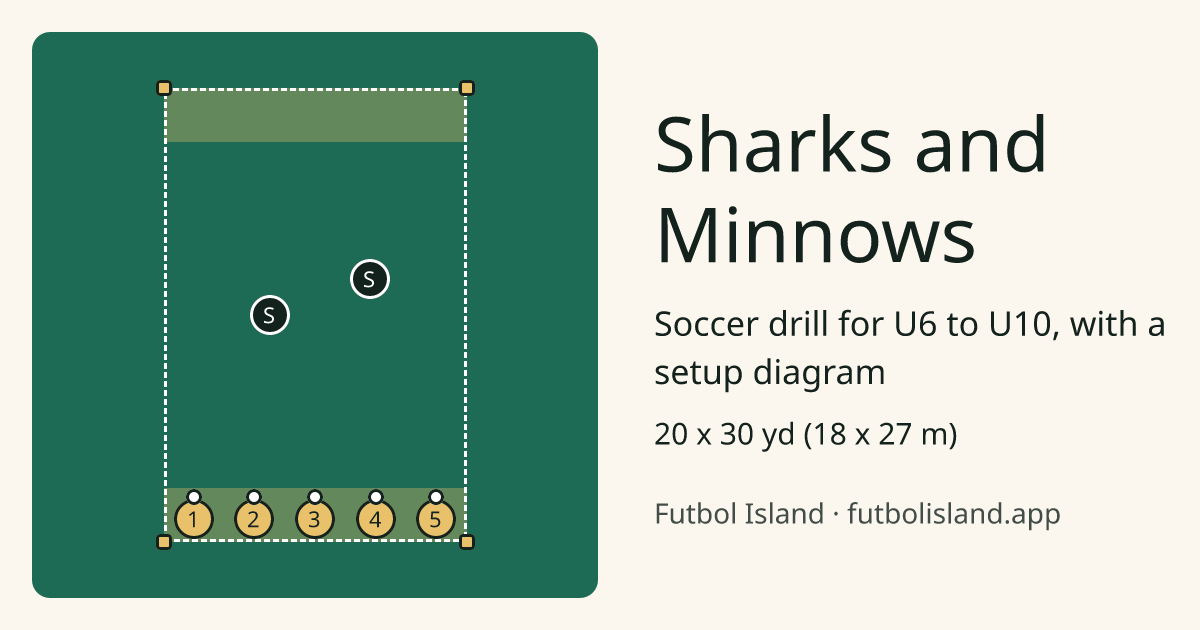
The area is drawn in proportion with its size in yards and metres. See how to play Sharks and Minnows.
How to use these drills
- Each child has a ball whenever the drill allows it.
- Play the game first, then stop for one coaching point, then play again.
- If a child is “out”, give them a quick job that brings them back in.
- Finish every practice with a small game, such as 3v3 or 4v4.
- Give water breaks often, and more often in the heat.
Change the size of the area to fit your group: bigger makes it easier for the player with the ball, smaller makes it harder. Everyone who goes out comes straight back in, and nobody runs laps.
Guides by skill and practice plans
- Soccer drills to do at homeSolo and parent-and-child drills for a yard, a driveway or a wall
- Soccer passing drills for kidsPassing drills in teaching order: pairs, triangles, give-and-go and rondos
- Soccer dribbling drills for kidsBall mastery, ball-each games, turns and 1v1 for every age
- Soccer shooting drills for kidsShooting and finishing drills without long lines, for U6 to U12
- First touch soccer drills for kidsReceiving drills: back foot, touch into space, turning and high balls
- Soccer goalkeeper drills for kidsSet position, catching, angles and distribution for U10 and U12, with soft service
- Soccer practice plans for kids12 ready-to-use soccer practice plans for U6, U8, U10 and U12, each with a clock table, equipment list and linked drills
Lessons that teach the ideas behind the drills
- Carry or Pass? (7v7 lesson)Watch which route the defender leaves open.
- Look, Then Turn or Return (7v7 lesson)Look for pressure before receiving. Turn into room or give the ball back.
- Step Out of the Blocked Lane (7v7 lesson)Move so the defender is no longer between you and the ball.
- Stay Between the Ball and Goal (7v7 lesson)Move with the attacker while keeping yourself between the ball and your goal.
Questions about soccer drills
What are the best soccer drills for beginners?
Games where every child has a ball: Sharks and Minnows, Red Light Green Light, gates dribbling and Pirates and Treasure. They teach dribbling and stopping the ball without anyone standing in a line.
How many drills should I use in one practice?
Two or three, plus a game at the end. Young players need time to get good at a game, so it is better to repeat a favorite than to explain a new one every ten minutes.
What soccer drills can kids do at home?
Toe taps, a cone weave, wall passing and turn-and-go all work alone in a small space. Our at-home page lists the drills that need one player or one parent.
Should young kids practice heading?
No. In US youth soccer, players aged 10 and under do not head the ball in games or practice, and practice heading is limited at 11 and 12. None of the drills here use heading.
How long should a soccer practice be?
US Youth Soccer’s coaching guidance suggests about 45 minutes at U6, 45 to 60 at U8, 60 to 75 at U10 and 75 at U12. Our practice plans are built to those lengths.
Keep reading
Futbol Island is a free football (soccer) learning game for kids aged 7 to 12. Every idea on this page is taught on a pitch with moving players, then checked with a quick quiz.