Receive across the body soccer drill
Receiving across the body is a first touch drill in which a player lets the pass roll across them and controls it with the foot farther from the passer. It trains an open body shape, so the player can see the whole field and play forward with the second touch.
Soccer is called football in most of the world. This guide is part of Futbol Island’s free football lessons for kids aged 7 to 12.
Receive across the body: setup diagram
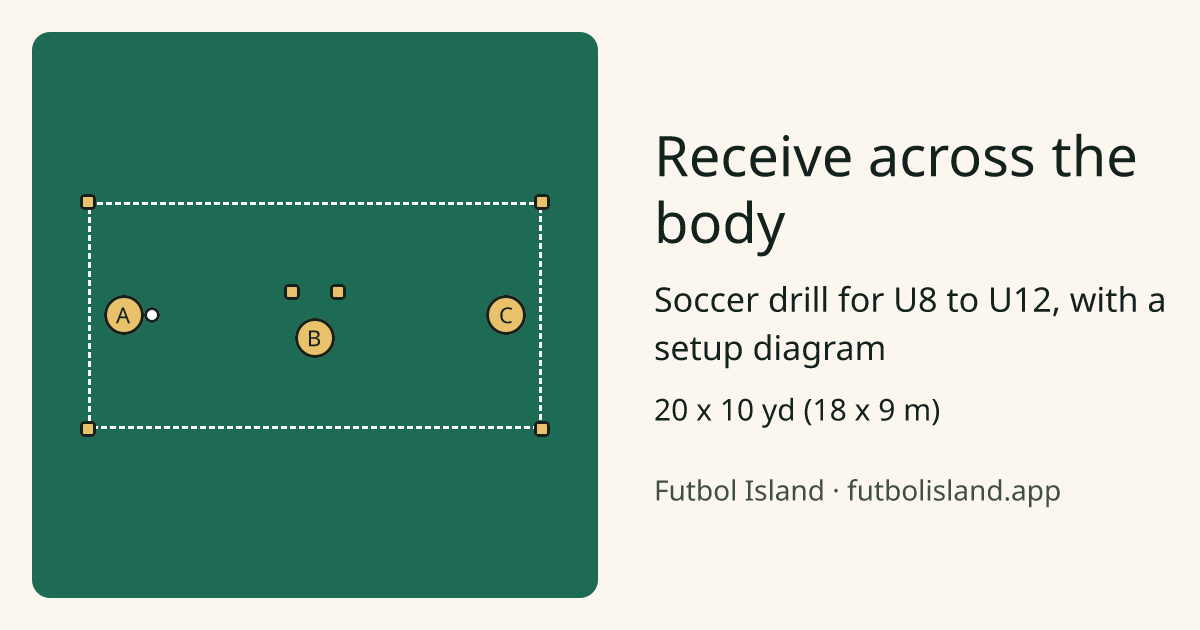
At a glance
| Detail | For this drill |
|---|---|
| Ages | U8 to U12 (ages 7 to 12) |
| Players | Groups of 3 |
| Space | 20 x 10 yd (18 x 9 m) |
| Equipment | One ball per group; 3 cones |
| Time | 10 minutes |
| Skill | First touch |
Change the size of the area to fit your group: bigger makes it easier for the player with the ball, smaller makes it harder. Everyone who goes out comes straight back in, and nobody runs laps.
How to run it
- Three players in a line, 8 to 10 yards apart. The middle player stands side on, so they can see both partners.
- A passes to B’s back foot, the foot farther from A.
- B lets the ball roll across their body, takes one touch toward C with that back foot, and passes to C with the next touch.
- C passes back to B, who now receives on the other foot and plays to A.
- After ten passes, change the middle player. Later, B starts behind a cone gate and steps out of it to receive, as if moving away from a marker.
Coaching points to say out loud
- “Open up: chest to the far side.”
- “Back foot.”
- “Look over your shoulder first.”
- “Touch forward, not under you.”
Make it easier or harder
Easier
Let the middle player stop the ball dead with the back foot first, then turn and pass.
Harder
Add a passive defender behind the middle player. If the defender stands tight, the middle player passes back first time instead of turning.
Common mistakes
- Facing the passer square on, which means the first touch goes back where the ball came from.
- Controlling with the near foot, so the body blocks the turn.
- A first touch that stops under the body. It should travel a yard toward the next pass.
Why it matters in a game
This is a midfielder receiving from a defender and playing forward in two touches. Our 7v7 and 9v9 receiving lessons add the decision: look for pressure before the ball arrives, turn into room, or give it back.
The lesson that teaches it: Look, Then Turn or Return.
Do it at home
With a wall or one parent: pass in from the side, receive on the back foot, and play to a second target such as a cone or a second wall.
Questions about Receive across the body
What does “receive on the back foot” mean?
The back foot is the one farther from where the pass comes from. Receiving with it lets the ball travel across your body so you end up facing forward.
What is an open body shape?
Standing half turned, so you can see the passer and the field ahead at the same time, instead of facing the passer with your back to the game.
When should a player not turn?
When a defender is tight behind them. Then the safe choice is to pass back and move again. Checking over the shoulder tells the player which it is.
Lessons that teach this idea
- Look, Then Turn or Return (7v7 lesson)Look for pressure before receiving. Turn into room or give the ball back.
- Receive: Turn or Connect (9v9 lesson)Check the space before receiving; a turn and a return solve different pressure.
- Can You Turn? (11v11 lesson)Look before the ball arrives. Turn when you have room; use your support when you don’t.
Related drills and guides
- Receive and turn (drill)It trains checking over the shoulder and choosing the right first touch for the pressure.
- First touch gates (drill)It trains a first touch that moves the ball away from pressure into space, not one that stops it dead.
- Triangle passing (drill)It trains passing to the correct foot, an open body shape and moving right after the pass.
- Shoulder check colors (drill)It trains scanning: taking a look away from the ball so the player knows what is around them before they receive it.
- First touch (soccer term)The touch you take as the ball arrives
- Central midfielder in soccerThe link player who receives on the turn
- Switching play (soccer term)Moving the ball to the empty side
- U8 soccer drills for 7 and 8 year oldsTen drills for 7 and 8 year olds: dribbling, 1v1, first passing and 3v3
- U10 soccer drills for 9 and 10 year oldsTen drills for 9 and 10 year olds: rondos, first touch, 2v1 and first goalkeeping
- U12 soccer drills for 11 and 12 year oldsTen drills for 11 and 12 year olds: 4v2 rondos, possession, defending in pairs and finishing
- Soccer drills to do at homeSolo and parent-and-child drills for a yard, a driveway or a wall
- U10 soccer practice plan: passing and first touchA 60-minute plan that uses this drill
- All first touch drillsReceiving the ball so the next action is easy.
Futbol Island is a free football (soccer) learning game for kids aged 7 to 12. Every idea on this page is taught on a pitch with moving players, then checked with a quick quiz.