What is switching play in soccer?
Switching play in soccer means moving the ball from the crowded side of the field to the side with more space. Defenders shift toward the ball, so the far side opens up, and a quick switch gets there before they can shift back.
Other names: switching play, switch.
Soccer is called football in most of the world. This guide is part of Futbol Island’s free football lessons for kids aged 7 to 12.
Switch of Play: diagram
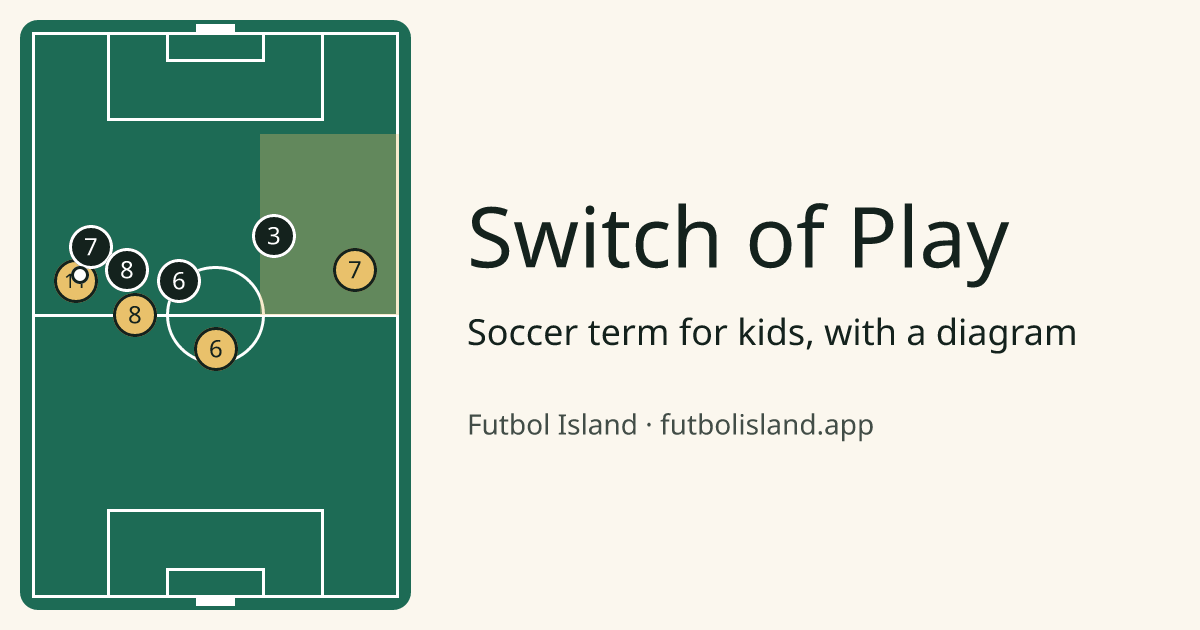
How to switch play
- Pull the other team to one side by keeping the ball there for a pass or two.
- Play back to a teammate who can see the whole field.
- Move the ball across quickly, through one or two players or with one long pass.
- The player on the far side stays wide and ready, and goes forward on the first touch.
Common mistakes
- Switching slowly. If the passes are soft, the defenders arrive at the same time as the ball.
- Switching when the far side has no space or no teammate. Switch to use space, not just to send the ball across.
- A square pass across your own goal with an opponent close by.
In 7v7, 9v9, 11v11 and futsal
In 7v7 the lesson is simple: when one side is crowded, use the other side. In 9v9 and 11v11 the ball often goes through a center back or a midfielder. In futsal a team draws the defense to one side before using the far-side player.
Questions about the switch of play
Why do teams pass backward to switch play?
The player behind the ball has time and can see both sides. Going back first is often the fastest way to the other side.
Is a switch always a long pass?
No. Two or three quick short passes through the middle do the same job and are easier for young players.
Who switches play?
Center backs, the defensive midfielder and the goalkeeper do it most, because they are behind the ball.
Lessons that teach it
- Find the Other Side (9v9 lesson)Move the ball through support when the nearby routes close.
- Find the Open Side (11v11 lesson)Switch to use space, not just to send the ball across the pitch.
- Move the Block, Then Switch (Futsal lesson)Draw a compact defensive unit to one side before using the far-side route.
Related soccer terms
- OverlapA run around the outside of the teammate who has the ball, to make two attackers against one defender on the side of the field.
- Third-Man RunA run by a third player who receives after two teammates pass between themselves. It reaches a player the first passer could not find directly.
- First TouchThe touch you take as the ball arrives. A good one puts the ball where you want to play next.
- CrossA pass from a wide area into the space in front of the goal.
- All soccer terms, A to Z92 soccer words in plain English, from advantage to yellow card, 18 with a diagram
- Soccer rules for kids16 rules explained for kids, each with a diagram: offside, handball, throw-ins and more
Futbol Island is a free football (soccer) learning game for kids aged 7 to 12. Every idea on this page is taught on a pitch with moving players, then checked with a quick quiz.