Central midfielder in soccer
A central midfielder, or center mid, is the soccer player in the middle of the field who links the defense to the attack.
It suits players who want to be near the ball all game, can run a lot and enjoy both passing and tackling.
Soccer is called football in most of the world. This guide is part of Futbol Island’s free football lessons for kids aged 7 to 12.
Where the central midfielder stands
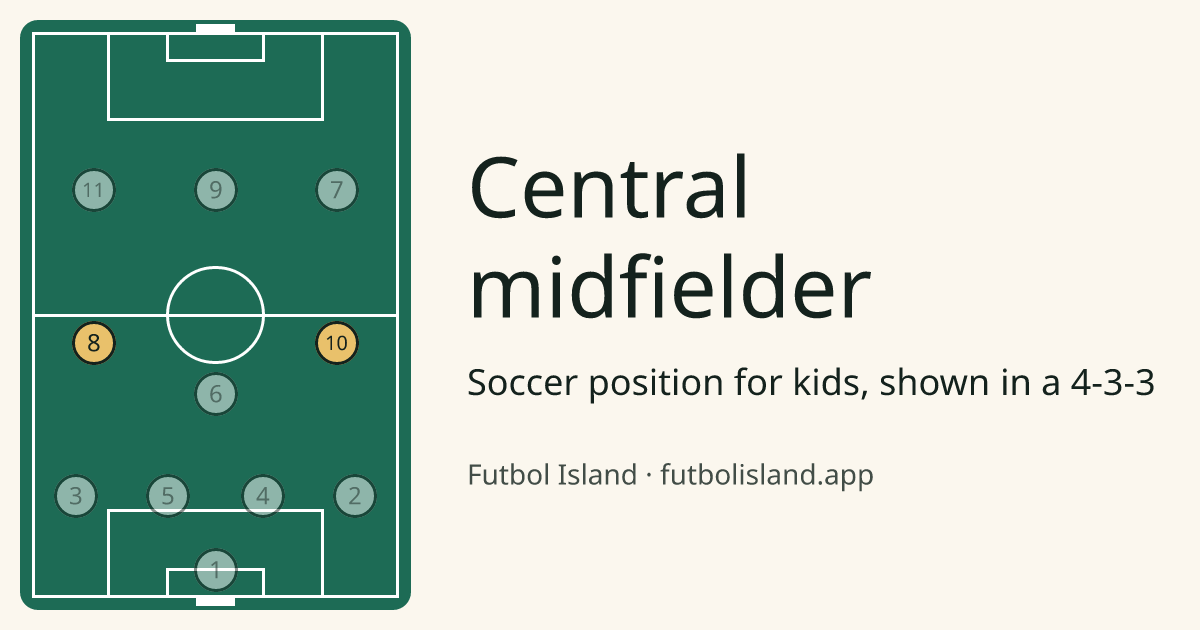
In the middle of the field, between the defenders and the forwards. Because this player runs from one penalty area to the other, coaches also say box-to-box midfielder.
With the ball
- Offers a passing angle to whoever has the ball.
- Receives, turns if there is room, and passes forward. If there is no room, gives it back and moves again.
- Arrives late in the penalty area to finish a move.
Without the ball
- Presses the player with the ball in the middle of the field.
- Tracks a midfielder who runs forward.
- Helps protect the middle, close to the other midfielders.
Three habits to practise
Move after you pass
Pass, then find a new space at once. Standing still makes you easy to mark.
Receive on the half turn
Stand side-on, so you can see the passer and the field ahead in one look.
Give another angle
If the straight pass to you is blocked, step to the side until the passer can see you.
Shirt number: 8
The central midfielder is often called the 8. The numbers are a coaching custom from the days when starters wore 1 to 11. Players today can wear any number.
In 7v7, 9v9 and futsal
In 7v7 the middle midfielder of a 2-3-1 is the busiest player on the field, linking the backs to the forward. In 9v9 the two midfielders of a 3-2-3 connect the back three to the front three.
Formations with a central midfielder
- 2-3-1 (7v7) formationMiddle midfielder (8)
- 3-2-1 (7v7) formationTwo midfielders (6 and 8)
- 2-2-2 (7v7) formationTwo midfielders (6 and 8)
- 3-1-2 (7v7) formationMidfielder (8)
- 3-2-3 (9v9) formationTwo midfielders (6 and 8)
- 3-3-2 (9v9) formationCentral midfielder (8)
- 2-3-2-1 (9v9) formationTeams that keep the ball well.
- 4-3-1 (9v9) formationCentral midfielder (8)
- 4-3-3 (11v11) formationTwo midfielders ahead (8 and 10)
- 4-4-2 (11v11) formationTwo central midfielders (6 and 8)
- 3-5-2 (11v11) formationThree central midfielders (7, 8 and 10)
- All soccer formations16 formations for 7v7, 9v9, 11v11 and futsal, each with a diagram
Questions about the central midfielder
What does a center mid do in soccer?
A center mid connects the team. With the ball, the center mid links the defenders to the forwards. Without the ball, the center mid presses and protects the middle of the field.
What is a box-to-box midfielder?
A central midfielder who works from one penalty box to the other: defending near their own goal, then running to join the attack.
What is the difference between a 6, an 8 and a 10?
They are three midfield jobs. The 6 stays deeper to protect the defense. The 10 plays higher, close to the striker. The 8 works between them and helps both.
Lessons for this position
- Meet Your Team (7v7 lesson)Recognize the goalkeeper and three lines of teammates, then adjust your midfield role as the ball changes sides.
- 3-2-3: Connect the Two Blocks (9v9 lesson)Two midfielders share the links between a back-three block and a front-three block.
- 4-3-3 vs 5-3-2: Find the Checking Midfielder (11v11 lesson)When their wing-backs block your fullbacks, an eight checks short to get free. If a defender follows the eight, pass to the fullback instead.
- Look, Then Turn or Return (7v7 lesson)Look for pressure before receiving. Turn into room or give the ball back.
- Use the Next Teammate (11v11 lesson)A third player helps when the direct pass is covered. You don’t need an extra pass when it’s already open.
Player cards
The card binder keeps all midfielders in one group. Here are more of them.
Other positions
Futbol Island is a free football (soccer) learning game for kids aged 7 to 12. Every idea on this page is taught on a pitch with moving players, then checked with a quick quiz.