Attacking midfielder in soccer
An attacking midfielder is a soccer player who plays between the midfield and the striker, and the job is to create chances to score.
It suits creative players with a good first touch who can find space in a crowd and enjoy the final pass.
Soccer is called football in most of the world. This guide is part of Futbol Island’s free football lessons for kids aged 7 to 12.
Where the attacking midfielder stands
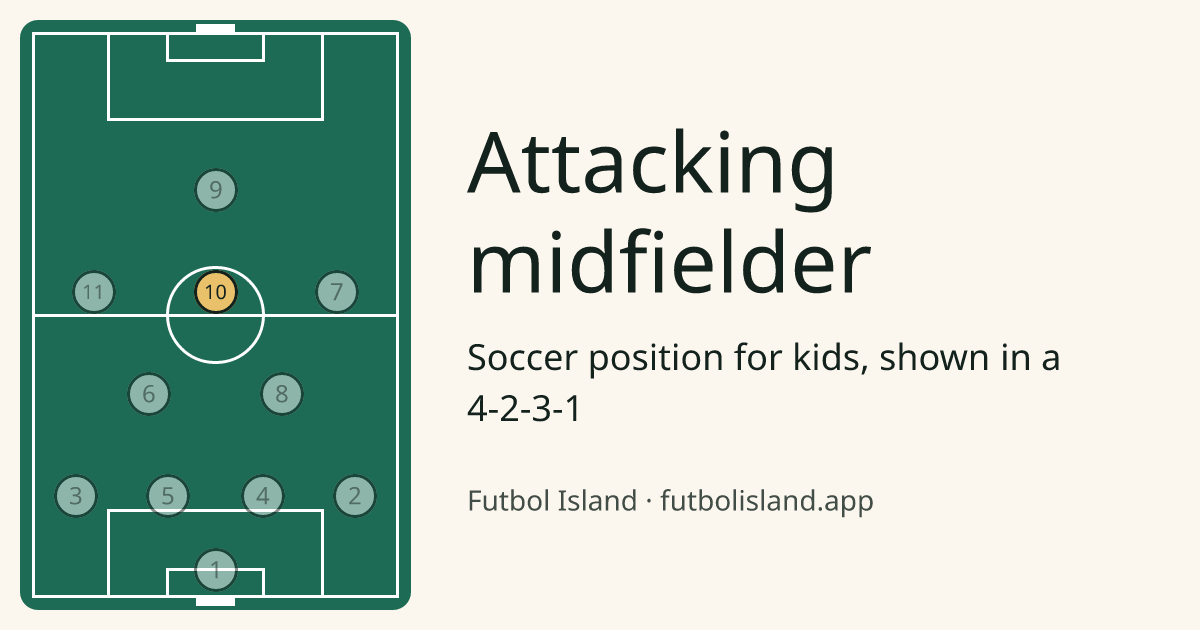
In the middle, just behind the striker, in the gap between the other team’s midfielders and defenders. People also say playmaker, or the number 10.
With the ball
- Receives between the lines and turns to face the goal.
- Plays the pass that sends a striker or a winger through.
- Shoots from the edge of the penalty area or runs past the striker.
Without the ball
- Blocks the pass into the other team’s holding midfielder.
- Runs back to help the holding midfielder right after the ball is lost.
- Presses with the striker to make a front two.
Three habits to practise
Find the pocket
Stand where no defender is close: behind their midfielders and in front of their defenders.
Know before you get it
Look around before the pass arrives. Then decide: turn, or play it back with one touch.
Pass and follow
After the final pass, keep running toward goal for a rebound or a pass back.
Shirt number: 10
The attacking midfielder is often called the 10. The numbers are a coaching custom from the days when starters wore 1 to 11. Players today can wear any number.
In 7v7, 9v9 and futsal
In 7v7 the middle midfielder does this job when the team attacks. In 9v9 the 3-1-3-1 has a central attacking midfielder behind the striker, and the 2-3-2-1 has two.
Formations with a attacking midfielder
Questions about the attacking midfielder
What does a number 10 do in soccer?
The 10 is the attacking midfielder: the link between the midfield and the striker. The 10 receives in tight spaces and tries to make the pass that leads to a shot.
What is a playmaker?
A player the team looks for when it wants to create a chance. The word is used most for the attacking midfielder, but a deeper midfielder can be a playmaker too.
Does an attacking midfielder have to defend?
Yes. When the ball is lost, the attacking midfielder is often the nearest player to help the holding midfielder. In our 9v9 lesson, that recovery run is the key idea.
Lessons for this position
- Can You Turn? (11v11 lesson)Look before the ball arrives. Turn when you have room; use your support when you don’t.
- Receive: Turn or Connect (9v9 lesson)Check the space before receiving; a turn and a return solve different pressure.
- 3-1-3-1: Help the Single Holder (9v9 lesson)Three-one-three-one has one holder behind three attacking midfielders and a striker. When the ball is lost, the central attacking midfielder can help that single holder.
- Use the Next Teammate (11v11 lesson)A third player helps when the direct pass is covered. You don’t need an extra pass when it’s already open.
Player cards
The card binder keeps all midfielders in one group. Here are more of them.
Other positions
Futbol Island is a free football (soccer) learning game for kids aged 7 to 12. Every idea on this page is taught on a pitch with moving players, then checked with a quick quiz.