Soccer positions explained for kids
Soccer positions are the jobs players take on the field: one goalkeeper, then defenders, midfielders and forwards. This guide shows all eleven positions on one field, explains the numbers 1 to 11, and shows how the positions change in 7v7 and 9v9.
Soccer is called football in most of the world. This guide is part of Futbol Island’s free football lessons for kids aged 7 to 12.
Play it on the islandAll eleven positions on one field
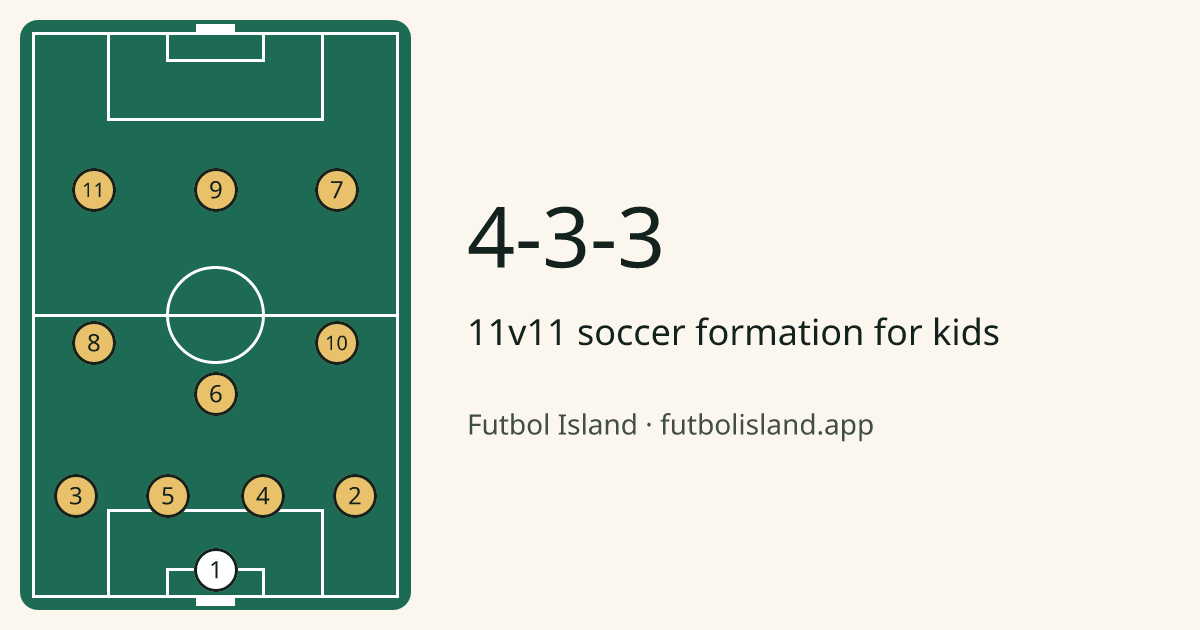
- Goalkeeper. One player guards the goal and may use their hands inside the penalty area.
- Defenders. Center backs protect the middle. Fullbacks defend the sides and can support attacks. Wingbacks do the fullback job from higher up the field.
- Midfielders. They connect the lines. A defensive midfielder starts deeper, a central midfielder works in between, and an attacking midfielder plays close to the striker.
- Forwards. Wingers give width. The striker, or center forward, gives height and finishes chances. The forwards also help defend.
Each position explained
- Goalkeeper (GK)The goalkeeper is the one soccer player who may use their hands, and the job is to keep the ball out of the goal and to start the team’s attacks.
- Center back (CB)A center back is a soccer defender who plays in the middle of the back line, and the job is to protect the space in front of the goal.
- Fullback (LB / RB)A fullback is a soccer defender who plays on the left or right side of the back line: the left back and the right back.
- Wingback (LWB / RWB)A wingback is a soccer player who covers one whole side of the field, attacking like a winger and defending like a fullback.
- Defensive midfielder (DM)A defensive midfielder is a soccer player who stays in front of the defenders, to protect them and to link them with the rest of the team.
- Central midfielder (CM)A central midfielder, or center mid, is the soccer player in the middle of the field who links the defense to the attack.
- Attacking midfielder (AM)An attacking midfielder is a soccer player who plays between the midfield and the striker, and the job is to create chances to score.
- Winger (LW / RW)A winger is a soccer attacker who plays wide on the left or right, to stretch the other team and to create chances from the side.
- Striker (ST)A striker is the soccer forward who plays closest to the other team’s goal, and the main job is to score and to help teammates score.
Soccer position numbers 1 to 11
- Long ago, the eleven starters wore 1 to 11, and each number went with a place on the field. Coaches still use those numbers as short names: “play as a 6”, “a classic number 9”.
- It is a custom, not a law, and it is not the same in every country. Today players can wear any number their team allows.
| Number | Position | Job |
|---|---|---|
| 1 | Goalkeeper | Guards the goal. The only player who may use hands. |
| 2 | Right back | Defends the right side and joins attacks. |
| 3 | Left back | Defends the left side and joins attacks. |
| 4 | Center back | Defends the middle, in front of the goal. |
| 5 | Center back | The other half of the center back pair. |
| 6 | Defensive midfielder | Protects the defenders and starts attacks. |
| 7 | Right winger | Attacks wide on the right. |
| 8 | Central midfielder | Links defense and attack in the middle. |
| 9 | Striker | Plays closest to goal and finishes chances. |
| 10 | Attacking midfielder | Creates chances behind the striker. |
| 11 | Left winger | Attacks wide on the left. |
How positions change in 7v7, 9v9 and 11v11
7v7
Seven players: a goalkeeper and six outfield players. In a 2-3-1 that means two defenders, three midfielders and one forward. Each player covers more than one job: the two defenders are center backs and fullbacks at once.
9v9
Nine players: a goalkeeper and eight outfield players. In a 3-2-3 there is a center back between two outside backs, two midfielders and three forwards. The positions start to look like the full game.
11v11
Eleven players: a goalkeeper and ten outfield players. Now there are two center backs, two fullbacks, three midfielders with different jobs, two wingers and a center forward.
See the 4-3-3 (11v11) formation or compare 11v11 formations.
Futsal has its own names. The four outfield players are the fixo (at the back), two alas (the wings) and the pivot (at the front). See the futsal 3-1.
Lessons that introduce the positions
- Meet Your Team (7v7 lesson)Recognize the goalkeeper and three lines of teammates, then adjust your midfield role as the ball changes sides.
- 3-2-3: Know Your Unit (9v9 lesson)Understand nine players, three outfield units, and cover behind an advancing defender.
- Our Eleven: Shape & Shared Jobs (11v11 lesson)Understand the goalkeeper and each line, then adapt midfield support as a fullback advances.
- 3-1: Meet the Court Roles (Futsal lesson)Meet five players and the 3-1 roles; choose forward depth or support behind as pressure changes.
Questions about positions
What are the positions in soccer?
Goalkeeper, defenders (center backs, fullbacks, wingbacks), midfielders (defensive, central, attacking) and forwards (wingers and strikers). A full team has eleven players on the field.
What do the position numbers mean in soccer?
They are short names from the days when starters wore 1 to 11. In a common version: 1 goalkeeper, 2 and 3 fullbacks, 4 and 5 center backs, 6 defensive midfielder, 8 central midfielder, 10 attacking midfielder, 7 and 11 wingers, 9 striker.
What position should my child play?
At young ages, all of them. Children learn the game by trying every job. A favorite position usually appears later, as they grow.
Do players have to stay in their position?
No. A position is a starting job. Players move to help the teammate with the ball and to protect their goal, then return to their shape.
Keep reading
Futbol Island is a free football (soccer) learning game for kids aged 7 to 12. Every idea on this page is taught on a pitch with moving players, then checked with a quick quiz.