11v11 soccer formations
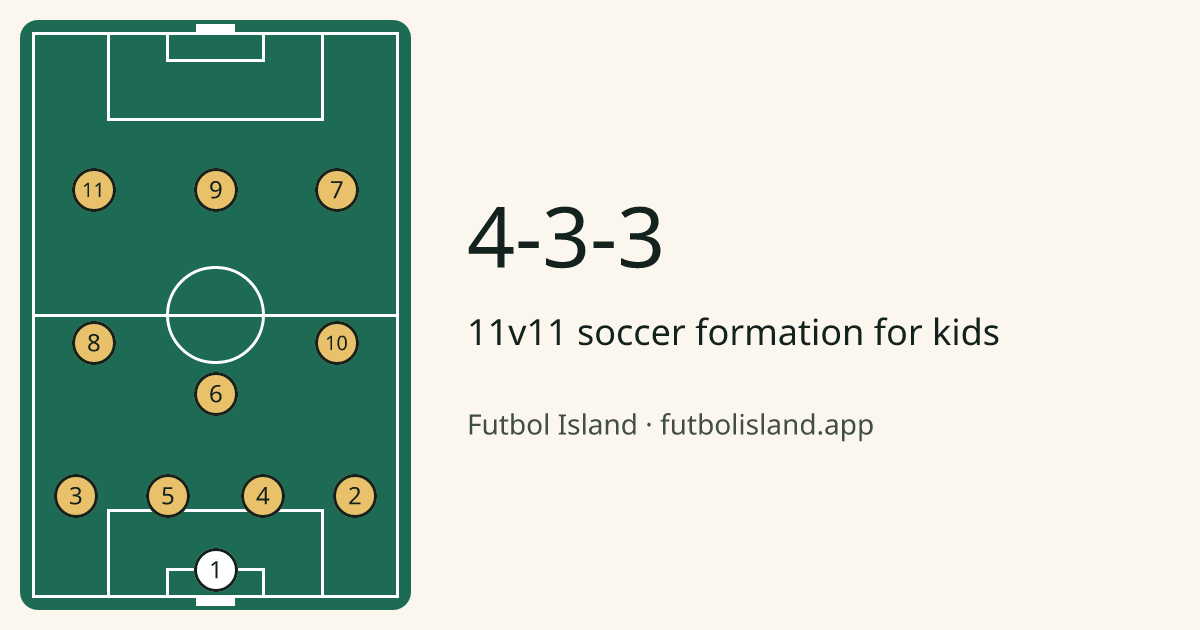
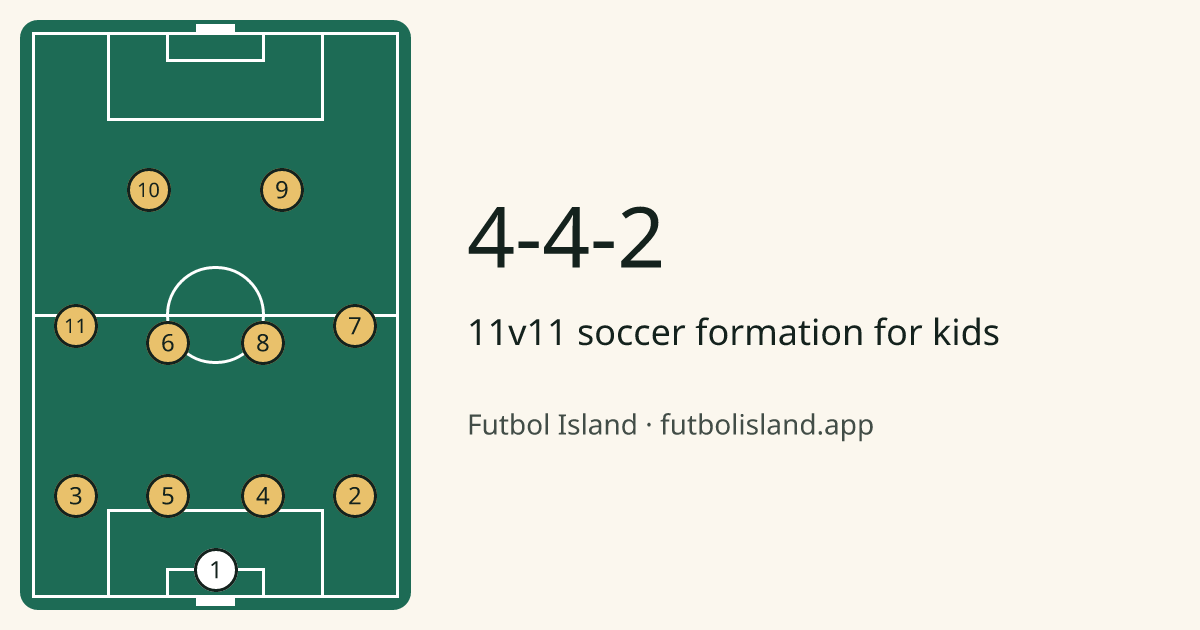
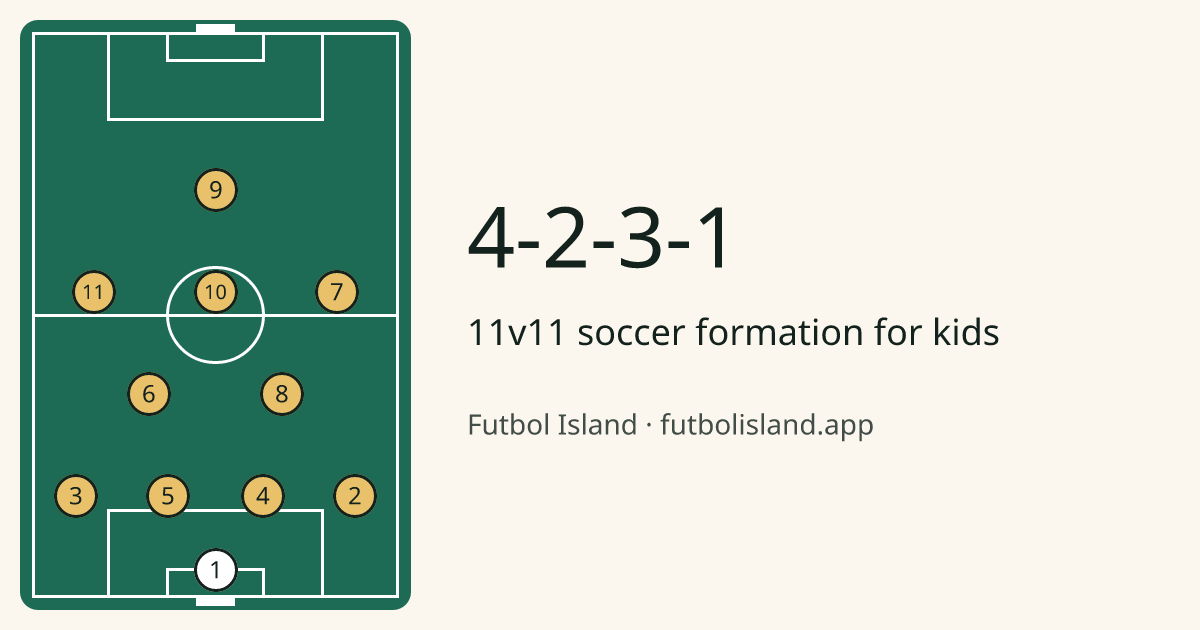
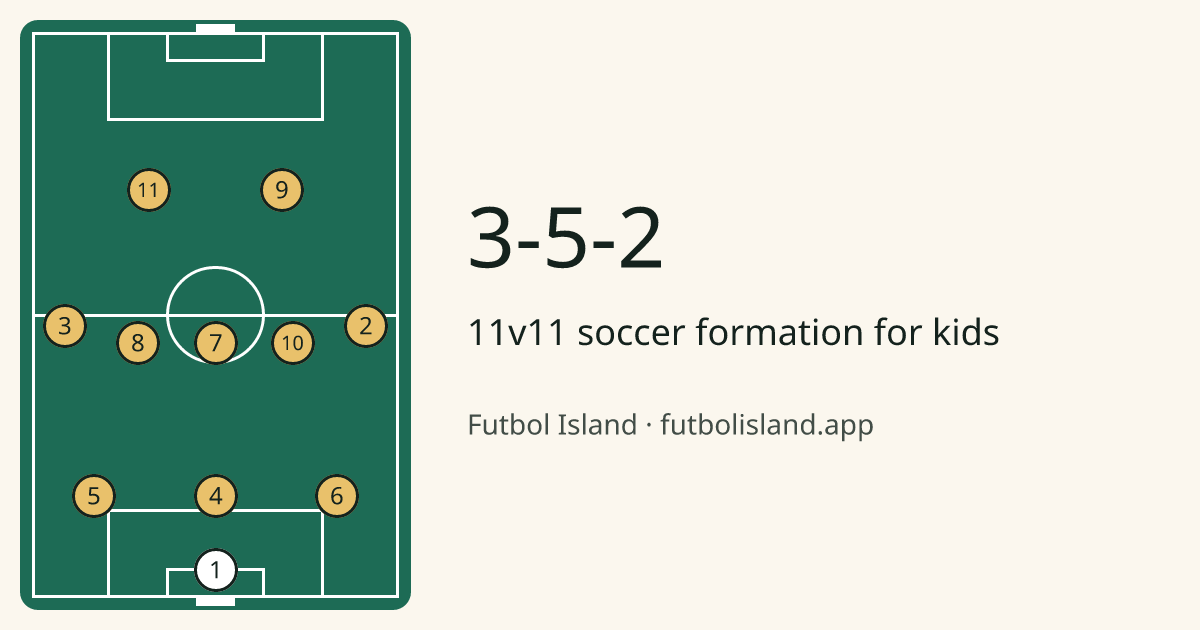
In 11v11 soccer each team has a goalkeeper and ten outfield players. Four formations cover most of what young players meet: the 4-3-3, the 4-4-2, the 4-2-3-1 and the 3-5-2. Teams moving up from 9v9 usually find the 4-3-3 the easiest step.
Soccer is called football in most of the world. This guide is part of Futbol Island’s free football lessons for kids aged 7 to 12.
Play it on the island11v11 formations compared
| Formation | With the goalkeeper | Best for | Watch out for |
|---|---|---|---|
| 4-3-3 | 1-4-3-3 | Teams with wingers who like to attack. | Space behind the fullbacks when they go forward. |
| 4-4-2 | 1-4-4-2 | Teams that want simple lines and two strikers. | Two central midfielders can be outnumbered. |
| 4-2-3-1 | 1-4-2-3-1 | Teams with a creative attacking midfielder. | The striker is alone if the three behind stay away. |
| 3-5-2 | 1-3-5-2 | Teams with two fit wing-backs. | Space behind the wing-backs. |
U.S. Soccer writes youth formations with the goalkeeper first, so a 4-3-3 in 11v11 is also written 1-4-3-3.
Which 11v11 formation should my team use?
- Start with the 4-3-3 if your players come from a 9v9 3-2-3. The back line gets one more defender, the midfield gets one more player, and the three forwards keep their jobs.
- Choose the 4-4-2 if your team needs a simple shape without the ball. Two lines of four are easy to see and to coach.
- Choose the 4-2-3-1 if you want two midfielders guarding the middle and you have a creative player to put behind the striker.
- Choose the 3-5-2 only with older, fit players. The two wing-backs must cover the whole side of the field.
- The numbers describe where players start. Everyone still moves to help with the ball and to defend without it.
Diagrams of each 11v11 formation
11v11 soccer in short
- Eleven players: one goalkeeper and ten outfield players. That is the most the Laws of the Game allow.
- In the United States, players move to 11v11 at under 13 (U13) in the U.S. Soccer standards.
- The field and the goals are full size, so teams need to stay close together to cover the space.
- A formation is written from the back: 4-3-3 means four defenders, three midfielders and three forwards.
- With the goalkeeper counted it becomes 1-4-3-3.
- Leagues can set their own details, so check your league’s rules.
Questions about 11v11 formations
What is the best formation for a youth 11v11 team?
Many youth teams start with the 4-3-3, because it follows on from 9v9 and covers the field evenly. A 4-4-2 is simpler without the ball. The best one is the shape your players understand.
What do the numbers in a soccer formation mean?
They count the outfield players in each line, from the defense forward. A 4-4-2 has four defenders, four midfielders and two strikers. The goalkeeper is left out unless the shape is written 1-4-4-2.
What is the most attacking formation?
A shape does not attack by itself. Players do. A 4-3-3 starts with three forwards, but a 4-4-2 with fullbacks who go forward can attack with just as many players.
When do kids start playing 11v11?
In the U.S. Soccer standards, at under 13. Before that, children play 7v7 at U9 and U10 and 9v9 at U11 and U12. Some leagues differ.
11v11 lessons to start with
- Our Eleven: Shape & Shared Jobs (11v11 lesson)Understand the goalkeeper and each line, then adapt midfield support as a fullback advances.
- 4-3-3: Fullback Inside or Outside? (11v11 lesson)Fill the lane nobody holds: with the winger wide, the fullback moves inside; with the winger inside, the fullback goes wide.
- 4-4-2: Support the Second Ball (11v11 lesson)Forwards at two depths and a midfielder underneath win the loose ball. If Blue wins it, recover through the middle.
- Back Five: When Can the Wing-back Go? (11v11 lesson)A wing-back presses only when the touch is slow and a center back covers the winger behind. When that cue is gone, recover.
- Slide Across Together (11v11 lesson)Follow the danger as a group. Don’t leave a big gap for the next pass.
- Can You Turn? (11v11 lesson)Look before the ball arrives. Turn when you have room; use your support when you don’t.
Keep reading
- 7v7 soccer formations2-3-1, 3-2-1, 2-2-2 and 3-1-2 compared, with diagrams
- 9v9 soccer formations3-2-3, 3-3-2, 2-3-2-1, 3-1-3-1 and 4-3-1 compared, with diagrams
- All soccer formations16 formations for 7v7, 9v9, 11v11 and futsal, each with a diagram
- Soccer positions explained for kids9 positions and the numbers 1 to 11 explained, each with a diagram
- 7v7, 9v9 and 11v11 lessonsEvery lesson by team size
Futbol Island is a free football (soccer) learning game for kids aged 7 to 12. Every idea on this page is taught on a pitch with moving players, then checked with a quick quiz.