4-2-3-1 soccer formation (11v11)
The 4-2-3-1 is an 11v11 soccer formation with four defenders, two holding midfielders, three attacking midfielders and one striker. It suits teams that want two players guarding the middle and a creative player behind the striker.
Soccer is called football in most of the world. This guide is part of Futbol Island’s free football lessons for kids aged 7 to 12.
4-2-3-1 (11v11) diagram
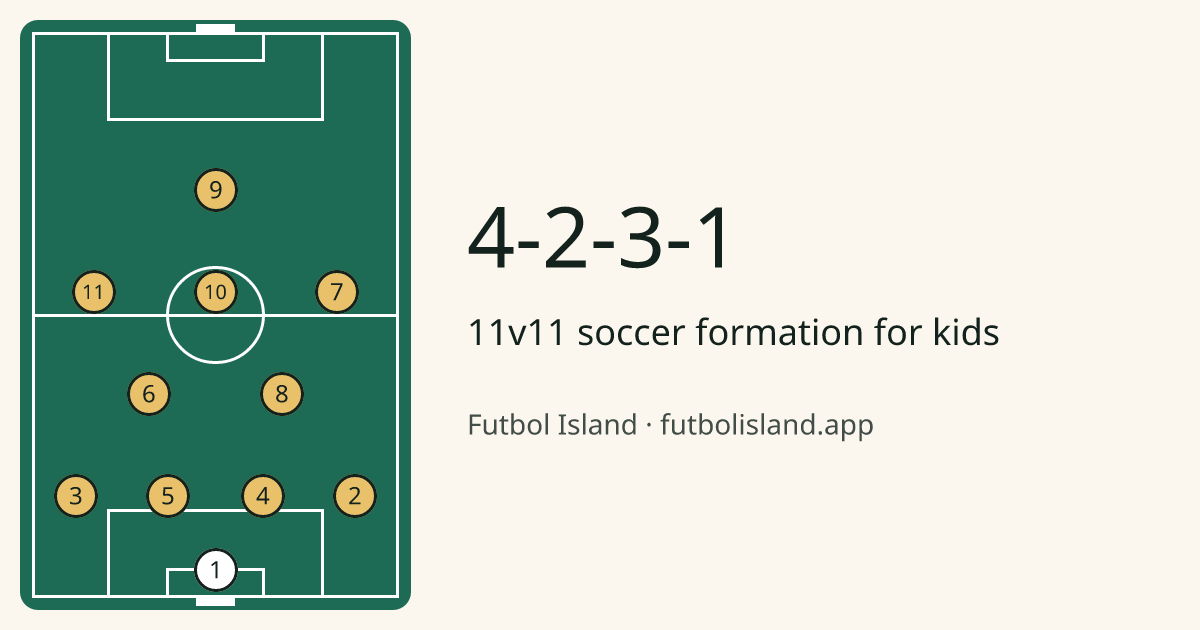
Coaches write this shape in two ways. 4-2-3-1 counts the 10 outfield players, from the defense forward. U.S. Soccer counts the goalkeeper first and writes 1-4-2-3-1. Both mean the same formation. The numbers on the dots are a common coaching custom, not a rule: players can wear any shirt number.
Who plays where
- Goalkeeper (1). Protects the goal and starts attacks through the center backs or the two holders.
- Two center backs (4 and 5). Protect the middle, with two midfielders in front to help them.
- Two fullbacks (2 and 3). Defend the sides. They can go forward more freely, because two holders cover.
- Two holding midfielders (6 and 8). Guard the space in front of the defense. One may join the attack while the other stays.
- Attacking midfielder (10). Plays between the other team’s midfield and defense. Looks for the pass that makes a chance.
- Two wide attackers (7 and 11). Start wide, then run inside toward goal or stay out to cross.
- Striker (9). Stays highest. Holds the ball for the three behind and finishes chances.
Strengths of the 4-2-3-1
- Two holders make the middle hard to attack through.
- Four attackers at different heights are hard to mark.
- Fullbacks can attack with cover behind them.
Weak spots and how to cover them
The striker is alone if the attacking midfielders stay far away.
How to cover it: The 10 stays close to the striker, and the wide attackers run inside when the ball goes up.
Both holders can stay too deep, so the team is split in two.
How to cover it: One holder steps forward to link, the other stays. They do not go together. Lesson: Leave Someone to Help.
A striker who drops deep can pull a center back out.
How to cover it: A holder picks up the dropping forward, so the center back can stay in line. Lesson: Back Four + Six: Pass On the Dropping Forward.
How the 4-2-3-1 moves
When your team has the ball
With the ball, the fullbacks go forward and the wide attackers come inside. The 10 finds space behind the other team’s midfield. One holder steps up to link and one stays back.
When the other team has the ball
Without the ball, the wide attackers drop beside the two holders, making a line of four. The 10 and the striker block the passes into the middle.
Who it suits
Players aged 13 and up with some 11v11 experience. It has more lines to learn than a 4-4-2 or a 4-3-3.
Questions about the 4-2-3-1
What is the difference between 4-2-3-1 and 4-3-3?
Where the midfield triangle points. In a 4-2-3-1, two midfielders sit deep and one plays high behind the striker. In the 4-3-3 our lessons use, one sits deep and two play ahead.
What is a double pivot?
A name for the two holding midfielders in a 4-2-3-1. Pivot means a point that play turns around. The two of them take the ball from the defenders and turn the play forward.
What does the number 10 do in a 4-2-3-1?
The 10 is the attacking midfielder in the middle of the line of three. This player receives between the lines, turns if there is room, and links the midfield to the striker.
Lessons that teach this shape
- Can You Turn? (11v11 lesson)Look before the ball arrives. Turn when you have room; use your support when you don’t.
- Back Four + Six: Pass On the Dropping Forward (11v11 lesson)When their striker drops, your six takes them so the center backs hold the line. If the six is busy, a center back steps out with cover.
- Leave Someone to Help (11v11 lesson)Joining an attack is a team decision. Check who will cover the space you leave.
- Look Behind the Defenders (11v11 lesson)Find the teammate, then check the route. A cut-back is useful only when that pass is there.
Keep reading
- 11v11 soccer formations4-3-3, 4-4-2, 4-2-3-1 and 3-5-2 compared, with diagrams
- 4-3-3 (11v11) formationTeams with wingers who like to attack.
- 4-4-2 (11v11) formationTeams that want simple lines and two strikers.
- 3-5-2 (11v11) formationTeams with two fit wing-backs.
- Soccer positions explained for kids9 positions and the numbers 1 to 11 explained, each with a diagram
- All soccer formations16 formations for 7v7, 9v9, 11v11 and futsal, each with a diagram
Futbol Island is a free football (soccer) learning game for kids aged 7 to 12. Every idea on this page is taught on a pitch with moving players, then checked with a quick quiz.