Winger in soccer
A winger is a soccer attacker who plays wide on the left or right, to stretch the other team and to create chances from the side.
It suits quick players who love to dribble at a defender and are brave enough to try again after losing the ball.
Soccer is called football in most of the world. This guide is part of Futbol Island’s free football lessons for kids aged 7 to 12.
Where the winger stands
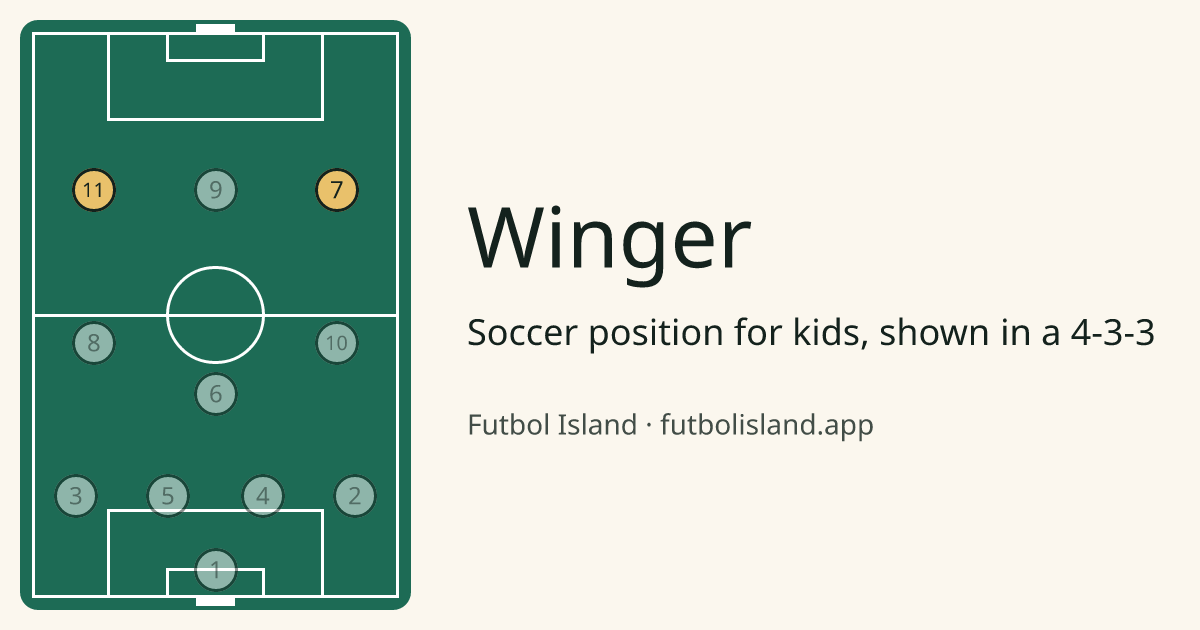
High and wide, near the sideline, on the left or the right of the forward line. In a 4-4-2 the wide midfielders do the same job from a little deeper.
With the ball
- Stays wide to stretch the defense, which opens space in the middle for teammates.
- Takes on the fullback one against one, then crosses or cuts inside to shoot.
- Passes the ball back from the goal line to a teammate arriving in front of goal.
Without the ball
- Tracks the other team’s fullback when that player runs forward.
- Drops back beside the midfielders to help block the middle.
- Presses from the front to trap the ball near the sideline.
Three habits to practise
Start wide
Stand near the sideline before the ball comes. It is easier to move inside late than to get wide late.
Attack the defender’s front foot
Dribble straight at the defender, then change direction quickly.
Look up before you cross
One look tells you where your teammates are. Then choose: cross, pass back or shoot.
Shirt number: 7 and 11
The right winger is usually 7 and the left winger is 11. The numbers are a coaching custom from the days when starters wore 1 to 11. Players today can wear any number.
In 7v7, 9v9 and futsal
In 7v7 the wide midfielders of a 2-3-1 are the wingers: they give width on each side and support the striker. In 9v9 the 3-2-3 has two wide forwards, and one of them comes inside to help when the midfield is outnumbered.
Formations with a winger
- 2-3-1 (7v7) formationWide midfielders (7 and 11)
- 3-2-3 (9v9) formationWide forwards (7 and 11)
- 3-3-2 (9v9) formationWide midfielders (7 and 11)
- 2-3-2-1 (9v9) formationWide midfielders (2 and 3)
- 3-1-3-1 (9v9) formationWide attacking midfielders (7 and 11)
- 4-3-1 (9v9) formationWide midfielders (7 and 11)
- 4-3-3 (11v11) formationTwo wingers (7 and 11)
- 4-4-2 (11v11) formationTwo wide midfielders (7 and 11)
- 4-2-3-1 (11v11) formationTwo wide attackers (7 and 11)
- All soccer formations16 formations for 7v7, 9v9, 11v11 and futsal, each with a diagram
Questions about the winger
What does a winger do in soccer?
A winger gives the team width. Wingers stay near the sideline, take on the fullback, and cross, pass back or cut inside to shoot. They also run back to help defend.
What is an inverted winger?
A winger who plays on the side opposite to their stronger foot, such as a right-footed player on the left. That makes it natural to cut inside and shoot.
Do wingers have to defend?
Yes. A winger follows the other team’s fullback and drops back beside the midfielders, so the team defends with more players.
Lessons for this position
- Make Room for Your Team (7v7 lesson)Spread into useful space so the player on the ball has another route.
- 3-2-3: Two Midfielders Face Three (9v9 lesson)A wide forward helps the midfield pair against three opponents while the outside back supplies the vacated width.
- Look Behind the Defenders (11v11 lesson)Find the teammate, then check the route. A cut-back is useful only when that pass is there.
- Two Against One: Carry or Pass (9v9 lesson)Watch whether the defender approaches the ball or stays with the teammate.
- Find the Open Side (11v11 lesson)Switch to use space, not just to send the ball across the pitch.
Player cards
Wingers in the Futbol Island card binder.
Other positions
Futbol Island is a free football (soccer) learning game for kids aged 7 to 12. Every idea on this page is taught on a pitch with moving players, then checked with a quick quiz.