3-3-2 soccer formation (9v9)
The 3-3-2 is a 9v9 soccer formation with three defenders, three midfielders and two strikers. It suits teams that want a strong middle of the field and two players near goal.
Soccer is called football in most of the world. This guide is part of Futbol Island’s free football lessons for kids aged 7 to 12.
3-3-2 (9v9) diagram
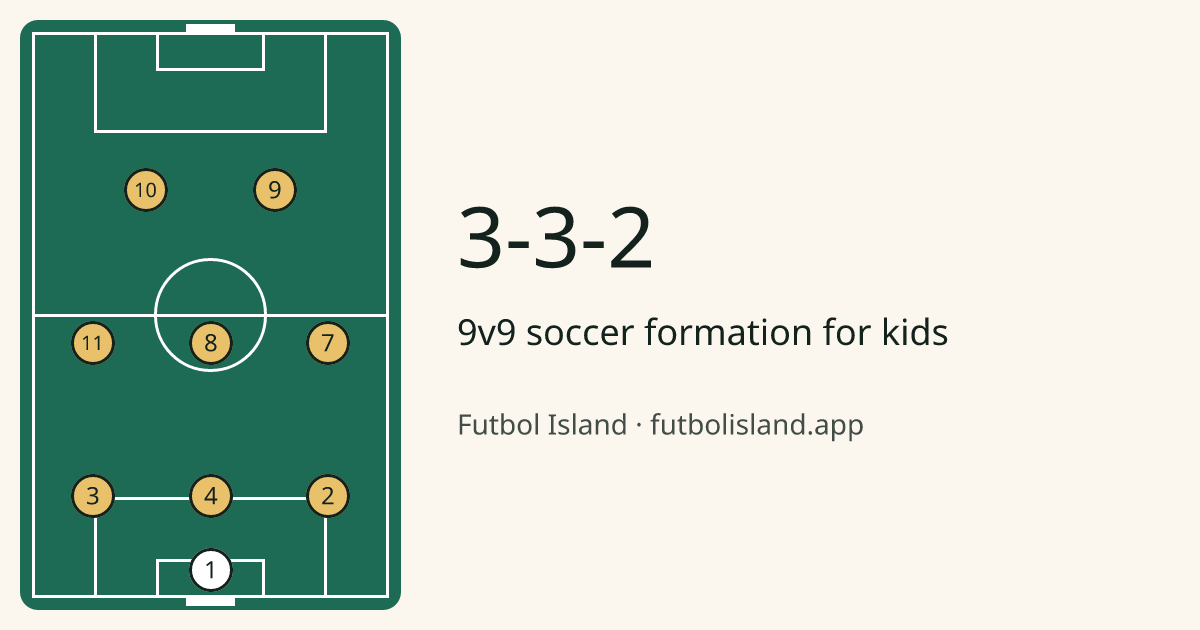
Coaches write this shape in two ways. 3-3-2 counts the 8 outfield players, from the defense forward. U.S. Soccer counts the goalkeeper first and writes 1-3-3-2. Both mean the same formation. The numbers on the dots are a common coaching custom, not a rule: players can wear any shirt number.
Who plays where
- Goalkeeper (1). Protects the goal and starts attacks with a pass to the back three.
- Three defenders (2, 3 and 4). Cover the width of the field together. The middle one covers behind the other two.
- Central midfielder (8). Stays in the middle to link passes and to protect the space in front of the defenders.
- Wide midfielders (7 and 11). Give the width outside the two strikers, then run back to make a line of three.
- Two strikers (9 and 10). Split the jobs. One shows for the ball, the other stays high to keep a defender busy.
Strengths of the 3-3-2
- Three midfielders match up well against most 9v9 midfields.
- Two strikers can combine close to goal.
- Three lines of three and two are easy to keep tidy.
Weak spots and how to cover them
The front two have no width of their own.
How to cover it: The wide midfielders run outside them, one at a time. Lesson: 3-3-2: Split the Two Striker Jobs.
If a wide midfielder joins the attack, the midfield is one short.
How to cover it: The other two midfielders slide across, and the three is rebuilt as soon as the ball is lost. Lesson: 3-3-2: Add an Attacker, Rebuild the Three.
Two strikers pressing three defenders can be passed around.
How to cover it: A wide midfielder joins the press only when the others protect behind. Lesson: Front Pair: When Can Midfield Join?.
How the 3-3-2 moves
When your team has the ball
With the ball, the wide midfielders move up outside the strikers. One striker comes short to link with the midfield and the other stays on the last defender.
When the other team has the ball
Without the ball, the three midfielders stay in one line in front of the three defenders. The two strikers stand between the other team’s defenders and midfielders.
Who it suits
Teams with two forwards who enjoy playing together, and wide midfielders who can run up and back. Good for players aged 11 and 12.
Questions about the 3-3-2
What is the difference between 3-3-2 and 3-2-3?
One player. The 3-3-2 has an extra midfielder and two strikers in the middle. The 3-2-3 has an extra forward and two of the forwards start wide. The 3-3-2 is stronger in the middle. The 3-2-3 is wider up front.
How should two strikers move in a 3-3-2?
At different depths. One shows toward the ball to connect with the midfield. The other keeps depth, staying high so a defender has to stay back too.
Who gives width in a 3-3-2?
The wide midfielders. They supply the width that the front line is missing, so they need energy to go forward and come back.
Lessons that teach this shape
- 3-3-2: Split the Two Striker Jobs (9v9 lesson)Two strikers share showing and depth against three defenders, while wide midfielders supply the missing front-line width.
- 3-3-2: Add an Attacker, Rebuild the Three (9v9 lesson)A wide midfielder joins two strikers while the other midfielders support, then rebuilds the midfield three after loss.
- Front Pair: When Can Midfield Join? (9v9 lesson)Three-three-two has two strikers facing three backs. A wide midfielder can join the first pressure only when the other midfielders protect behind.
- Three Backs Against Two Pressers (9v9 lesson)Three-two-three gives us three backs against their two strikers. Our two central midfielders stay ahead of the first line.
Keep reading
- 9v9 soccer formations3-2-3, 3-3-2, 2-3-2-1, 3-1-3-1 and 4-3-1 compared, with diagrams
- 3-2-3 (9v9) formationMost teams. Wide forwards and a clear back three.
- 2-3-2-1 (9v9) formationTeams that keep the ball well.
- 3-1-3-1 (9v9) formationTeams with a calm holding midfielder.
- 4-3-1 (9v9) formationGetting ready for a back four in 11v11.
- Soccer positions explained for kids9 positions and the numbers 1 to 11 explained, each with a diagram
- All soccer formations16 formations for 7v7, 9v9, 11v11 and futsal, each with a diagram
Futbol Island is a free football (soccer) learning game for kids aged 7 to 12. Every idea on this page is taught on a pitch with moving players, then checked with a quick quiz.