7v7 soccer formations
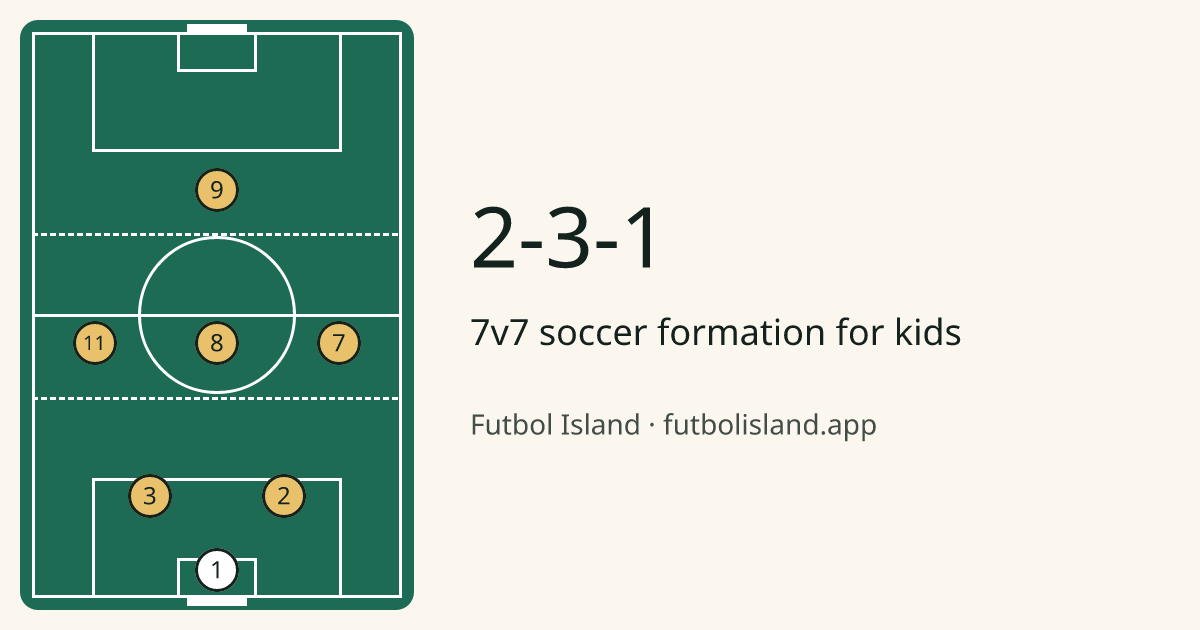
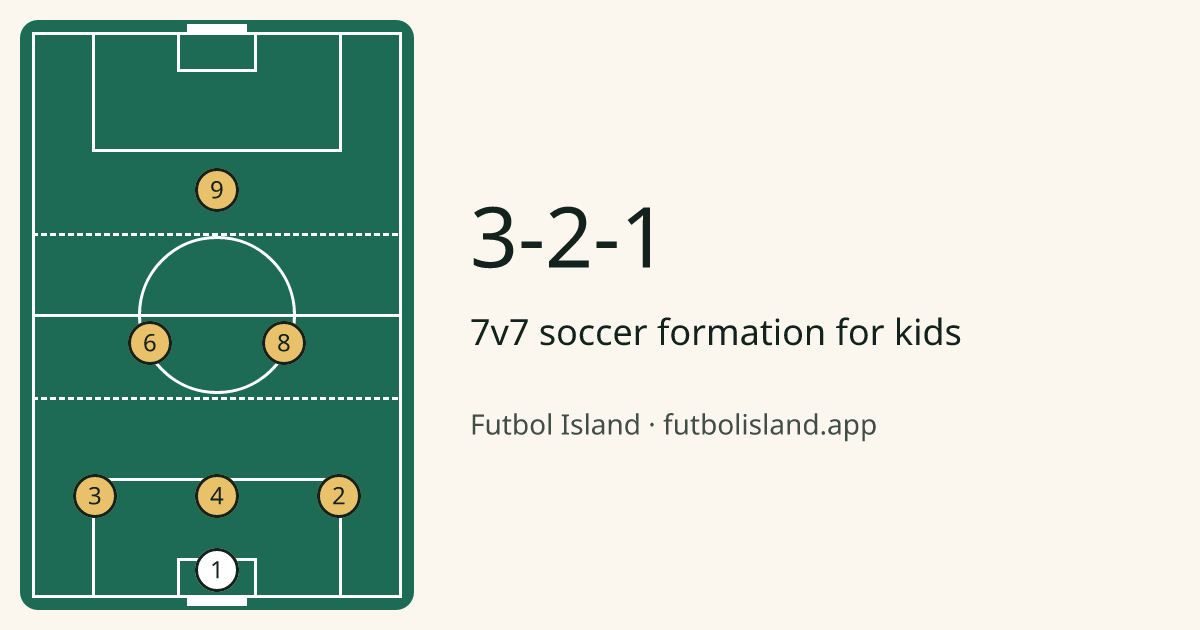
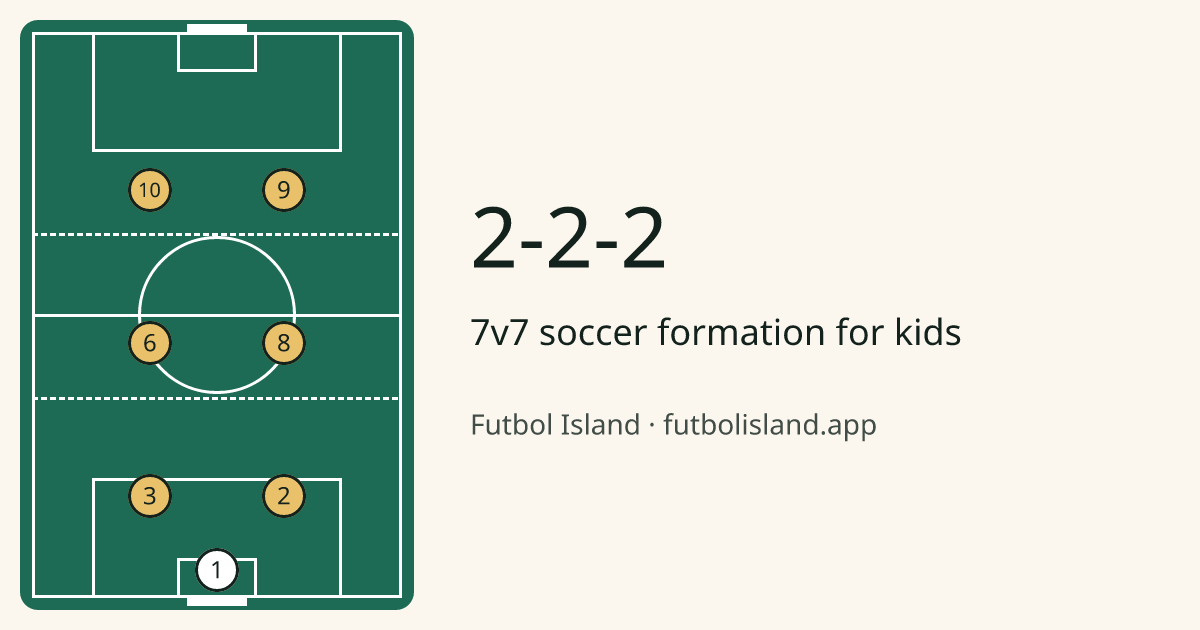
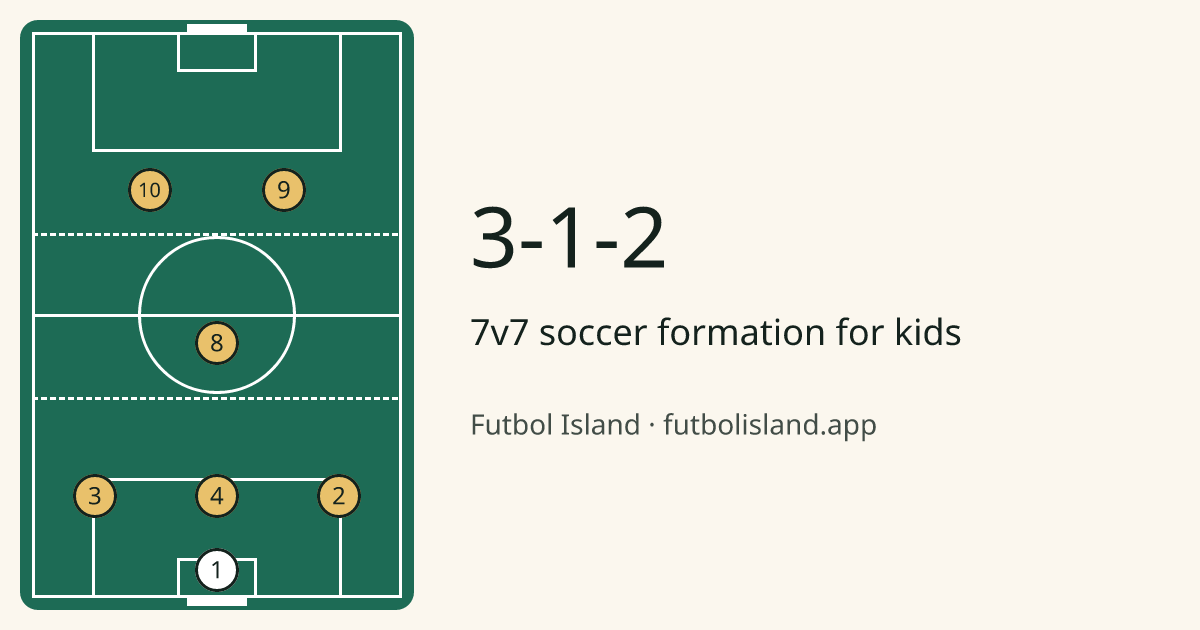
In 7v7 soccer each team has a goalkeeper and six outfield players. The four common formations are the 2-3-1, the 3-2-1, the 2-2-2 and the 3-1-2. For most teams of nine and ten-year-olds, the 2-3-1 is the best place to start.
Soccer is called football in most of the world. This guide is part of Futbol Island’s free football lessons for kids aged 7 to 12.
Play it on the island7v7 formations compared
| Formation | With the goalkeeper | Best for | Watch out for |
|---|---|---|---|
| 2-3-1 | 1-2-3-1 | Most teams. A balanced first shape. | Only two defenders on a fast break. |
| 3-2-1 | 1-3-2-1 | Teams that let in a lot of goals. | No wide midfielders. Outside backs must go forward. |
| 2-2-2 | 1-2-2-2 | New players. Pairs are easy to understand. | Nobody starts wide, so the team bunches up. |
| 3-1-2 | 1-3-1-2 | Teams with two strong forwards. | One midfielder has a lot of ground to cover. |
U.S. Soccer writes youth formations with the goalkeeper first, so a 2-3-1 in 7v7 is also written 1-2-3-1.
Which 7v7 formation should my team use?
- Start with the 2-3-1 if you are not sure. It has two defenders, wide players and a link player in the middle, so children meet every kind of job.
- Choose the 3-2-1 if your team lets in many goals or is new to the game. Three defenders give more cover, and the outside backs can still attack.
- Choose the 2-2-2 for a first season if pairs are easier for your players to understand. Move on once they can spread out.
- Choose the 3-1-2 if you have two forwards who work well together and one midfielder with a lot of energy.
- Whatever you pick, a formation is a starting arrangement. Players can leave their starting spot when the game needs it, and every child should try every position.
Diagrams of each 7v7 formation
7v7 soccer in short
- Seven players: one goalkeeper and six outfield players.
- In the United States, 7v7 is the game for players under 9 and under 10 (U9 and U10) in the U.S. Soccer standards.
- Those standards add a build-out line. On a goal kick, or when the keeper holds the ball, the other team waits behind it until the ball is played.
- The keeper may not punt or drop-kick the ball, so the team learns to pass out from the back.
- Offside is only called between the build-out line and the goal line, not between halfway and the build-out line.
- Leagues can set their own details, so check your league’s rules.
Questions about 7v7 formations
What is the best formation for 7v7 soccer?
There is no single best one. The 2-3-1 is the most common starting point because it is balanced and teaches width. The best formation for your team is the one your players understand.
What does 1-2-3-1 mean?
It is the 2-3-1 with the goalkeeper counted first: one keeper, two defenders, three midfielders, one forward. U.S. Soccer writes youth formations this way.
Should 7v7 players stay in one position all season?
No. At nine and ten, children learn most by trying every job: defending, playing wide, playing in the middle and scoring. Rotate positions from game to game.
How many defenders should a 7v7 team have?
Two or three. Two defenders leave more players for midfield. Three defenders are safer but need the outside backs to go forward, or the team has too few attackers.
7v7 lessons to start with
- Meet Your Team (7v7 lesson)Recognize the goalkeeper and three lines of teammates, then adjust your midfield role as the ball changes sides.
- A Formation Gives Us Options (7v7 lesson)Use the jobs of the back line, midfield and forward to find a missing wide or supporting option.
- Goal Kick & Build-Out Line (7v7 lesson)On our goal kick, the other team waits behind the build-out line. Once the ball is kicked and moves, they can come and press.
- Which Line Matters? (7v7 lesson)In many 7v7 leagues (like AYSO), you can't be called offside until you pass the far build-out line. Past it, offside counts, so time your run.
- Your Keeper Can Help (7v7 lesson)Pass back to your keeper when the way is clear. The keeper must play it with their feet, not hands. If it's covered, pick another teammate.
- Make Room for Your Team (7v7 lesson)Spread into useful space so the player on the ball has another route.
Keep reading
- 9v9 soccer formations3-2-3, 3-3-2, 2-3-2-1, 3-1-3-1 and 4-3-1 compared, with diagrams
- 11v11 soccer formations4-3-3, 4-4-2, 4-2-3-1 and 3-5-2 compared, with diagrams
- All soccer formations16 formations for 7v7, 9v9, 11v11 and futsal, each with a diagram
- Soccer positions explained for kids9 positions and the numbers 1 to 11 explained, each with a diagram
- 7v7, 9v9 and 11v11 lessonsEvery lesson by team size
Futbol Island is a free football (soccer) learning game for kids aged 7 to 12. Every idea on this page is taught on a pitch with moving players, then checked with a quick quiz.