Soccer drills to do at home
These soccer drills work at home with one ball, a few yards of space and, for some, a wall or a parent. Ten to fifteen minutes on most days does more than one long session a week.
Practice at home is for the things a team practice has too little time for: hundreds of touches, the weaker foot, and a first touch that does what you want.
Soccer is called football in most of the world. This guide is part of Futbol Island’s free football lessons for kids aged 7 to 12.
What you need
- A ball in the right size: size 3 up to age 8, size 4 for ages 9 to 12.
- A flat space of about 5 by 5 yards. Grass, a driveway or a garage all work.
- Four markers. Shoes or water bottles are fine.
- A solid wall with no windows, or a parent who can pass the ball back.
A 15-minute home practice
- Minutes 0 to 3: toe taps and foundations, 30 seconds on, 30 seconds off.
- Minutes 3 to 6: cone weave, right foot only, then left foot only.
- Minutes 6 to 9: turn and go between two markers, five of each turn.
- Minutes 9 to 13: wall passing, two touches, then one touch, both feet.
- Minutes 13 to 15: free play. Try a move, shoot at a target, or beat a parent 1v1.
Soccer drills that work at home
- Toe taps and foundationsTwo square yards is enough. Count your touches and beat the score. U6 to U12.
- Cone weave dribblingShoes for cones. Time ten trips. U6 to U12.
- Turn and goTwo markers, three turns, both feet. U8 to U12.
- Wall passingThe wall always passes back. The best solo drill there is. U6 to U12.
- First touch gatesTake your first touch through a gate made of two shoes. U8 to U12.
- Receive across the bodyPass in from the side, receive on the back foot. U8 to U12.
- Thigh and chest controlA parent throws underarm from five steps. U8 to U12.
- Shoulder check colorsA parent holds up fingers behind you before the pass. U8 to U12.
- 1v1 to end zonesParent against child, to a line. U6 to U12.
- Goalkeeper catching: W and basketSoft throws and safe hands in the yard. U10 to U12.
Example: Wall passing
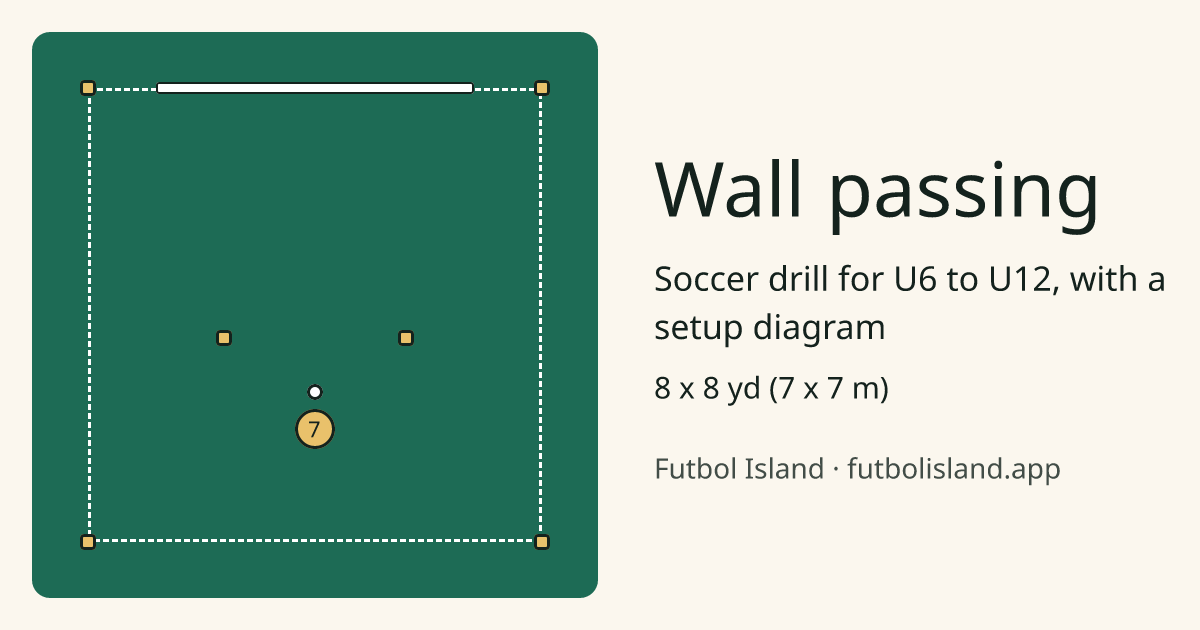
Wall passing is a solo drill in which a player passes the ball against a wall and controls the rebound, again and again. It trains a firm, accurate pass and a clean first touch with both feet, because the wall always gives the ball back. See the full drill.
Tips for parents
- Keep it short and stop while it is still fun. Tomorrow matters more than five extra minutes today.
- Let your child keep score against their own best, not against a brother or sister.
- Join in. You do not need to be good at soccer to pass a ball back or be a slow defender.
- Praise effort with the weaker foot more than a goal with the strong one.
- No heading at home either for players aged 10 and under.
Questions about drills to do at home
How can my child practice soccer alone?
With ball mastery and a wall: toe taps, foundations, a cone weave, turns and wall passing. All of them work in a small space with one ball.
How long should a child practice at home?
Ten to fifteen minutes on most days is plenty for ages 7 to 12. Short and regular beats long and rare.
What is the best soccer drill to do at home?
Wall passing. It trains the pass and the first touch together, with both feet, and a child can count and beat their own score.
Can we practice indoors?
Toe taps, foundations and slow turns work indoors on a soft floor with a soft or futsal-style ball, if there is nothing breakable nearby.
Lessons to go with these drills
Keep reading
- Soccer passing drills for kidsPassing drills in teaching order: pairs, triangles, give-and-go and rondos
- Soccer dribbling drills for kidsBall mastery, ball-each games, turns and 1v1 for every age
- Soccer shooting drills for kidsShooting and finishing drills without long lines, for U6 to U12
- First touch soccer drills for kidsReceiving drills: back foot, touch into space, turning and high balls
- Soccer goalkeeper drills for kidsSet position, catching, angles and distribution for U10 and U12, with soft service
- Soccer ball size by ageSize 3, 4 or 5 for each age group
- First touch (soccer term)The touch you take as the ball arrives
- Give-and-go (soccer term)Pass, run past the defender, get it back
- All soccer drills for kids46 soccer drills and practice games for U6 to U12, each with a setup diagram, coaching points and the lesson it trains
- Soccer practice plans for kids12 ready-to-use soccer practice plans for U6, U8, U10 and U12, each with a clock table, equipment list and linked drills
Futbol Island is a free football (soccer) learning game for kids aged 7 to 12. Every idea on this page is taught on a pitch with moving players, then checked with a quick quiz.