Toe taps and foundations soccer drill
Toe taps and foundations are two ball mastery moves done on the spot: tapping the top of the ball with the sole of each foot in turn, and knocking the ball from one foot to the other with the inside of the feet. They train balance, quick feet and a soft touch, so the ball stays close when a player dribbles.
Soccer is called football in most of the world. This guide is part of Futbol Island’s free football lessons for kids aged 7 to 12.
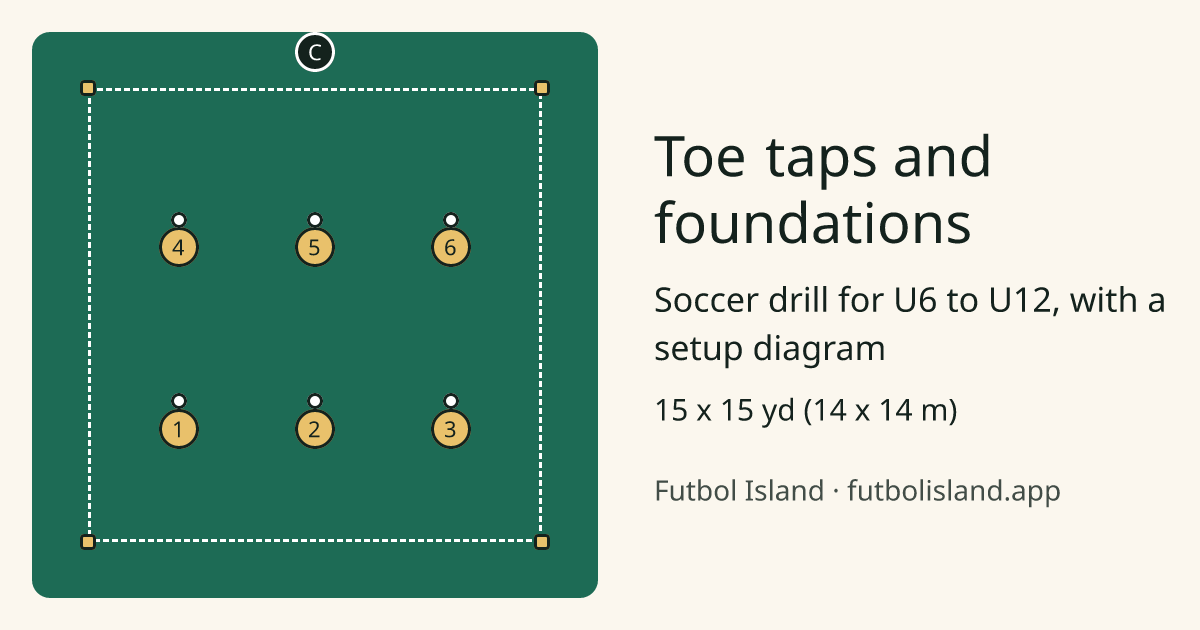
Toe taps and foundations: setup diagram
At a glance
| Detail | For this drill |
|---|---|
| Ages | U6 to U12 (ages 5 to 12) |
| Players | Any number, one ball each |
| Space | 15 x 15 yd (14 x 14 m) |
| Equipment | One ball per player; cones to mark the area |
| Time | 5 to 8 minutes, in bursts of 30 seconds |
| Skill | Dribbling and ball mastery |
Change the size of the area to fit your group: bigger makes it easier for the player with the ball, smaller makes it harder. Everyone who goes out comes straight back in, and nobody runs laps.
How to run it
- Give every player a ball and room to swing a leg without touching anyone.
- Toe taps: touch the top of the ball lightly with the sole of one foot, then the other, like climbing stairs. The ball should hardly move.
- Foundations: stand over the ball and tap it from the inside of one foot to the inside of the other, knees bent.
- Work for 30 seconds, rest for 30 seconds. Count touches and try to beat the score.
- Add movement: toe taps going round the ball in a circle, foundations travelling forward to a line and back.
Coaching points to say out loud
- “Light feet.”
- “Knees bent, on your toes.”
- “Eyes up for a second.”
- “Soft touch, ball stays home.”
Make it easier or harder
Easier
Slow it right down and let players watch the ball. For five-year-olds, simply stepping on and off a still ball with each foot is the first win.
Harder
Call a number of fingers for players to shout out while they tap, so they have to look up. Then add a signal: on “go” they dribble to a new space and start again.
Common mistakes
- Stamping on the ball instead of touching it lightly, so the ball rolls away or the player slips.
- Standing tall with straight legs. Bent knees make it far easier to keep balance.
- Staring down the whole time. A quick look up, even for one count, is the habit to build.
Why it matters in a game
In a game the ball has to stay close when a defender is near, and a player who is comfortable on top of the ball can stop, wait and choose. That choice is what our carrying lesson is about: watch the defender, then go where they leave room.
The lesson that teaches it: Carry or Pass?.
Do it at home
This is the best at-home drill there is. Two square yards and one ball are enough: three rounds of 30 seconds of each move, trying to beat yesterday’s count.
Questions about Toe taps and foundations
What are toe taps in soccer?
A ball mastery move: you touch the top of a still ball with the sole of one foot, then the other, in a quick rhythm. The ball barely moves; your feet do.
What are foundations in soccer?
Passing the ball to yourself between the insides of your two feet, with your knees bent. Coaches also call it tick-tocks, bells or pendulums.
How many toe taps should a child do?
Go by time, not by number. Thirty seconds of work and thirty of rest, three or four times, is plenty. Stop while it is still fun.
Lessons that teach this idea
- Carry or Pass? (7v7 lesson)Watch which route the defender leaves open.
- Give Your Teammate Room to Dribble (7v7 lesson)The sole middle midfielder leaves room for a wide teammate to try a one-against-one, then reconnects after the dribble.
- Look, Then Turn or Return (7v7 lesson)Look for pressure before receiving. Turn into room or give the ball back.
Related drills and guides
- Cone weave dribbling (drill)It trains close control and changing direction, the skill a player needs to carry the ball past a defender.
- Turn and go (drill)It trains the three basic turns, the drag-back, the inside hook and the outside hook, and the burst of speed that makes a turn work.
- Simon Says with a ball (drill)It trains stopping the ball, listening and balance, and it lets a new coach learn every name.
- Gates dribbling (drill)It trains dribbling with the head up, because players must look for a gate that is open.
- Soccer ball size by ageSize 3, 4 or 5 for each age group
- Winger in soccerThe wide attacker who takes players on
- U6 soccer drills: fun games for 5 and 6 year oldsNine games for 5 and 6 year olds, a ball each, with what to avoid
- U8 soccer drills for 7 and 8 year oldsTen drills for 7 and 8 year olds: dribbling, 1v1, first passing and 3v3
- U10 soccer drills for 9 and 10 year oldsTen drills for 9 and 10 year olds: rondos, first touch, 2v1 and first goalkeeping
- U12 soccer drills for 11 and 12 year oldsTen drills for 11 and 12 year olds: 4v2 rondos, possession, defending in pairs and finishing
- Soccer drills to do at homeSolo and parent-and-child drills for a yard, a driveway or a wall
- All dribbling and ball mastery drillsOne ball each: lots of touches, turns and changes of speed.
Futbol Island is a free football (soccer) learning game for kids aged 7 to 12. Every idea on this page is taught on a pitch with moving players, then checked with a quick quiz.