U6 soccer drills: fun games for 5 and 6 year olds
The best soccer drills for 5 and 6 year olds do not look like drills at all. They are games with a story, where every child has a ball and nobody waits for a turn.
At this age a practice has one aim: each child falls in love with having a ball at their feet. Dribbling, stopping and kicking come first. Passing and positions can wait.
Soccer is called football in most of the world. This guide is part of Futbol Island’s free football lessons for kids aged 7 to 12.
U6 soccer at a glance
| Detail | U6 |
|---|---|
| Players | 5 and 6 years old |
| Game | 4v4, with no goalkeepers |
| Field | 25 to 35 yards long, 15 to 25 yards wide |
| Ball | Size 3 |
| Game length | 4 quarters of 10 minutes |
| Practice length | About 45 minutes |
| Heading | None |
Game format, field, ball and game length are U.S. Soccer’s small-sided standards; practice length is US Youth Soccer’s coaching guidance. Your league may differ.
What U6 players can and cannot do yet
- They can run, stop, chase and kick, and they love to be chased.
- They can dribble a ball with many small touches when a game gives them a reason to.
- They pay attention to one task at a time, for a short time. Explain a game in two sentences and start.
- They are not ready to share the ball. “Mine!” is normal, so give everyone their own ball.
- They do not yet understand positions or team shape. A bunch around the ball is what the game looks like at five.
- They tire quickly and recover quickly. Short bursts and many water breaks suit them.
Attention span and group sizes
- Change the activity about every eight minutes, or sooner if eyes start to wander.
- One ball per child for most of the practice.
- Play 1v1, 2v2 or 3v3 on small fields. Avoid any game bigger than 4v4.
- Ask a parent to help so two small games can run side by side.
The best U6 soccer drills
- Simon Says with a ballThe best first game: stop the ball with the body part the coach calls. U6 to U8.
- Red Light, Green LightDribble on green, foot on the ball on red. U6 to U8.
- Sharks and MinnowsDribble across the ocean past a shark. The coach is the first shark. U6 to U10.
- Pirates and TreasureSteal a ball from the middle and dribble it home to your ship. U6 to U8.
- Gates dribblingCount how many “doors” you can dribble through in a minute. U6 to U10.
- Dribble tagTag, but everyone keeps a ball at their feet. U6 to U10.
- Clean Your RoomKick every ball out of your half. The first lesson in using the laces. U6 to U8.
- Dribble and shootDribble through a gate and score in a small goal with no goalkeeper. U6 to U10.
- 3v3 small-sided gameFinish every practice with a real game on a small field. U6 to U10.
Example: Sharks and Minnows
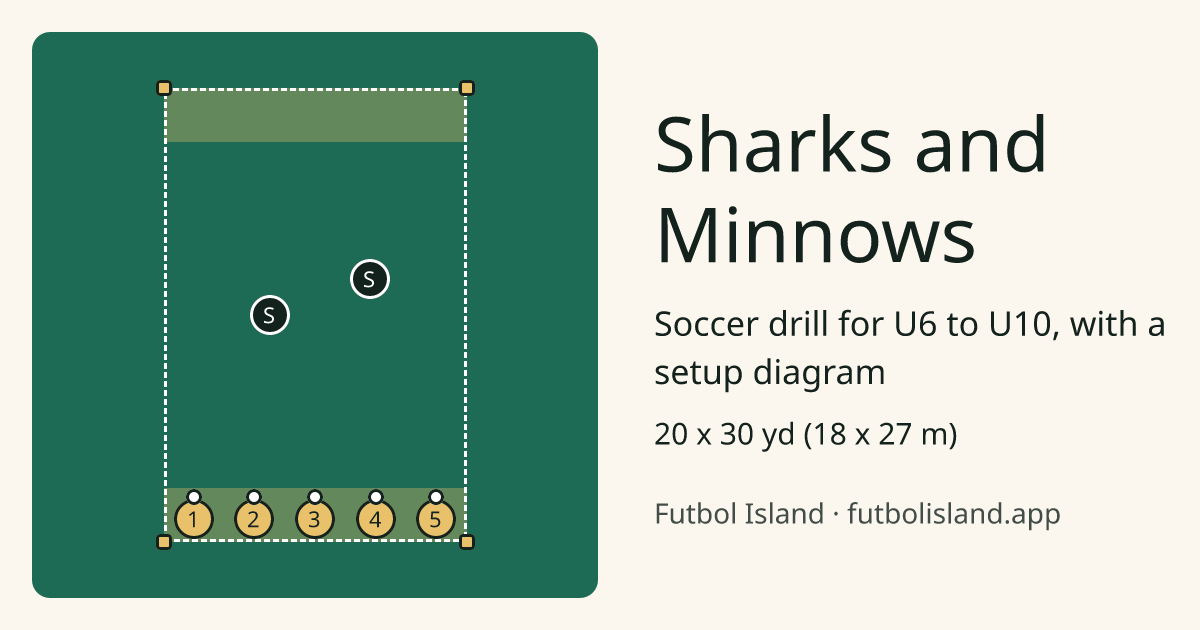
Sharks and Minnows is a dribbling game in which the minnows try to dribble a ball from one end of the area to the other while one or two sharks try to kick their balls out. It trains dribbling under pressure: keeping the ball close, changing direction and using open space. See the full drill.
What to avoid with U6 players
- Laps. Running without a ball teaches no soccer, and children this age warm up by playing.
- Lines. One child kicking while nine wait is the slowest way to learn.
- Lectures. If you talk for more than thirty seconds you have lost them.
- Elimination games that send children out. The ones who go out first need the ball most.
- Fixed positions and goalkeepers. Their games have neither.
- Heading. Players aged 10 and under do not head the ball.
U6 practice plans
Questions about U6 drills
What should a U6 soccer practice look like?
About 45 minutes: a small game as children arrive, three or four ball-each games of about eight minutes with water breaks, and a 3v3 or 4v4 game to finish.
How do I coach 5-year-olds who will not listen?
Talk less and play more. Use games with a story, give every child a ball, and change activity before they get bored. It is their attention span, not their attitude.
Should U6 players learn to pass?
A little, in pairs, for a few minutes. Most five-year-olds are not ready to give the ball away, and dribbling is the skill to build first.
How many kids should be on a U6 team?
Small rosters work best because the game is 4v4. Ask your league for its roster limit.
Lessons to go with these drills
- Carry or Pass? (7v7 lesson)Watch which route the defender leaves open.
- Look, Then Turn or Return (7v7 lesson)Look for pressure before receiving. Turn into room or give the ball back.
- Meet Your Team (7v7 lesson)Recognize the goalkeeper and three lines of teammates, then adjust your midfield role as the ball changes sides.
Keep reading
- U8 soccer drills for 7 and 8 year oldsTen drills for 7 and 8 year olds: dribbling, 1v1, first passing and 3v3
- U10 soccer drills for 9 and 10 year oldsTen drills for 9 and 10 year olds: rondos, first touch, 2v1 and first goalkeeping
- U12 soccer drills for 11 and 12 year oldsTen drills for 11 and 12 year olds: 4v2 rondos, possession, defending in pairs and finishing
- U6 first practice planA 45-minute plan for the first day
- Soccer age groups explainedWhat U6, U8, U10 and U12 mean
- Soccer ball size by ageSize 3, 4 or 5 for each age group
- Soccer field size by ageField, goal and game length for each age group
- All soccer drills for kids46 soccer drills and practice games for U6 to U12, each with a setup diagram, coaching points and the lesson it trains
- Soccer practice plans for kids12 ready-to-use soccer practice plans for U6, U8, U10 and U12, each with a clock table, equipment list and linked drills
Futbol Island is a free football (soccer) learning game for kids aged 7 to 12. Every idea on this page is taught on a pitch with moving players, then checked with a quick quiz.