Sharks and Minnows soccer drill
Sharks and Minnows is a dribbling game in which the minnows try to dribble a ball from one end of the area to the other while one or two sharks try to kick their balls out. It trains dribbling under pressure: keeping the ball close, changing direction and using open space.
Soccer is called football in most of the world. This guide is part of Futbol Island’s free football lessons for kids aged 7 to 12.
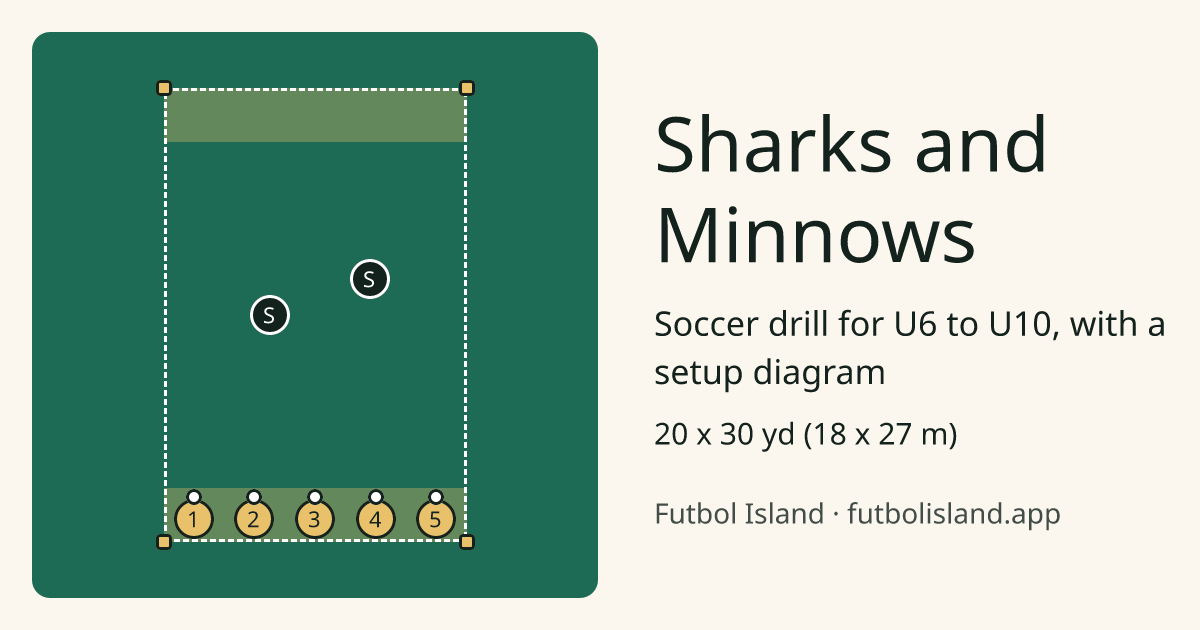
Sharks and Minnows: setup diagram
At a glance
| Detail | For this drill |
|---|---|
| Ages | U6 to U10 (ages 5 to 10) |
| Players | 6 to 16 |
| Space | 20 x 30 yd (18 x 27 m) |
| Equipment | One ball per minnow; cones; bibs for the sharks |
| Time | 8 to 10 minutes |
| Skill | Dribbling and ball mastery |
Change the size of the area to fit your group: bigger makes it easier for the player with the ball, smaller makes it harder. Everyone who goes out comes straight back in, and nobody runs laps.
How to run it
- Mark an area about 20 yards wide and 30 yards long. The two end lines are safe zones.
- Minnows line up on one end line, each with a ball. One or two sharks stand in the middle without a ball.
- On “swim!” the minnows dribble to the other end. Sharks try to kick a ball out of the area.
- A minnow who loses the ball fetches it and does five toe taps on the side, then joins the sharks for the next crossing. Nobody stands and watches.
- Play until two or three minnows are left, then start again with new sharks.
Coaching points to say out loud
- “Find the open water.”
- “Ball close when a shark is near.”
- “Change direction.”
- “Speed up into space.”
Make it easier or harder
Easier
Make the area wider, start with one shark, or have the sharks hold hands in a pair so they are slower.
Harder
Make the area narrower, or let sharks dribble a caught ball to a goal so minnows can win it back. For U10, sharks must win the ball and keep it, not just kick it away.
Common mistakes
- Minnows kicking the ball long and chasing it. A ball far from the foot belongs to the shark.
- Everyone going at once down the middle. Praise the player who waits and picks a gap.
- Children who are caught standing out for the rest of the round. Always give a quick job and a way back in.
Why it matters in a game
This is dribbling out of pressure in midfield with a defender closing in. The player with the ball has to see where the defender is and go the other way, which is the idea in our 7v7 lesson on carrying the ball: watch which route the defender leaves open.
The lesson that teaches it: Carry or Pass?.
Questions about Sharks and Minnows
How do you play Sharks and Minnows in soccer?
Minnows dribble from one end line to the other. Sharks in the middle try to kick their balls out. A minnow who loses the ball becomes a shark on the next crossing.
How big should the area be?
About 20 by 30 yards for 10 to 12 players. If the sharks win every ball, make it wider. If no ball is ever won, make it narrower.
Is it a good game for U6?
Yes, with one change: the coach or a parent is the first shark and is not very good at it. Five-year-olds should get across most of the time.
What does it teach?
Dribbling with your head up, shielding the ball, changing direction, and for the sharks, closing down a player and winning the ball.
Lessons that teach this idea
- Carry or Pass? (7v7 lesson)Watch which route the defender leaves open.
- Give Your Teammate Room to Dribble (7v7 lesson)The sole middle midfielder leaves room for a wide teammate to try a one-against-one, then reconnects after the dribble.
- Make Room for Your Team (7v7 lesson)Spread into useful space so the player on the ball has another route.
Related drills and guides
- Pirates and Treasure (drill)It trains dribbling at speed, turning with the ball and stopping it under control.
- Gates dribbling (drill)It trains dribbling with the head up, because players must look for a gate that is open.
- Knockout (drill)It trains shielding, dribbling with the head up and winning the ball.
- Dribble tag (drill)It warms players up while training dribbling with the head up and quick changes of direction.
- Winger in soccerThe wide attacker who takes players on
- Tackle (soccer term)Winning the ball fairly with your foot
- U6 soccer drills: fun games for 5 and 6 year oldsNine games for 5 and 6 year olds, a ball each, with what to avoid
- U8 soccer drills for 7 and 8 year oldsTen drills for 7 and 8 year olds: dribbling, 1v1, first passing and 3v3
- U10 soccer drills for 9 and 10 year oldsTen drills for 9 and 10 year olds: rondos, first touch, 2v1 and first goalkeeping
- Soccer dribbling drills for kidsBall mastery, ball-each games, turns and 1v1 for every age
- U6 soccer practice plan: dribblingA 45-minute plan that uses this drill
- U8 soccer practice plan: first practice of the seasonA 60-minute plan that uses this drill
- All dribbling and ball mastery drillsOne ball each: lots of touches, turns and changes of speed.
Futbol Island is a free football (soccer) learning game for kids aged 7 to 12. Every idea on this page is taught on a pitch with moving players, then checked with a quick quiz.