Knockout soccer drill
Knockout is a game in which every player dribbles a ball inside a square and tries to kick the other players’ balls out while protecting their own. It trains shielding, dribbling with the head up and winning the ball.
Soccer is called football in most of the world. This guide is part of Futbol Island’s free football lessons for kids aged 7 to 12.
Knockout: setup diagram
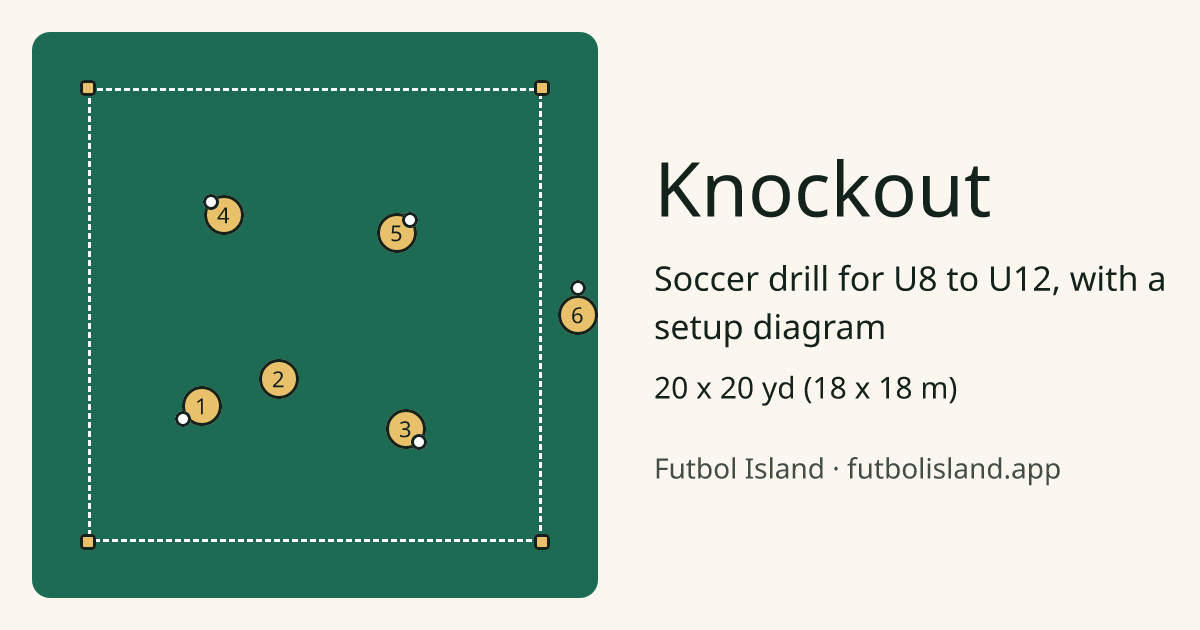
At a glance
| Detail | For this drill |
|---|---|
| Ages | U8 to U12 (ages 7 to 12) |
| Players | 6 to 14, one ball each |
| Space | 20 x 20 yd (18 x 18 m) |
| Equipment | One ball per player; cones for a square |
| Time | 8 to 10 minutes, in rounds of two minutes |
| Skill | Dribbling and ball mastery |
Change the size of the area to fit your group: bigger makes it easier for the player with the ball, smaller makes it harder. Everyone who goes out comes straight back in, and nobody runs laps.
How to run it
- Mark a square about 20 yards across. Everyone dribbles inside it.
- On “go”, players try to kick anyone else’s ball out of the square while keeping their own.
- A player whose ball leaves the square fetches it, does ten toe taps outside, and comes straight back in.
- Play for two minutes. Players count how many balls they knocked out, not how long they survived.
- Round two: a player may only attack while their own ball is within reach. No leaving your ball behind.
Coaching points to say out loud
- “Body between the ball and them.”
- “Side on, arm out for balance.”
- “Head up: who is coming?”
- “Keep your own ball close.”
Make it easier or harder
Easier
Make the square bigger. Or play “tails”: players tuck a bib in their shorts and pull tails instead of kicking balls.
Harder
Shrink the square each round. Or split into two teams in different bibs who only knock out the other team’s balls.
Common mistakes
- The classic rule that sends the first players out to watch for five minutes. The weakest dribblers then get the least practice.
- Leaving your own ball to chase others. Add the within-reach rule.
- Wild kicks at ankles. A fair challenge goes for the ball with the side of the foot.
Why it matters in a game
Shielding is what a forward does with a defender on their back, and what any player does near the touchline. It also sets up the next choice in our lesson on receiving under pressure: if you can protect the ball, you can wait for support.
The lesson that teaches it: Look, Then Turn or Return.
Questions about Knockout
How do you play Knockout in soccer?
Everyone dribbles in a square and tries to kick other balls out while protecting their own. In our version a player who is knocked out does ten toe taps and comes back in.
Why not make players sit out?
Because the children who go out first are the ones who need the most touches. A quick task and a fast return keeps the game fair and useful.
What is shielding?
Standing side on between the defender and the ball, with the ball on the far foot. The defender has to go through you to reach it, and that is a foul.
Lessons that teach this idea
- Look, Then Turn or Return (7v7 lesson)Look for pressure before receiving. Turn into room or give the ball back.
- Pivot: Turn or Combine (Futsal lesson)The pivot reads the marker and chooses a turn or lay-off.
- Lost It? Protect the Middle (7v7 lesson)After losing the ball, protect a route to goal; approach when a teammate can cover.
Related drills and guides
- Sharks and Minnows (drill)It trains dribbling under pressure: keeping the ball close, changing direction and using open space.
- Dribble tag (drill)It warms players up while training dribbling with the head up and quick changes of direction.
- 1v1 defending (drill)It trains the approach to the ball: fast at first, then slow, low and side on, steering the attacker to one side.
- Busy square dribbling (drill)It trains dribbling with the head up, because a player who only looks at the ball will bump into someone.
- Striker in soccerThe player who finishes chances
- Tackle (soccer term)Winning the ball fairly with your foot
- Fouls and free kicksWhat a fair challenge looks like
- U8 soccer drills for 7 and 8 year oldsTen drills for 7 and 8 year olds: dribbling, 1v1, first passing and 3v3
- U10 soccer drills for 9 and 10 year oldsTen drills for 9 and 10 year olds: rondos, first touch, 2v1 and first goalkeeping
- U12 soccer drills for 11 and 12 year oldsTen drills for 11 and 12 year olds: 4v2 rondos, possession, defending in pairs and finishing
- Soccer dribbling drills for kidsBall mastery, ball-each games, turns and 1v1 for every age
- All dribbling and ball mastery drillsOne ball each: lots of touches, turns and changes of speed.
Futbol Island is a free football (soccer) learning game for kids aged 7 to 12. Every idea on this page is taught on a pitch with moving players, then checked with a quick quiz.