U12 soccer drills for 11 and 12 year olds
U12 soccer drills can look more like the real game, because 11 and 12 year olds can think about teammates and opponents at the same time. Possession games, defending in pairs and attacks that end with a finish all fit this age.
The game is now 9v9 on a field up to 80 yards long, with offside. Players need skill at speed and good decisions, and both come from games with real opponents more than from patterns around cones.
Soccer is called football in most of the world. This guide is part of Futbol Island’s free football lessons for kids aged 7 to 12.
U12 soccer at a glance
| Detail | U12 |
|---|---|
| Players | 11 and 12 years old |
| Game | 9v9, with goalkeepers and offside |
| Field | 70 to 80 yards long, 45 to 55 yards wide |
| Ball | Size 4 |
| Game length | 2 halves of 30 minutes |
| Practice length | About 75 minutes |
| Heading | Allowed in games from age 11 under US Youth Soccer rules, with limits in practice |
Game format, field, ball and game length are U.S. Soccer’s small-sided standards; practice length is US Youth Soccer’s coaching guidance. Your league may differ.
What U12 players can and cannot do yet
- They can keep the ball in tight spaces and are ready for two-touch and one-touch games.
- They can understand a shape with lines: backs, midfielders and forwards, and how they connect.
- They can defend with a partner: one presses, one covers.
- They can time a run to stay onside, once they have learned the rule.
- They vary a lot in size and speed, since some are growing fast and some are not. Judge skill and decisions, not size.
- They still learn best by playing. A whiteboard is no replacement for a small-sided game.
Attention span and group sizes
- Activities of twelve to fifteen minutes work, if the challenge is real.
- Use groups of four to six for practice games, and build to 6v6 or the full 9v9 at the end.
- Give players a problem to solve, such as “score within eight seconds”, and let them talk about it.
- Keep water breaks in the plan. They are also the best moment for one coaching point.
The 10 best U12 soccer drills
- Rondo 4v2Find the pass that splits two defenders. U10 to U12.
- Three-team keep-awayPossession with a sudden change every time the ball is lost. U10 to U12.
- Receive and turnCheck your shoulder: turn, or play back? U8 to U12.
- Pressure and cover 2v2Defend as a pair and swap jobs as the ball moves. U10 to U12.
- Recover goal-sideRun to the goal first, then challenge. U8 to U12.
- 3v2 to goalUse the spare attacker before the defense recovers. U10 to U12.
- Crossing and finishingLow crosses and cutbacks, finished by foot at the near and far post. U10 to U12.
- End zone gameTime the run to arrive with the pass. U8 to U12.
- 1v1 to two small goalsChange direction to open up a goal. U8 to U12.
- Goalkeeper anglesWhere to stand so the goal looks small. U10 to U12.
Example: Rondo 4v2
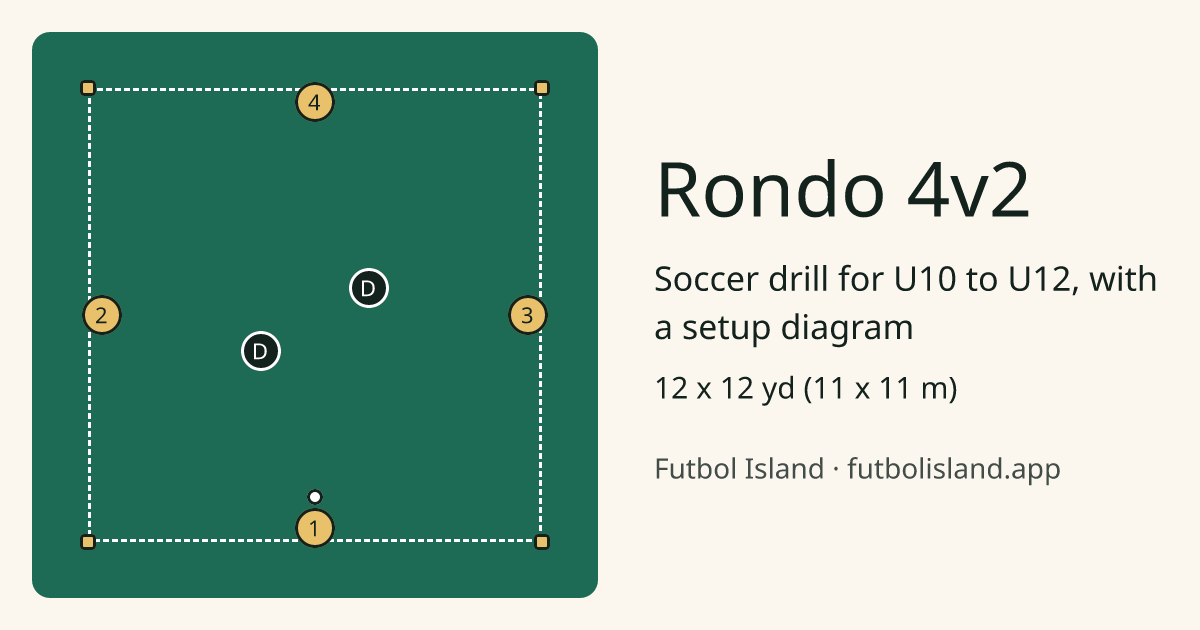
A 4v2 rondo is a keep-away game in which four players on the sides of a square pass the ball while two defenders in the middle work together to win it. It trains the attackers to find the pass between the two defenders, and the defenders to press and cover as a pair. See the full drill.
What to avoid with U12 players
- Running as punishment, or laps to “get fit”. Games at speed do the job and teach soccer too.
- Standing in lines to shoot one at a time.
- Lectures on tactics. Show the idea in a small game and ask the players what they saw.
- Patterns with no defenders for more than a few minutes. Decisions need opponents.
- Repeated heading practice. US Youth Soccer limits heading in practice at ages 11 and 12; see our heading rules page.
- Choosing positions by size. Let every player try defending, midfield and attacking.
- Winning the practice game at any cost. The scoreboard that matters at 12 is how many players improved.
U12 practice plans
Questions about U12 drills
How long should a U12 soccer practice be?
About 75 minutes, according to US Youth Soccer’s coaching guidance: an opening game, two practice activities on one theme, and a longer game at the end.
What should U12 players focus on?
Passing and receiving under pressure, scanning before the ball arrives, defending in pairs, and finishing attacks quickly when they have an extra player.
Can U12 players head the ball?
US Youth Soccer allows heading in games from age 11, with limits on heading in practice at 11 and 12. None of our drills use heading. Check your own league’s rule.
What formation do U12 teams play?
U12 teams play 9v9. Shapes such as 3-2-3 and 3-3-2 are common, and our 9v9 formations page shows each one.
Lessons to go with these drills
- Receive: Turn or Connect (9v9 lesson)Check the space before receiving; a turn and a return solve different pressure.
- One Presses, One Covers (9v9 lesson)Approach the ball with support behind; adjust cover when the attack moves.
- Find the Other Side (9v9 lesson)Move the ball through support when the nearby routes close.
- Run When the Pass Is On (11v11 lesson)Run when the pass is on, and leave as it is played so you stay onside (Law 11). If the pass is blocked, check toward the ball first.
Keep reading
- U6 soccer drills: fun games for 5 and 6 year oldsNine games for 5 and 6 year olds, a ball each, with what to avoid
- U8 soccer drills for 7 and 8 year oldsTen drills for 7 and 8 year olds: dribbling, 1v1, first passing and 3v3
- U10 soccer drills for 9 and 10 year oldsTen drills for 9 and 10 year olds: rondos, first touch, 2v1 and first goalkeeping
- U12 first practice planA 75-minute plan for the first day
- U12 possession practice planRondos into a three-team game
- 9v9 soccer formationsShapes for U11 and U12 teams
- The offside ruleWhy the timing of a run matters
- Heading rules for kids in the USNo heading at 10 and under
- All soccer drills for kids46 soccer drills and practice games for U6 to U12, each with a setup diagram, coaching points and the lesson it trains
- Soccer practice plans for kids12 ready-to-use soccer practice plans for U6, U8, U10 and U12, each with a clock table, equipment list and linked drills
Futbol Island is a free football (soccer) learning game for kids aged 7 to 12. Every idea on this page is taught on a pitch with moving players, then checked with a quick quiz.