1v1 to two small goals soccer drill
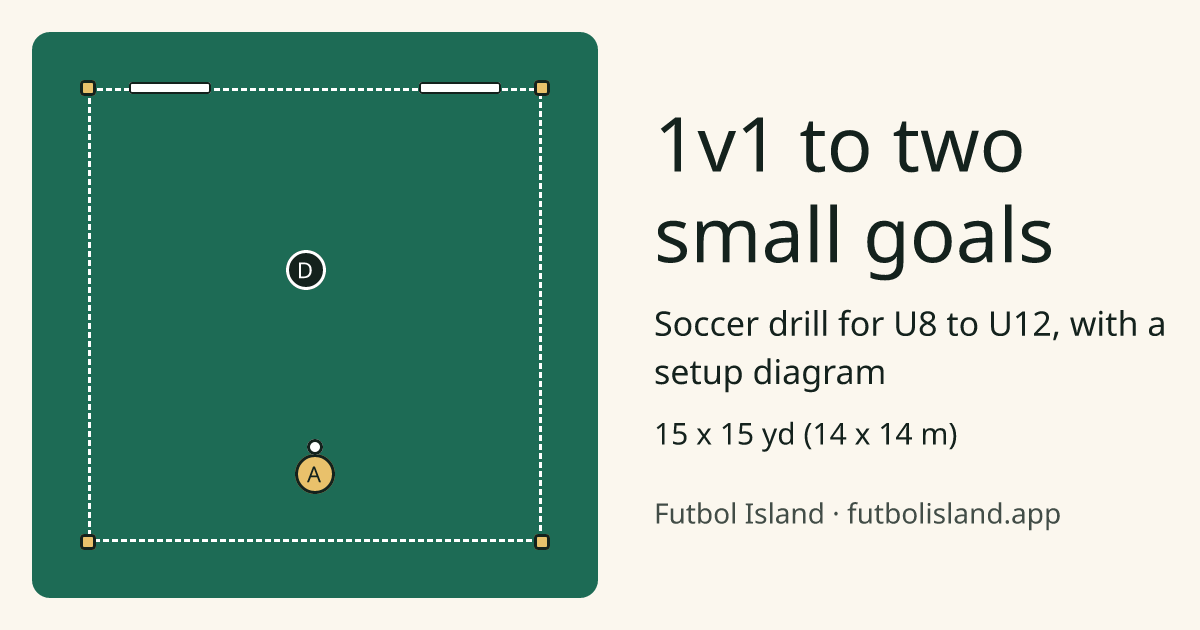
In 1v1 to two small goals, an attacker faces one defender and can score in either of two small goals set wide apart on the end line. It trains changing direction to unbalance a defender, because the defender cannot guard both goals at once.
Soccer is called football in most of the world. This guide is part of Futbol Island’s free football lessons for kids aged 7 to 12.
1v1 to two small goals: setup diagram
At a glance
| Detail | For this drill |
|---|---|
| Ages | U8 to U12 (ages 7 to 12) |
| Players | Groups of 4 per field |
| Space | 15 x 15 yd (14 x 14 m) |
| Equipment | One ball and 8 cones, or 2 small goals, per field |
| Time | 10 to 12 minutes |
| Skill | 1v1 attacking |
Change the size of the area to fit your group: bigger makes it easier for the player with the ball, smaller makes it harder. Everyone who goes out comes straight back in, and nobody runs laps.
How to run it
- Mark a 15 by 15 yard field with two small goals, 2 yards wide, at the corners of one end line.
- The defender starts between the goals and passes to the attacker, then defends.
- The attacker scores by passing the ball into either small goal from inside the last five yards.
- If the defender wins it, they score by dribbling over the attacker’s start line.
- Rotate: attacker becomes defender, and a new attacker steps in. Two pairs per field take turns.
Coaching points to say out loud
- “Attack one goal to open the other.”
- “Watch their hips and feet.”
- “Cut and go.”
- “Finish early when the goal is open.”
Make it easier or harder
Easier
Make the goals wider, or the field wider.
Harder
Add a third small goal behind the attacker for the defender to score in, so losing the ball has a cost. Or limit the attacker to eight seconds.
Common mistakes
- Dribbling straight at the middle and into the defender.
- A change of direction with no change of speed, so the defender simply follows.
- Shooting from far away. The goals are small, so get close.
Why it matters in a game
A defender can only protect one side. Moving them one way and going the other is how an attacker creates a shot or a cross, and our dribbling lessons describe the same cue: see which side the defender covers.
The lesson that teaches it: Carry or Pass?.
Questions about 1v1 to two small goals
Why use two goals in a 1v1?
It gives the attacker a reason to change direction. With one goal the defender just blocks the way. With two, the defender has to choose and can be wrong-footed.
Can I use cones as goals?
Yes. Two cones 2 yards apart make a small goal. Score by passing through them along the ground.
How long should each 1v1 last?
About ten seconds. If nobody has scored, the next pair goes. Short turns keep the speed high.
Lessons that teach this idea
- Carry or Pass? (7v7 lesson)Watch which route the defender leaves open.
- Give Your Teammate Room to Dribble (7v7 lesson)The sole middle midfielder leaves room for a wide teammate to try a one-against-one, then reconnects after the dribble.
- Two Attackers: Commit the Defender (Futsal lesson)Carry at the lone defender, then choose the route their movement leaves.
Related drills and guides
- 1v1 to end zones (drill)It trains taking a player on with a change of speed or direction, and for the defender, staying between the attacker and the line.
- 1v1 defending (drill)It trains the approach to the ball: fast at first, then slow, low and side on, steering the attacker to one side.
- Four-goal game (drill)It trains switching play: when one goal is crowded, the team moves the ball to the open one.
- Numbers game (drill)It trains 1v1 and 2v2 attacking and defending, with a race to the ball to start.
- Winger in soccerThe wide attacker who takes players on
- Striker in soccerThe player who finishes chances
- Goal-side (soccer term)Between the attacker and your own goal
- U8 soccer drills for 7 and 8 year oldsTen drills for 7 and 8 year olds: dribbling, 1v1, first passing and 3v3
- U10 soccer drills for 9 and 10 year oldsTen drills for 9 and 10 year olds: rondos, first touch, 2v1 and first goalkeeping
- U12 soccer drills for 11 and 12 year oldsTen drills for 11 and 12 year olds: 4v2 rondos, possession, defending in pairs and finishing
- U10 soccer practice plan: 1v1 attacking and defendingA 60-minute plan that uses this drill
- All 1v1 attacking drillsTaking on one defender with a change of speed or direction.
Futbol Island is a free football (soccer) learning game for kids aged 7 to 12. Every idea on this page is taught on a pitch with moving players, then checked with a quick quiz.