Numbers game soccer drill
The numbers game is a small-sided game in which two teams wait on their own end line, each player with a number, and the players whose number is called run out to play against each other. It trains 1v1 and 2v2 attacking and defending, with a race to the ball to start.
Soccer is called football in most of the world. This guide is part of Futbol Island’s free football lessons for kids aged 7 to 12.
Numbers game: setup diagram
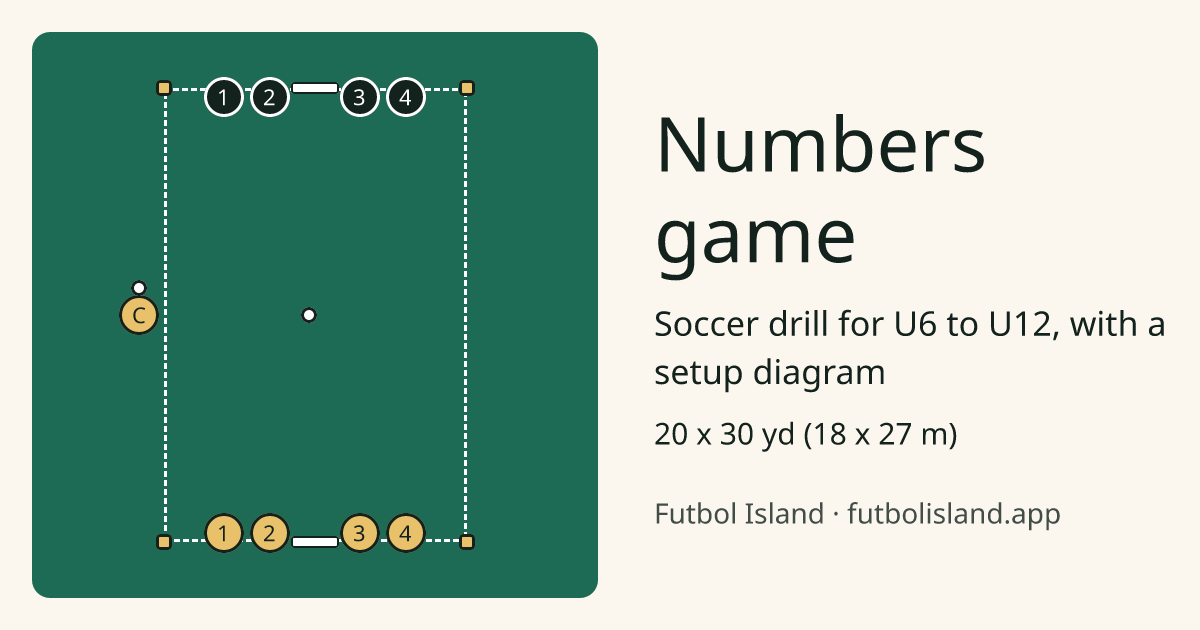
At a glance
| Detail | For this drill |
|---|---|
| Ages | U6 to U12 (ages 5 to 12) |
| Players | 8 to 14, in two teams |
| Space | 20 x 30 yd (18 x 27 m) |
| Equipment | Two small goals; a supply of balls with the coach; cones; bibs |
| Time | 12 minutes |
| Skill | 1v1 attacking |
Change the size of the area to fit your group: bigger makes it easier for the player with the ball, smaller makes it harder. Everyone who goes out comes straight back in, and nobody runs laps.
How to run it
- Two teams line up along their own end line, either side of a small goal. Give every player a number, the same numbers on both teams.
- The coach calls a number and plays a ball into the middle. Those two players run out and play 1v1 to the small goals.
- Call two numbers for 2v2, or three for 3v3.
- A turn lasts until a goal, the ball going out, or 30 seconds. Then the next call comes at once.
- Keep the wait short: call numbers quickly, call several at once, and give waiting players a job, such as toe taps with a ball or acting as side players who pass back in one touch.
Coaching points to say out loud
- “First to the ball: attack.”
- “Second: get goal-side.”
- “Take them on.”
- “In 2v2, one presses and one covers.”
Make it easier or harder
Easier
Call two numbers most of the time, so players have a teammate.
Harder
Call a math question for older players, or call uneven numbers such as “one and two” for one team only, to make 2v1.
Common mistakes
- Calling one number at a time with fourteen players. Twelve stand still. Use two fields or call pairs.
- Turns that last two minutes. Keep them short and sharp.
- Forgetting to call someone. Keep a mental loop: one, two, three, four, then mixes.
Why it matters in a game
Loose balls are everywhere in youth games, and the player who gets there first has to attack while the second has to defend. Our lesson on what to do after winning the ball covers the first player’s choice, and the goal-side lesson covers the second.
The lesson that teaches it: Win It: Look, Then Choose.
Questions about Numbers game
How do you play the numbers game in soccer?
Each player on two teams has a number. The coach calls a number and serves a ball, and those players come out to play until a goal is scored or the ball goes out.
How do I keep everyone busy?
Split into two small games if you have more than ten players, call two or three numbers at a time, and keep each turn under 30 seconds.
Is the numbers game good for U6?
Yes, as 1v1 and 2v2 with a short field. Five-year-olds understand “when you hear your number, go and score”.
Lessons that teach this idea
- Win It: Look, Then Choose (9v9 lesson)After gaining possession, use a clear forward advantage or secure the ball.
- Stay Between the Ball and Goal (7v7 lesson)Move with the attacker while keeping yourself between the ball and your goal.
- Carry or Pass? (7v7 lesson)Watch which route the defender leaves open.
- Two Against One: Carry or Pass (9v9 lesson)Watch whether the defender approaches the ball or stays with the teammate.
Related drills and guides
- 1v1 to end zones (drill)It trains taking a player on with a change of speed or direction, and for the defender, staying between the attacker and the line.
- 3v3 small-sided game (drill)It trains everything at once, dribbling, passing, shooting and defending, and gives each child far more time on the ball than a big game.
- World Cup shooting game (drill)It trains finishing in a crowd, quick shots and reacting to rebounds.
- 1v1 defending (drill)It trains the approach to the ball: fast at first, then slow, low and side on, steering the attacker to one side.
- Goal-side (soccer term)Between the attacker and your own goal
- 2v1 (soccer term)Two attackers against one defender
- Counterattack (soccer term)Attacking fast after winning the ball
- U6 soccer drills: fun games for 5 and 6 year oldsNine games for 5 and 6 year olds, a ball each, with what to avoid
- U8 soccer drills for 7 and 8 year oldsTen drills for 7 and 8 year olds: dribbling, 1v1, first passing and 3v3
- U10 soccer drills for 9 and 10 year oldsTen drills for 9 and 10 year olds: rondos, first touch, 2v1 and first goalkeeping
- U12 soccer drills for 11 and 12 year oldsTen drills for 11 and 12 year olds: 4v2 rondos, possession, defending in pairs and finishing
- U8 soccer practice plan: dribbling and 1v1A 60-minute plan that uses this drill
- U10 soccer practice plan: 1v1 attacking and defendingA 60-minute plan that uses this drill
- All 1v1 attacking drillsTaking on one defender with a change of speed or direction.
Futbol Island is a free football (soccer) learning game for kids aged 7 to 12. Every idea on this page is taught on a pitch with moving players, then checked with a quick quiz.