World Cup soccer shooting game
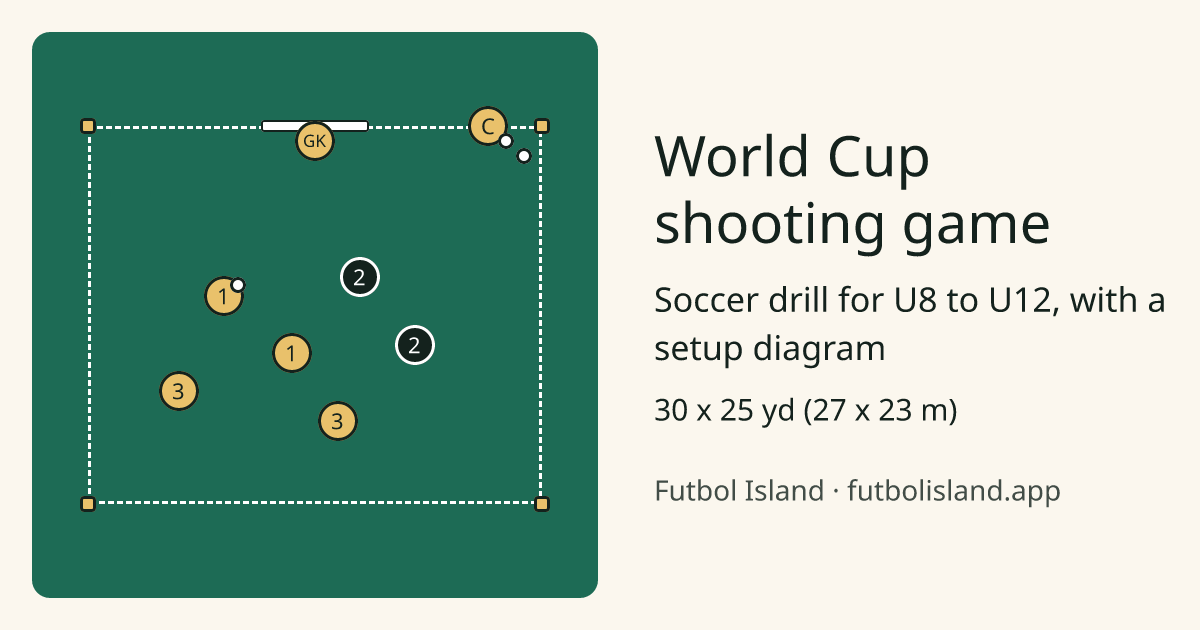
World Cup is a shooting game in which teams of two each pick a country and all attack the same goal at once, trying to score before the other pairs do. It trains finishing in a crowd, quick shots and reacting to rebounds.
Soccer is called football in most of the world. This guide is part of Futbol Island’s free football lessons for kids aged 7 to 12.
World Cup shooting game: setup diagram
At a glance
| Detail | For this drill |
|---|---|
| Ages | U8 to U12 (ages 7 to 12) |
| Players | 6 to 12 in pairs, plus a goalkeeper from U10 |
| Space | 30 x 25 yd (27 x 23 m) |
| Equipment | One goal; 3 or 4 balls kept beside the goal; cones |
| Time | 12 to 15 minutes |
| Skill | Shooting and finishing |
Change the size of the area to fit your group: bigger makes it easier for the player with the ball, smaller makes it harder. Everyone who goes out comes straight back in, and nobody runs laps.
How to run it
- Players make pairs and each pair chooses a country.
- The coach kicks a ball into the area. Every pair tries to win it and score in the one goal. A pair shouts its country when it scores.
- In the classic game a pair that scores sits out until the next round. Use this instead: a pair that scores runs around the back of the goal, comes straight back in and keeps counting goals.
- Play rounds of three minutes. The pair with the most goals wins the round.
- For U8, play without a goalkeeper and with a smaller goal. From U10, players take turns in goal for one round each.
Coaching points to say out loud
- “Shoot when you see the goal.”
- “Follow every shot.”
- “Partner: get open, do not crowd the ball.”
- “First touch away from the crowd.”
Make it easier or harder
Easier
Play in threes, or with only three pairs in the area at once while the others play in a second area.
Harder
A goal counts only if both partners touched the ball. Or one touch to finish inside the area near the goal.
Common mistakes
- Using the sit-out rules with young players, which leaves the best finishers watching and, in the knockout version, the weakest pairs watching longest.
- Both partners chasing the ball. One goes to the ball, the other finds space near the goal.
- Waiting for the perfect shot. In a crowd the first clear look is the one to take.
Why it matters in a game
A crowded goal area after a corner or a blocked shot looks just like this game. Our lesson on reacting to a shot is about that moment: read the rebound and arrive while others are watching.
The lesson that teaches it: Watch What Happens After the Shot.
Questions about World Cup shooting game
How do you play World Cup in soccer?
Pairs each choose a country. All pairs attack one goal with one ball. In the classic rules a pair that scores is through to the next round and the last pair is knocked out.
How do I stop players sitting out?
Keep every pair in and count goals over a timed round. A pair that scores runs around the goal and rejoins, which gives the others a short advantage.
Who plays goalkeeper?
From U10, players take turns for a round each, or a coach goes in. For U8, play with no goalkeeper and a small goal, because their games have no goalkeepers.
Lessons that teach this idea
- Watch What Happens After the Shot (7v7 lesson)A wide midfielder reads a loose rebound or a goalkeeper’s controlled ball before deciding whether to approach or recover.
- Arrive at the Far Post (Futsal lesson)Time support across goal, and keep another option when that route is covered.
- Look Behind the Defenders (11v11 lesson)Find the teammate, then check the route. A cut-back is useful only when that pass is there.
Related drills and guides
- Follow the shot (drill)It trains the habit of following in after every shot, so the attacker reaches the loose ball first.
- 2v1 to goal (drill)It trains the main decision of attacking with an extra player: dribble at the defender, then pass if they come to you or keep going if they do not.
- Dribble and shoot (drill)It trains striking a moving ball with the laces and looking at the goal before the shot.
- Numbers game (drill)It trains 1v1 and 2v2 attacking and defending, with a race to the ball to start.
- Striker in soccerThe player who finishes chances
- Goalkeeper in soccerThe job, the skills and where to stand
- Cutback (soccer term)A pass pulled back from the end line
- U8 soccer drills for 7 and 8 year oldsTen drills for 7 and 8 year olds: dribbling, 1v1, first passing and 3v3
- U10 soccer drills for 9 and 10 year oldsTen drills for 9 and 10 year olds: rondos, first touch, 2v1 and first goalkeeping
- U12 soccer drills for 11 and 12 year oldsTen drills for 11 and 12 year olds: 4v2 rondos, possession, defending in pairs and finishing
- Soccer shooting drills for kidsShooting and finishing drills without long lines, for U6 to U12
- U12 soccer practice plan: shooting and finishingA 75-minute plan that uses this drill
- All shooting and finishing drillsStriking at goal, and what to do after the shot.
Futbol Island is a free football (soccer) learning game for kids aged 7 to 12. Every idea on this page is taught on a pitch with moving players, then checked with a quick quiz.