1v1 to end zones soccer drill
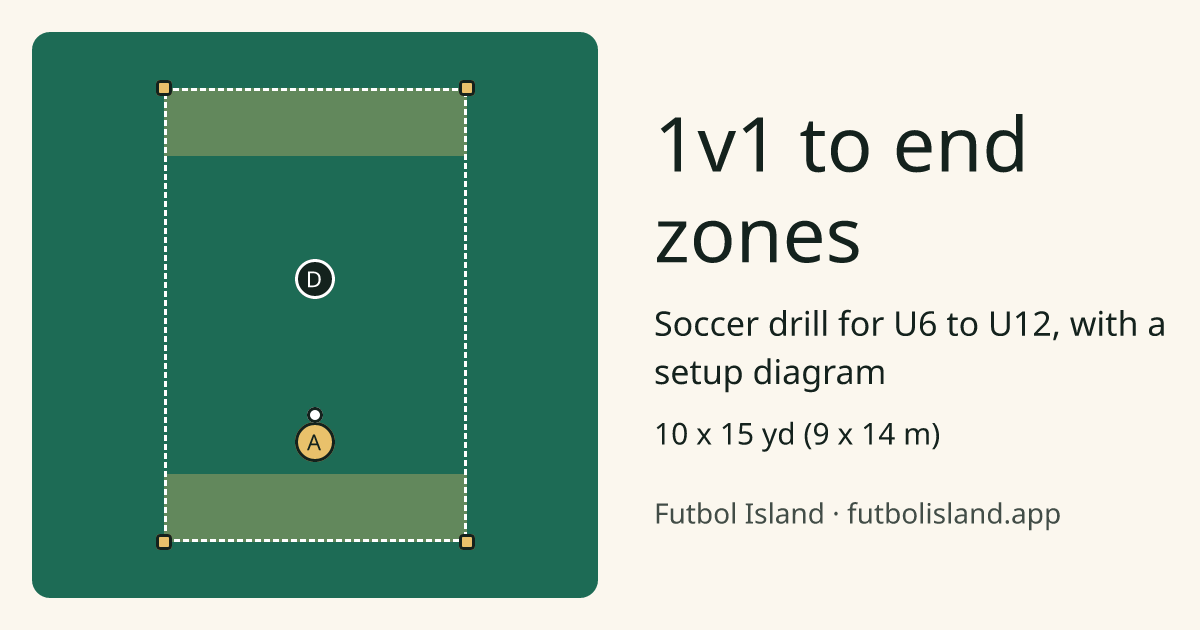
In 1v1 to end zones, an attacker tries to dribble past one defender and stop the ball inside a zone behind them. It trains taking a player on with a change of speed or direction, and for the defender, staying between the attacker and the line.
Soccer is called football in most of the world. This guide is part of Futbol Island’s free football lessons for kids aged 7 to 12.
1v1 to end zones: setup diagram
At a glance
| Detail | For this drill |
|---|---|
| Ages | U6 to U12 (ages 5 to 12) |
| Players | Pairs or groups of 4 per field; build several fields |
| Space | 10 x 15 yd (9 x 14 m) |
| Equipment | One ball and 8 cones per field |
| Time | 10 to 12 minutes, in turns of 30 to 45 seconds |
| Skill | 1v1 attacking |
Change the size of the area to fit your group: bigger makes it easier for the player with the ball, smaller makes it harder. Everyone who goes out comes straight back in, and nobody runs laps.
How to run it
- Build one small field for every two to four players, 10 yards wide and 15 long, with a 2-yard zone at each end.
- The defender passes to the attacker to start, then comes out to defend.
- The attacker scores by dribbling into the far end zone and stopping the ball there with the sole.
- If the defender wins the ball, they attack the other end zone at once.
- Play for 30 to 45 seconds, then rest while the other pair plays. Change opponents every few turns.
Coaching points to say out loud
- “Go at them with speed.”
- “Fake one way, go the other.”
- “Change of pace after the move.”
- “Protect the ball when they get close.”
Make it easier or harder
Easier
Make the field wider. For U6, the defender starts on their knees or must hold a ball in their hands.
Harder
Make the field narrower, or the attacker has only six seconds. Add a second attacker who can be used once as a wall.
Common mistakes
- One big field with two players and ten watching. Many small fields is the whole point.
- Slowing down in front of the defender and stopping. Attack the space beside them.
- Trying a trick too close. The move starts two yards away, before the defender can reach.
Why it matters in a game
Wingers and forwards face this every time they get the ball with one defender in front. Our lessons on carrying the ball and on making room for a one-against-one teach when to take it: watch which route the defender leaves open.
The lesson that teaches it: Carry or Pass?.
Do it at home
A parent makes a fine defender. Mark a line to reach, and the parent defends at half speed at first.
Questions about 1v1 to end zones
Why are 1v1 drills so important for kids?
Soccer is full of one-against-one moments, and a small 1v1 field gives a child many tries at attacking and defending in a few minutes.
What size is a 1v1 field?
About 10 by 15 yards for most ages. Wider helps the attacker and narrower helps the defender, so change it to keep the contest even.
What moves should I teach?
Start with one: a step to one side and a push of the ball to the other with the outside of the foot, then speed. One move done fast beats five done slowly.
Lessons that teach this idea
- Carry or Pass? (7v7 lesson)Watch which route the defender leaves open.
- Give Your Teammate Room to Dribble (7v7 lesson)The sole middle midfielder leaves room for a wide teammate to try a one-against-one, then reconnects after the dribble.
- Two Attackers: Commit the Defender (Futsal lesson)Carry at the lone defender, then choose the route their movement leaves.
Related drills and guides
- 1v1 to two small goals (drill)It trains changing direction to unbalance a defender, because the defender cannot guard both goals at once.
- 1v1 defending (drill)It trains the approach to the ball: fast at first, then slow, low and side on, steering the attacker to one side.
- Numbers game (drill)It trains 1v1 and 2v2 attacking and defending, with a race to the ball to start.
- Turn and go (drill)It trains the three basic turns, the drag-back, the inside hook and the outside hook, and the burst of speed that makes a turn work.
- Winger in soccerThe wide attacker who takes players on
- Nutmeg (soccer term)The ball played through a defender’s legs
- Tackle (soccer term)Winning the ball fairly with your foot
- U6 soccer drills: fun games for 5 and 6 year oldsNine games for 5 and 6 year olds, a ball each, with what to avoid
- U8 soccer drills for 7 and 8 year oldsTen drills for 7 and 8 year olds: dribbling, 1v1, first passing and 3v3
- U10 soccer drills for 9 and 10 year oldsTen drills for 9 and 10 year olds: rondos, first touch, 2v1 and first goalkeeping
- U12 soccer drills for 11 and 12 year oldsTen drills for 11 and 12 year olds: 4v2 rondos, possession, defending in pairs and finishing
- Soccer drills to do at homeSolo and parent-and-child drills for a yard, a driveway or a wall
- U8 soccer practice plan: first practice of the seasonA 60-minute plan that uses this drill
- U8 soccer practice plan: dribbling and 1v1A 60-minute plan that uses this drill
- All 1v1 attacking drillsTaking on one defender with a change of speed or direction.
Futbol Island is a free football (soccer) learning game for kids aged 7 to 12. Every idea on this page is taught on a pitch with moving players, then checked with a quick quiz.