3v3 small-sided soccer game for practice
A 3v3 small-sided game is a real game of soccer with three players on each team, two small goals and no goalkeepers. It trains everything at once, dribbling, passing, shooting and defending, and gives each child far more time on the ball than a big game.
Soccer is called football in most of the world. This guide is part of Futbol Island’s free football lessons for kids aged 7 to 12.
3v3 small-sided game: setup diagram
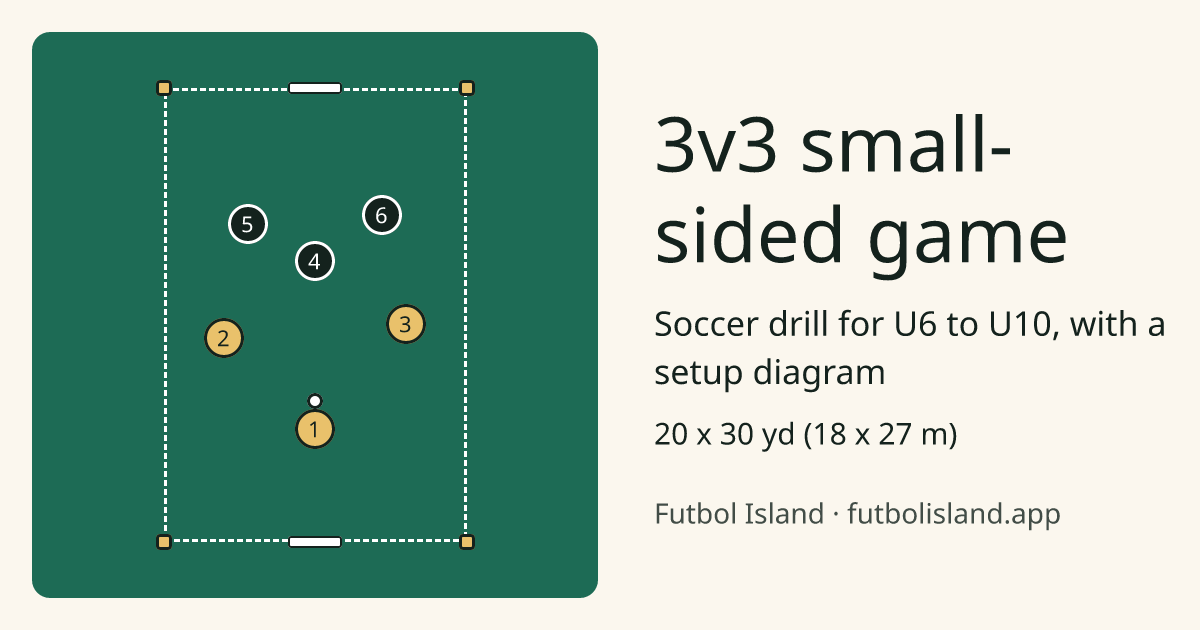
At a glance
| Detail | For this drill |
|---|---|
| Ages | U6 to U10 (ages 5 to 10) |
| Players | 6 per field, or 4 teams rotating on two fields |
| Space | 20 x 30 yd (18 x 27 m). For 4v4, U.S. Soccer’s standard field for U6 to U8 is 25 to 35 yards long and 15 to 25 yards wide |
| Equipment | One ball and spares; 2 small goals or 4 cones per field; bibs |
| Time | 15 to 20 minutes, in games of four or five minutes |
| Skill | Small-sided games |
Change the size of the area to fit your group: bigger makes it easier for the player with the ball, smaller makes it harder. Everyone who goes out comes straight back in, and nobody runs laps.
How to run it
- Mark a field about 20 yards wide and 30 long with a small goal at each end. Set up one field for every six to eight players.
- Play 3v3 with no goalkeepers. Start with a pass from the middle.
- When the ball goes out, restart with a pass or dribble in from the line, with defenders three steps away. No throw-ins or corners needed at practice.
- Play games of four or five minutes, then a water break, then change opponents.
- Coach during the breaks, not during play. Ask one question, such as “where can you stand so your teammate can pass to you?”
Coaching points to say out loud
- “Spread out when we have it.”
- “Can you go forward?”
- “Lost it? Get back between the ball and our goal.”
- “Help your teammate.”
Make it easier or harder
Easier
For U6, play 2v2 or 3v3 with wide cone goals, and let the bunch happen. It thins out with age.
Harder
A goal counts double after three passes, or add a third small goal so teams must switch the ball.
Common mistakes
- One big game of 7v7 at practice for under-8s. Half the players never touch the ball.
- Stopping the game every thirty seconds to coach.
- A goalkeeper standing still in a small goal. At these ages everyone plays out on the field.
Why it matters in a game
This is the game itself, shrunk to fit. Three players make the first triangle, which is why our 7v7 lessons on shape and on spreading out begin with the same picture: the player on the ball with a teammate on each side.
The lesson that teaches it: A Formation Gives Us Options.
Questions about 3v3 small-sided game
Why do coaches use 3v3 at practice?
With six players and one ball, everyone is always near the play. Children dribble, pass, shoot and defend many more times than in a big game.
What size is a 3v3 soccer field?
About 20 by 30 yards at practice. U.S. Soccer’s 4v4 game field for under-8s is 25 to 35 yards long and 15 to 25 yards wide.
Should there be goalkeepers in 3v3?
No. US small-sided games for under-8s have no goalkeepers, and small goals reward a pass into the goal over a long kick.
How do I handle an odd number of players?
Play 3v2 or 4v3 and give the smaller team the stronger players, or let one player be a “bonus” who plays for whichever team has the ball.
Lessons that teach this idea
- A Formation Gives Us Options (7v7 lesson)Use the jobs of the back line, midfield and forward to find a missing wide or supporting option.
- Make Room for Your Team (7v7 lesson)Spread into useful space so the player on the ball has another route.
- Step Out of the Blocked Lane (7v7 lesson)Move so the defender is no longer between you and the ball.
- Lost It? Protect the Middle (7v7 lesson)After losing the ball, protect a route to goal; approach when a teammate can cover.
Related drills and guides
- Four-goal game (drill)It trains switching play: when one goal is crowded, the team moves the ball to the open one.
- End zone game (drill)It trains forward passing and the timing of runs into space behind the defense.
- Numbers game (drill)It trains 1v1 and 2v2 attacking and defending, with a race to the ball to start.
- 1v1 to end zones (drill)It trains taking a player on with a change of speed or direction, and for the defender, staying between the attacker and the line.
- Soccer field size by ageField, goal and game length for each age group
- Soccer age groups explainedWhat U6, U8, U10 and U12 mean
- 7v7 soccer formationsShapes for U9 and U10 teams
- U6 soccer drills: fun games for 5 and 6 year oldsNine games for 5 and 6 year olds, a ball each, with what to avoid
- U8 soccer drills for 7 and 8 year oldsTen drills for 7 and 8 year olds: dribbling, 1v1, first passing and 3v3
- U10 soccer drills for 9 and 10 year oldsTen drills for 9 and 10 year olds: rondos, first touch, 2v1 and first goalkeeping
- U6 soccer practice plan: first practice of the seasonA 45-minute plan that uses this drill
- U6 soccer practice plan: dribblingA 45-minute plan that uses this drill
- All small-sided games drillsReal games with few players, so everyone is on the ball.
Futbol Island is a free football (soccer) learning game for kids aged 7 to 12. Every idea on this page is taught on a pitch with moving players, then checked with a quick quiz.