U6 soccer practice plan: first practice of the season
This 45-minute plan is for the very first practice with 5 and 6 year olds. It has one job: every child leaves smiling, having had a ball at their feet the whole time, and you leave knowing every name.
Soccer is called football in most of the world. This guide is part of Futbol Island’s free football lessons for kids aged 7 to 12.
At a glance
| Detail | This plan |
|---|---|
| Age group | U6 (ages 5 and 6) |
| Length | 45 minutes (guidance for U6: 45 minutes) |
| Players | 6 to 10 |
| Goal for the day | Meet the ball, meet each other |
| Final game | 4v4 with no goalkeepers, on about 30 x 20 yards |
The 45-minute plan
| Time | Activity | Stage | What it is for |
|---|---|---|---|
| 0:00 to 0:05 | Free play as children arrive | Welcome | Each child takes a ball and dribbles. Say hello to every child and every parent. |
| 0:05 to 0:12 | Simon Says with a ball | Play | Stopping the ball, listening and learning names. |
| 0:12 to 0:14 | Water break | Break | Drink. Ask who can remember two names. |
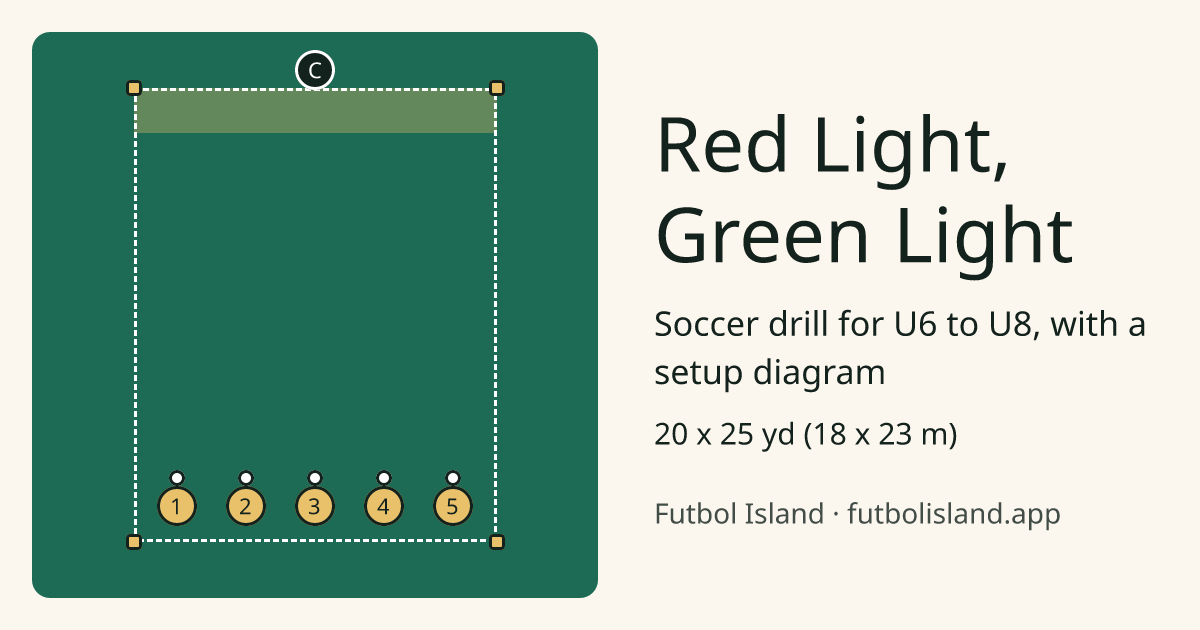
| 0:14 to 0:22 | Red Light, Green Light | Practice | Dribbling with small touches and stopping on the call. |
| 0:22 to 0:30 | Pirates and Treasure | Practice | Dribbling fast and stopping the ball in your ship. |
| 0:30 to 0:32 | Water break | Break | Drink. |
| 0:32 to 0:42 | 3v3 game with small goals | Play | A real game: two small fields if you have more than eight players. No positions. |
| 0:42 to 0:45 | Team cheer and one question | Finish | “What was your favorite game?” Tell parents when the next practice is. |
Times are minutes from the start of practice. Tap an activity for its setup diagram and coaching points.
Equipment
- A ball for every player
- About 20 cones
- Bibs in two colors
- A water bottle for every player
- A first aid kit and a ball pump
- 4 small goals, or 8 extra cones
Coach notes
- Explain each game in two sentences, then start. Fix the rules while they play.
- Kneel down when you talk, and keep it under thirty seconds.
- A child who does not want to join can watch with a ball at their feet. Most join within ten minutes.
- Ask one parent to help with the second small field.
If it is going badly
Children are wandering off or picking daisies.
Go straight to Sharks and Minnows with you as the shark. Being chased by the coach fixes almost everything at this age.
Give water breaks more often in hot weather, never use running as a punishment, and change the size of any area that is too hard or too easy.
How this plan is built
These plans follow the Play-Practice-Play structure that U.S. Soccer teaches grassroots coaches: players arrive and play small games, then practice the day’s idea in game-like activities, then finish with a game. The structure is U.S. Soccer’s; the minutes for each part are ours, so adjust them to your group.
To print this plan on one page, use your browser’s Print command.
Drills in this plan
- Simon Says with a ballIt trains stopping the ball, listening and balance, and it lets a new coach learn every name. U6 to U8.
- Red Light, Green LightIt trains keeping the ball close enough to stop it with the sole of the foot. U6 to U8.
- Pirates and TreasureIt trains dribbling at speed, turning with the ball and stopping it under control. U6 to U8.
- 3v3 small-sided gameIt trains everything at once, dribbling, passing, shooting and defending, and gives each child far more time on the ball than a big game. U6 to U10.
Questions about this U6 practice
What do I do at my first U6 soccer practice?
Learn names, give every child a ball and play simple games: Simon Says, Red Light Green Light and Pirates and Treasure. End with a short 3v3 game.
How long should a U6 practice be?
About 45 minutes, in line with US Youth Soccer’s coaching guidance for the age. Five- and six-year-olds have had enough after that.
What if some children have never played?
This plan assumes nobody has. Every game works for a child touching a soccer ball for the first time.
Lessons to share with your players
Keep reading
- U6 soccer practice plan: dribbling45 minutes: keep the ball close and go where the space is
- U6 soccer practice plan: kicking and shooting45 minutes: kick with the laces and score
- U6 soccer drills: fun games for 5 and 6 year oldsNine games for 5 and 6 year olds, a ball each, with what to avoid
- Soccer age groups explainedWhat U6, U8, U10 and U12 mean
- Soccer ball size by ageSize 3, 4 or 5 for each age group
- All soccer practice plans12 ready-to-use soccer practice plans for U6, U8, U10 and U12, each with a clock table, equipment list and linked drills
- All soccer drills for kids46 soccer drills and practice games for U6 to U12, each with a setup diagram, coaching points and the lesson it trains
Futbol Island is a free football (soccer) learning game for kids aged 7 to 12. Every idea on this page is taught on a pitch with moving players, then checked with a quick quiz.