Crossing and finishing soccer drill
Crossing and finishing is a drill in which a wide player dribbles down the side and plays a low cross or a cutback for two teammates who run to the near post and the far post. It trains the timing of runs into the goal area and a first-time finish with the foot.
Soccer is called football in most of the world. This guide is part of Futbol Island’s free football lessons for kids aged 7 to 12.
Crossing and finishing: setup diagram
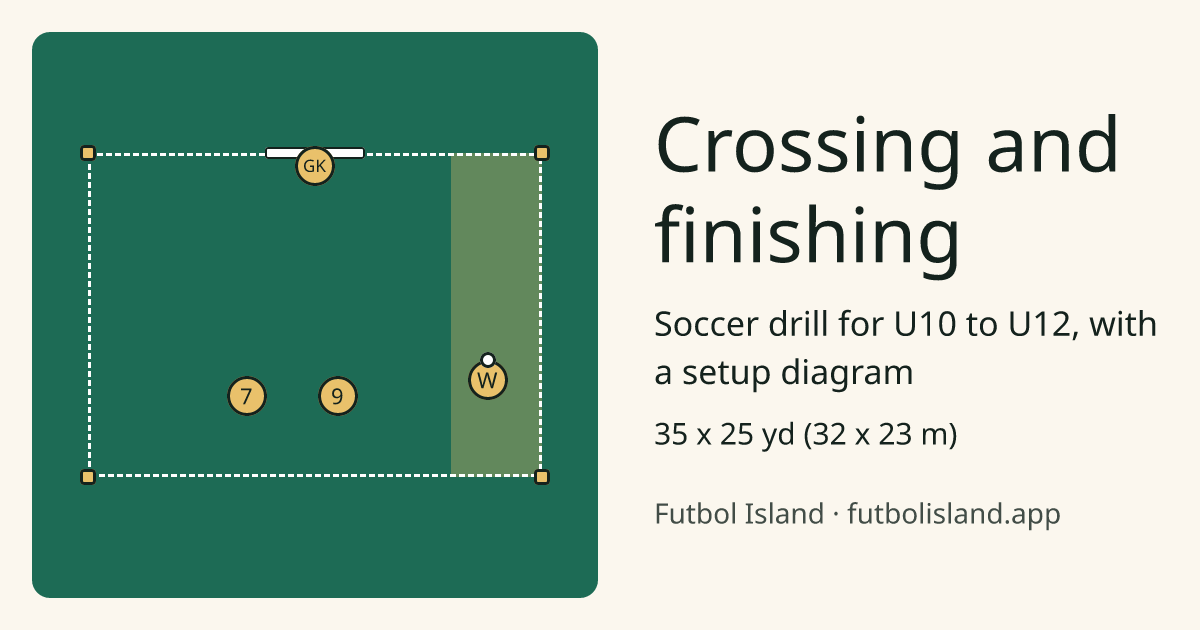
At a glance
| Detail | For this drill |
|---|---|
| Ages | U10 to U12 (ages 9 to 12) |
| Players | 6 to 12, in groups of 3 plus a goalkeeper |
| Space | 35 x 25 yd (32 x 23 m). Use the penalty area and wide channel of your own field if it is marked |
| Equipment | One goal; balls; cones for the wide channel and the start positions |
| Time | 12 to 15 minutes |
| Skill | Shooting and finishing |
Change the size of the area to fit your group: bigger makes it easier for the player with the ball, smaller makes it harder. Everyone who goes out comes straight back in, and nobody runs laps.
How to run it
- A wide player starts in the channel at the side. Two finishers start 20 yards from goal in the middle.
- The wide player dribbles toward the end line. That is the signal for the runs.
- One finisher sprints to the near post, the other arrives later at the far post. They must not run to the same place.
- The wide player looks up and plays a low pass across the goal, or pulls it back toward the penalty spot. The finish is with the foot, first time if possible.
- Rotate positions after each turn, and switch to the left side halfway through. All crosses stay on the ground or below knee height.
Coaching points to say out loud
- “Head up before you cross.”
- “One near, one far.”
- “Arrive, do not wait.”
- “Side foot, pass it into the goal.”
Make it easier or harder
Easier
The wide player crosses a still ball, and finishers start closer.
Harder
Add a defender who marks one runner, so the wide player must pick the free one. Add a third runner arriving late near the penalty spot for the cutback.
Common mistakes
- Both finishers standing in the goal area waiting. A moving target is far harder to mark.
- Crossing without looking, straight to the goalkeeper.
- High crosses. With under-11s there is no heading, and for all young players a low ball is easier to finish and to deliver.
Why it matters in a game
Many goals come from a ball played across the front of goal. Our lessons on the cut-back and on arriving at the far post explain why: defenders run toward their own goal, so the space opens behind them.
The lesson that teaches it: Look Behind the Defenders.
Questions about Crossing and finishing
Should young players practice heading crosses?
No. Players aged 10 and under do not head the ball in US youth soccer, and heading in practice is limited at 11 and 12. This drill uses low crosses finished with the foot.
What is a cutback?
A pass pulled backward from near the end line to a teammate arriving around the penalty spot. Defenders are running the other way, so it is hard to stop.
What are near-post and far-post runs?
The near post is the one closer to the ball. One attacker runs there and one to the far post, so the cross has two targets and the goalkeeper cannot cover both.
Lessons that teach this idea
- Look Behind the Defenders (11v11 lesson)Find the teammate, then check the route. A cut-back is useful only when that pass is there.
- Arrive at the Far Post (Futsal lesson)Time support across goal, and keep another option when that route is covered.
- Three Backs: Make the Outside Route (7v7 lesson)Without wide midfielders, an outside back can create width, then return inside when the forward route closes.
- Corner: Read the Cutback (Futsal lesson)Choose a corner delivery from the defender’s position, then read the next pressing movement.
Related drills and guides
- Lay-off and shoot (drill)It trains striking a ball that is rolling across or toward the shooter, and the set-up pass that makes a shot easy.
- 2v1 to goal (drill)It trains the main decision of attacking with an extra player: dribble at the defender, then pass if they come to you or keep going if they do not.
- Follow the shot (drill)It trains the habit of following in after every shot, so the attacker reaches the loose ball first.
- 3v2 to goal (drill)It trains finding the free player: the attackers must draw a defender to the ball and pass to the teammate left open.
- Cross (soccer term)A pass from wide into the goal area
- Cutback (soccer term)A pass pulled back from the end line
- Winger in soccerThe wide attacker who takes players on
- Heading rules for kids in the USNo heading at 10 and under
- U10 soccer drills for 9 and 10 year oldsTen drills for 9 and 10 year olds: rondos, first touch, 2v1 and first goalkeeping
- U12 soccer drills for 11 and 12 year oldsTen drills for 11 and 12 year olds: 4v2 rondos, possession, defending in pairs and finishing
- Soccer shooting drills for kidsShooting and finishing drills without long lines, for U6 to U12
- U12 soccer practice plan: shooting and finishingA 75-minute plan that uses this drill
- All shooting and finishing drillsStriking at goal, and what to do after the shot.
Futbol Island is a free football (soccer) learning game for kids aged 7 to 12. Every idea on this page is taught on a pitch with moving players, then checked with a quick quiz.