Recover goal-side: soccer defending drill
Recover goal-side is a drill in which an attacker dribbles toward a small goal while a defender, who starts level or just behind, sprints to get between the attacker and the goal. It trains the recovery run: running toward your own goal first and challenging only once you are goal-side.
Soccer is called football in most of the world. This guide is part of Futbol Island’s free football lessons for kids aged 7 to 12.
Recover goal-side: setup diagram
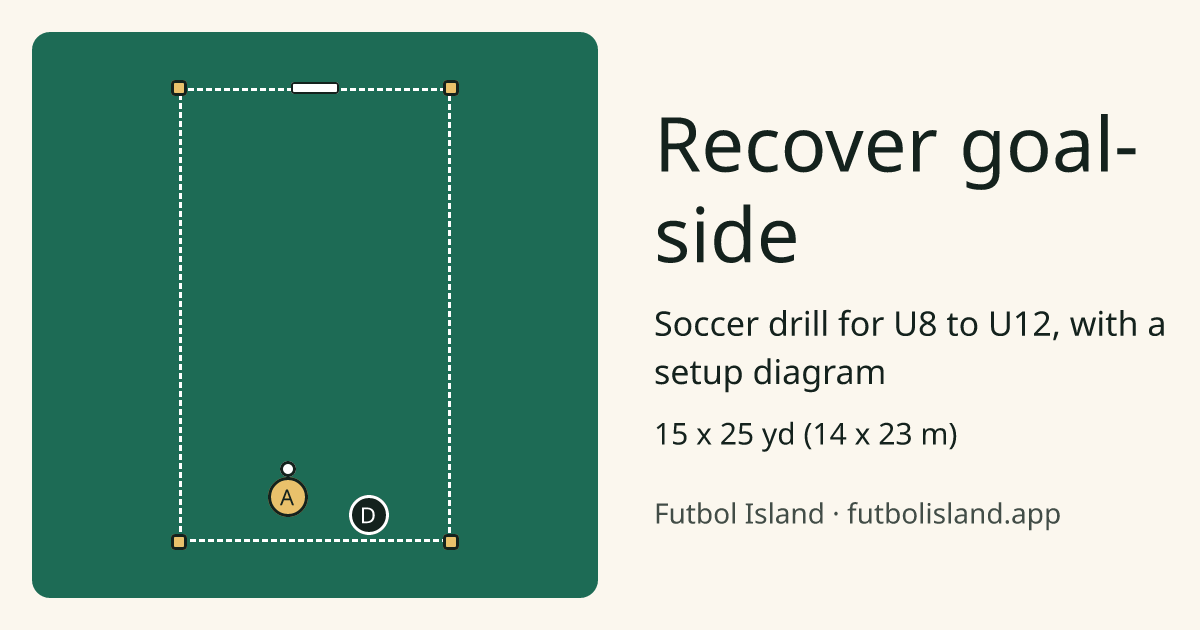
At a glance
| Detail | For this drill |
|---|---|
| Ages | U8 to U12 (ages 7 to 12) |
| Players | Groups of 4 |
| Space | 15 x 25 yd (14 x 23 m) |
| Equipment | One ball per pair; one small goal or cone goal; cones |
| Time | 10 minutes |
| Skill | 1v1 defending |
Change the size of the area to fit your group: bigger makes it easier for the player with the ball, smaller makes it harder. Everyone who goes out comes straight back in, and nobody runs laps.
How to run it
- A small goal on the end line. The attacker starts 25 yards out with the ball. The defender starts two yards to the side, level with them.
- The attacker’s first touch is the signal. The attacker dribbles to score, and must shoot from inside the last 8 yards.
- The defender does not chase the ball. They sprint toward the goal on the inside line, get ahead of the attacker and turn to face them.
- Once goal-side, the defender slows the attacker down and tries to win the ball.
- Move the defender’s start: beside, one yard behind, then two yards behind. Swap jobs every turn.
Coaching points to say out loud
- “Run to the goal, not to the ball.”
- “Get goal-side first.”
- “Then slow them down.”
- “No tackle from behind.”
Make it easier or harder
Easier
The defender starts a yard in front of the attacker.
Harder
Add a second attacker to make it 2v1 until the recovering defender arrives, with a second defender already in place.
Common mistakes
- Chasing the attacker’s heels. The defender never gets in front that way.
- Tackling from behind or from the side at full speed. It is a foul and it is dangerous.
- Giving up when beaten. A recovering defender who keeps running often gets a second chance.
Why it matters in a game
Every time a team loses the ball, somebody is on the wrong side of an attacker. Our recovery lessons teach the same order: recover toward goal when pressure cannot arrive, and challenge when the ball is there to win.
The lesson that teaches it: Lose It: Recover or Approach.
Questions about Recover goal-side
What does goal-side mean?
Standing between the attacker and your own goal. From there the attacker has to go through or around you to score.
What is a recovery run?
A sprint back toward your own goal after your team loses the ball, taking the shortest line to a position between the ball and the goal.
Why not just chase the ball?
Because a player dribbling straight is nearly as fast as the chaser, and a challenge from behind is often a foul. Getting in front solves both.
Lessons that teach this idea
- Lose It: Recover or Approach (9v9 lesson)Recover toward goal when pressure cannot arrive; approach when cover is ready.
- Can We Win It Back? (11v11 lesson)Challenge when the ball is there to win. If the chance has gone, get back and protect your goal.
- Stay Between the Ball and Goal (7v7 lesson)Move with the attacker while keeping yourself between the ball and your goal.
- Lost It? Protect the Middle (7v7 lesson)After losing the ball, protect a route to goal; approach when a teammate can cover.
Related drills and guides
- 1v1 defending (drill)It trains the approach to the ball: fast at first, then slow, low and side on, steering the attacker to one side.
- Pressure and cover 2v2 (drill)It trains defending together, and swapping the two jobs each time the ball is passed.
- 2v1 to goal (drill)It trains the main decision of attacking with an extra player: dribble at the defender, then pass if they come to you or keep going if they do not.
- Numbers game (drill)It trains 1v1 and 2v2 attacking and defending, with a race to the ball to start.
- Goal-side (soccer term)Between the attacker and your own goal
- Fullback in soccerThe defender on the side of the field
- Fouls and free kicksWhat a fair challenge looks like
- Counterattack (soccer term)Attacking fast after winning the ball
- U8 soccer drills for 7 and 8 year oldsTen drills for 7 and 8 year olds: dribbling, 1v1, first passing and 3v3
- U10 soccer drills for 9 and 10 year oldsTen drills for 9 and 10 year olds: rondos, first touch, 2v1 and first goalkeeping
- U12 soccer drills for 11 and 12 year oldsTen drills for 11 and 12 year olds: 4v2 rondos, possession, defending in pairs and finishing
- U10 soccer practice plan: 1v1 attacking and defendingA 60-minute plan that uses this drill
- All 1v1 defending drillsStaying goal-side, slowing the attacker and winning the ball.
Futbol Island is a free football (soccer) learning game for kids aged 7 to 12. Every idea on this page is taught on a pitch with moving players, then checked with a quick quiz.