Soccer fouls and free kicks: direct vs indirect
In soccer, a foul gives the other team a free kick from the place where it happened. A direct free kick can be shot straight into the goal, and an indirect free kick has to touch another player before a goal can count.
Soccer is called football in most of the world. This guide is part of Futbol Island’s free football lessons for kids aged 7 to 12.
Fouls and free kicks: diagram
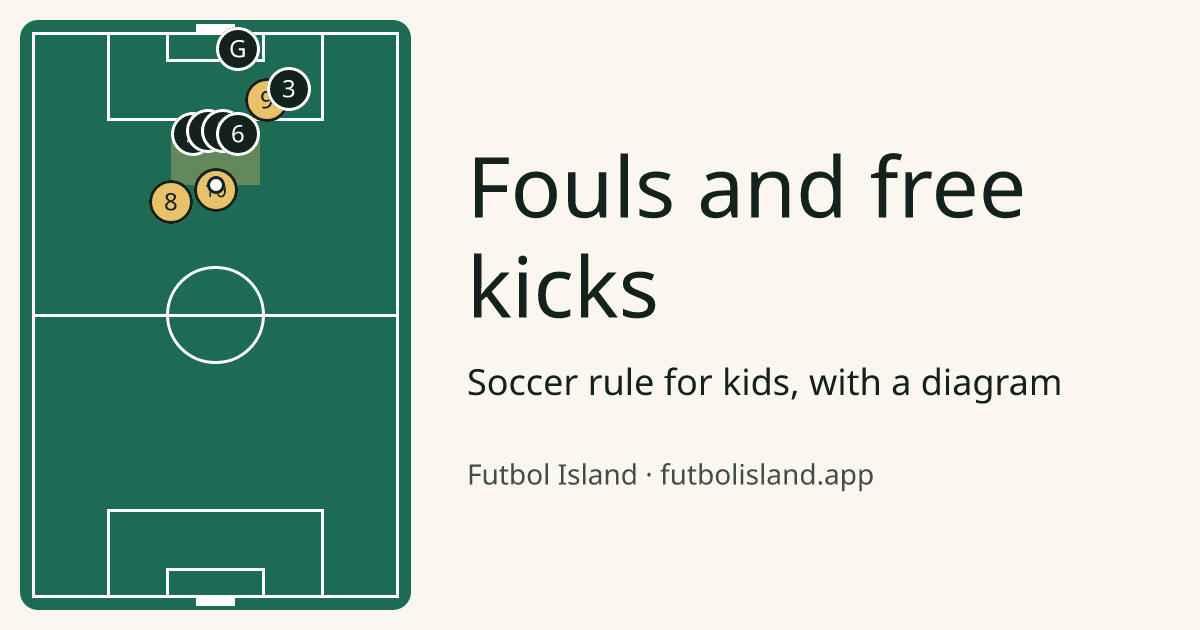
What the referee looks for
- Was the challenge careless, reckless or made with too much force? Careless is a foul, reckless is also a yellow card, too much force is a red card.
- The kind of foul. Kicking, tripping, pushing, charging, jumping at, striking, holding and handball give a direct free kick.
- Dangerous play with no contact, blocking an opponent’s way with no contact and stopping the goalkeeper from releasing the ball give an indirect free kick.
- The ball is still, and opponents are 9.15 m (10 yards) away until it is kicked.
- For an indirect free kick the referee keeps one arm straight up until the ball touches another player.
Rule: Laws 12 and 13. Read it in the Laws of the Game (The IFAB).
Common mix-ups
“They got the ball, so it is not a foul.”
Touching the ball first does not make a careless or reckless challenge fair. The referee judges how the challenge was made.
“Indirect means you cannot shoot.”
You can shoot, but a goal only counts if the ball touched another player from either team on the way.
“You must wait for the whistle.”
A team may take a quick free kick. If the kicking team asks for the 10 yards, the referee makes everyone wait for a signal.
“A high foot is always a foul.”
It is an indirect free kick only when it is dangerous to someone nearby. Contact with an opponent makes it a direct free kick.
In 7v7, 9v9, 11v11 and futsal
| Game | How the rule works |
|---|---|
| 7v7 | In the U.S. Soccer standards a deliberate header and a goalkeeper’s punt each give the other team an indirect free kick. Your league may add its own changes. |
| 9v9 and 11v11 | Laws 12 and 13 in full. A direct free kick foul by a defender inside their own penalty area is a penalty kick. |
| Futsal | Direct free kick fouls are counted for each team in each period. From a team’s sixth, the other team shoots from the 10 m mark with no wall. Free kicks are taken within four seconds, with opponents 5 m away. |
These are the Laws of the Game and typical US youth standards. Your league may differ, so check its rules. Sources: IFAB Laws of the Game (current edition), U.S. Soccer small-sided standards, US Youth Soccer playing rules (December 2025) and the FIFA Futsal Laws of the Game 2025-26. Checked on November 10, 2026.
Questions about fouls and free kicks
What is the difference between a direct and an indirect free kick?
A direct free kick can score without anyone else touching the ball. An indirect free kick must touch a second player first. If it goes straight in, the other team gets a goal kick.
How do I know a free kick is indirect?
The referee raises one arm straight up and keeps it there until the kick has been taken and the ball touches another player or goes out of play.
How far back does the wall have to be?
At least 9.15 metres, which is 10 yards, from the ball. In futsal the distance is 5 metres.
Is a slide tackle a foul?
Not by itself in the Laws of the Game. It is a foul if it is careless, reckless or uses too much force. Youth leagues can add their own rule about slide tackles, so check yours.
Lessons that go with this rule
- Wide Free Kick: Release the Wall at the Right Time (11v11 lesson)At a free kick the wall waits ten yards away (Law 13). Once a short kick moves, one wall player presses while everyone else keeps their job.
- Free-Kick: Keep a Safety Player (Futsal lesson)Coordinate the restart with a player who can collect the return and protect a counterattack.
- Can We Win It Back? (11v11 lesson)Challenge when the ball is there to win. If the chance has gone, get back and protect your goal.
- Stay Between the Ball and Goal (7v7 lesson)Move with the attacker while keeping yourself between the ball and your goal.
Keep reading
- Museum: Free kicks and the wallThe history, in the History Museum (1872)
- Center back in soccerThe defender in the middle of the back line
- Defensive midfielder in soccerThe player who protects the middle
- Goalkeeper in soccerThe one player who may use their hands
- Soccer penalty kick rules for kidsLaw 14, with a diagram
- Yellow and red cards in soccer, explained for kidsLaw 12, with a diagram
- All soccer rules for kids16 rules explained for kids, each with a diagram: offside, handball, throw-ins and more
- Soccer terms for kids: an A-Z glossary92 soccer words in plain English, from advantage to yellow card, 18 with a diagram
Futbol Island is a free football (soccer) learning game for kids aged 7 to 12. Every idea on this page is taught on a pitch with moving players, then checked with a quick quiz.
Play the lesson: Wide Free Kick: Release the Wall at the Right Time