Soccer penalty kick rules for kids
In soccer, a penalty kick is given when a defender commits a direct free kick foul, such as a trip, a push or a handball, inside their own penalty area. One attacker shoots from the penalty mark, 12 yards from the goal, with only the goalkeeper to beat.
Soccer is called football in most of the world. This guide is part of Futbol Island’s free football lessons for kids aged 7 to 12.
Penalty kick: diagram
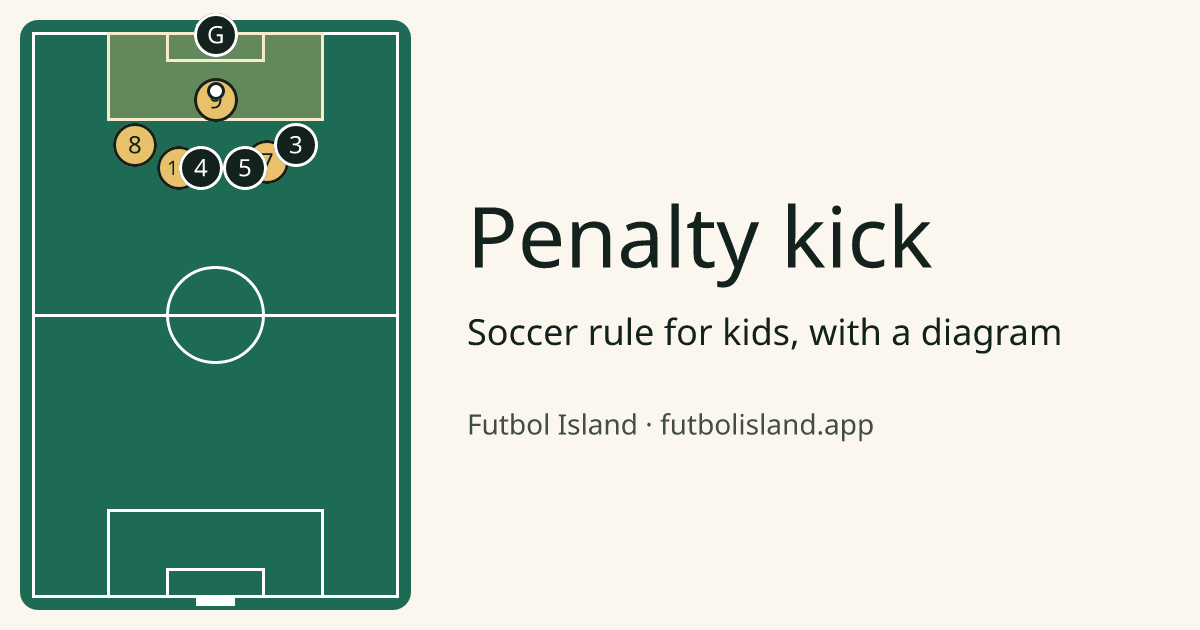
What the referee looks for
- The goalkeeper has at least part of one foot on, in line with or behind the goal line when the ball is kicked.
- Everyone else is outside the penalty area, outside the arc and behind the penalty mark.
- The ball is kicked forward.
- The kicker does not stop at the end of the run-up to fake the kick. Changing speed during the run-up is allowed.
- The kicker does not touch the ball a second time before another player touches it.
Rule: Law 14. Read it in the Laws of the Game (The IFAB).
Common mix-ups
“Any foul in the box is a penalty.”
Only a direct free kick foul by the defending team. An indirect free kick offence, such as a goalkeeper picking up a pass back, stays an indirect free kick.
“The kicker can score the rebound off the post.”
Not without another player touching the ball first. A rebound from the goalkeeper is different: the kicker may play it.
“The keeper cannot move before the kick.”
The keeper may move along the goal line. One foot has to be on or level with the line at the moment of the kick.
“A penalty kick and a penalty shoot-out are the same.”
A penalty kick happens during the game, and play goes on after a save. A shoot-out is a separate way to decide a tied cup game: five kicks each, taken in turns.
In 7v7, 9v9, 11v11 and futsal
| Game | How the rule works |
|---|---|
| 7v7 and 9v9 | The same rule on a smaller field, with a smaller penalty area and the mark closer to the goal. The exact distance is in your league’s field rules. |
| 11v11 | The mark is 11 m (12 yards) from the goal line. |
| Futsal | The penalty mark is 6 m from the goal. A second mark at 10 m is used for the free kick after a team’s sixth foul in a period. |
These are the Laws of the Game and typical US youth standards. Your league may differ, so check its rules. Sources: IFAB Laws of the Game (current edition), U.S. Soccer small-sided standards, US Youth Soccer playing rules (December 2025) and the FIFA Futsal Laws of the Game 2025-26. Checked on November 10, 2026.
Questions about penalty kick
How far is a penalty kick in soccer?
On a full-size field the penalty mark is 11 metres from the goal line, which is 12 yards. Smaller youth fields put it closer.
Can the goalkeeper come off the line on a penalty?
When the ball is kicked, at least part of one foot must be touching the goal line, in line with it or behind it. After the kick the keeper is free to move.
Can you pass a penalty kick?
Yes. The ball has to be kicked forward, and a teammate who started outside the penalty area may run on to it. The kicker cannot touch it again first.
What happens if the penalty hits the post?
Play goes on. Anyone may play the ball except the kicker, who has to wait until another player has touched it.
Who invented the penalty kick?
The penalty kick joined the Laws in 1891. Our History Museum exhibit tells the story.
Lessons that go with this rule
- Watch What Happens After the Shot (7v7 lesson)A wide midfielder reads a loose rebound or a goalkeeper’s controlled ball before deciding whether to approach or recover.
- Keeper: Defend the Goal or the Space (Futsal lesson)Adjust the goalkeeper’s depth to the attacker’s threat and whether a defender still provides cover.
- Stay Between the Ball and Goal (7v7 lesson)Move with the attacker while keeping yourself between the ball and your goal.
Keep reading
- Museum: The penalty kickThe history, in the History Museum (1891)
- Goalkeeper in soccerThe one player who may use their hands
- Striker in soccerThe player who times runs behind the defense
- Center back in soccerThe defender in the middle of the back line
- Yellow and red cards in soccer, explained for kidsLaw 12, with a diagram
- The back-pass rule in soccer, explained for kidsLaw 12, with a diagram
- All soccer rules for kids16 rules explained for kids, each with a diagram: offside, handball, throw-ins and more
- Soccer terms for kids: an A-Z glossary92 soccer words in plain English, from advantage to yellow card, 18 with a diagram
Futbol Island is a free football (soccer) learning game for kids aged 7 to 12. Every idea on this page is taught on a pitch with moving players, then checked with a quick quiz.