Yellow and red cards in soccer, explained for kids
In soccer, a yellow card is a warning and a red card sends a player off for the rest of the game. Two yellow cards for the same player in one game make a red card, and the team plays on with one player fewer.
Soccer is called football in most of the world. This guide is part of Futbol Island’s free football lessons for kids aged 7 to 12.
Yellow and red cards: diagram
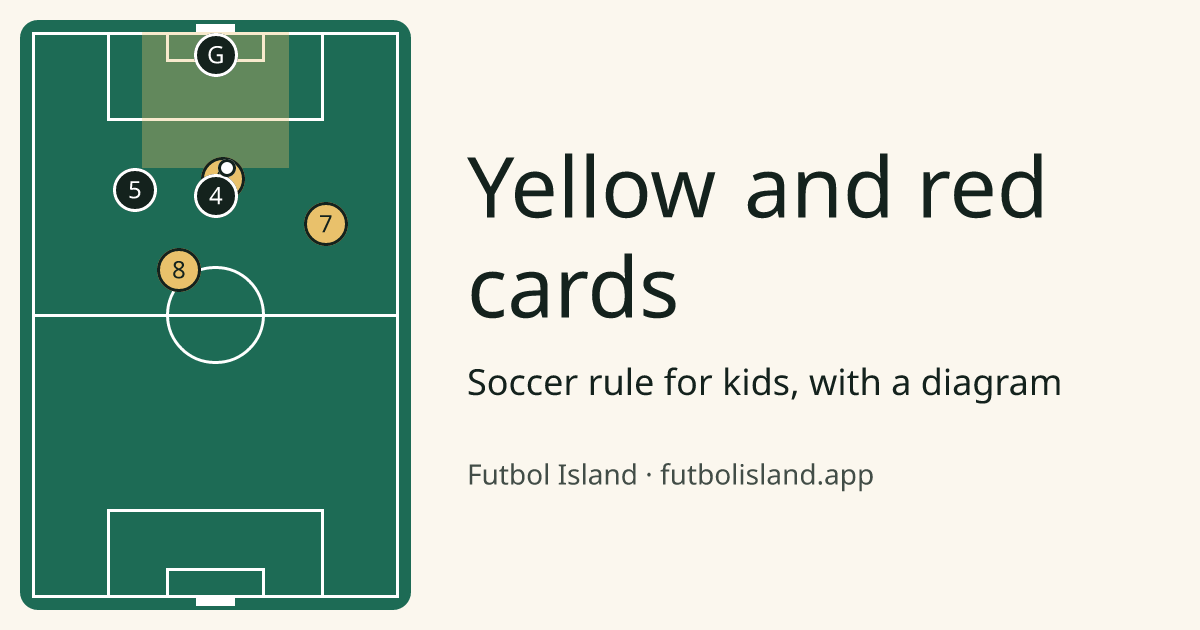
What the referee looks for
- Yellow: a reckless foul, stopping a promising attack with a foul, arguing with the referee, delaying a restart, not giving the distance at a free kick, pretending to be fouled.
- Yellow: fouls that keep happening from the same player.
- Red: a foul with far too much force (serious foul play), violent conduct, spitting or biting, insulting or abusive language.
- Red: stopping a goal or an obvious chance to score with a handball or a foul.
- A second yellow card in the same game.
Rule: Law 12. Read it in the Laws of the Game (The IFAB).
Common mix-ups
“A yellow card means you sit out.”
In the Laws of the Game the player stays on the field. Some youth leagues use short time-outs called sin bins, which the Laws allow for grassroots soccer.
“The last defender always gets a red.”
There is no last-defender rule. The referee asks whether an obvious chance to score was stopped. Inside the penalty area, a real try for the ball that gives away a penalty is a yellow card.
“A red card player can be replaced.”
No. The team plays with one player fewer for the rest of the game.
“Cards are only for fouls.”
Cards are also for behavior: arguing, wasting time and unsporting acts.
In 7v7, 9v9, 11v11 and futsal
| Game | How the rule works |
|---|---|
| 7v7 and 9v9 | The same cards exist, but referees of young players usually talk first. Ask your league what happens after a card, such as missing the next game. |
| 11v11 | Law 12 in full. |
| Futsal | Yellow and red cards are used in futsal too, and direct free kick fouls also count toward the team’s foul total. |
These are the Laws of the Game and typical US youth standards. Your league may differ, so check its rules. Sources: IFAB Laws of the Game (current edition), U.S. Soccer small-sided standards, US Youth Soccer playing rules (December 2025) and the FIFA Futsal Laws of the Game 2025-26. Checked on November 10, 2026.
Questions about yellow and red cards
How many yellow cards make a red card?
Two in the same game. The referee shows the second yellow card and then the red card.
Can a goalkeeper get a red card?
Yes. A goalkeeper can be sent off like any other player. Every team must have a goalkeeper, so another player goes in goal and the team plays one short.
Does the referee stop the game to show a card?
Not always. If the fouled team has a good attack, the referee can play advantage and show the card at the next stop.
Can VAR change a card?
Where video assistant referees are used, they can check straight red cards and a card shown to the wrong player. An ordinary yellow card is not one of the things they review.
Lessons that go with this rule
- Can We Win It Back? (11v11 lesson)Challenge when the ball is there to win. If the chance has gone, get back and protect your goal.
- Stay Between the Ball and Goal (7v7 lesson)Move with the attacker while keeping yourself between the ball and your goal.
- Who Goes, Who Helps? (11v11 lesson)Decide together. One player puts pressure on the ball; another looks after the next danger.
Keep reading
- Museum: The video assistant refereeThe history, in the History Museum (2018)
- Museum: The first LawsThe history, in the History Museum (1863)
- Center back in soccerThe defender in the middle of the back line
- Defensive midfielder in soccerThe player who protects the middle
- Goalkeeper in soccerThe one player who may use their hands
- The back-pass rule in soccer, explained for kidsLaw 12, with a diagram
- The build-out line in 7v7 soccer, explainedU.S. Soccer 7v7 standards, with a diagram
- All soccer rules for kids16 rules explained for kids, each with a diagram: offside, handball, throw-ins and more
- Soccer terms for kids: an A-Z glossary92 soccer words in plain English, from advantage to yellow card, 18 with a diagram
Futbol Island is a free football (soccer) learning game for kids aged 7 to 12. Every idea on this page is taught on a pitch with moving players, then checked with a quick quiz.