The back-pass rule in soccer, explained for kids
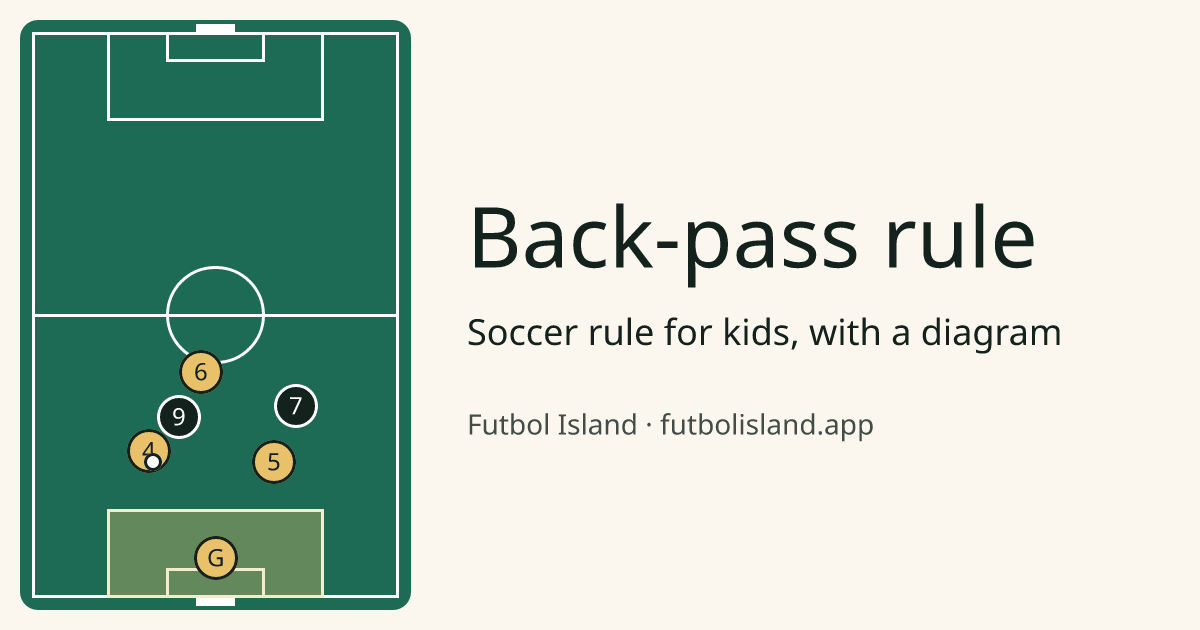
In soccer, the goalkeeper may not touch the ball with the hands when a teammate deliberately kicks it to them or throws it to them from a throw-in. The goalkeeper has to play that ball with the feet, and picking it up gives the other team an indirect free kick.
Soccer is called football in most of the world. This guide is part of Futbol Island’s free football lessons for kids aged 7 to 12.
Back-pass rule: diagram
What the referee looks for
- Was the ball kicked with the foot? The rule is about a kick, and about a throw-in.
- Was it deliberate, and was it meant for the goalkeeper? A miskick or a deflection is not a back-pass.
- Did the goalkeeper then touch it with a hand or arm inside the penalty area?
- How long the goalkeeper holds the ball: more than eight seconds in the hands gives the other team a corner kick.
- Tricks to get around the rule, such as flicking the ball up to head it back, are not allowed.
Rule: Law 12. Read it in the Laws of the Game (The IFAB).
Common mix-ups
“You cannot pass back to the keeper.”
You can, and good teams do it all the time. The keeper just has to use the feet.
“A header back is a back-pass.”
No. A teammate may head, chest or knee the ball to the goalkeeper, and the keeper may pick it up.
“It is a penalty if the keeper picks it up.”
It is an indirect free kick from where the keeper handled the ball. Inside the goal area it is taken from the goal area line.
“The keeper can hold the ball as long as they like.”
The current Laws give eight seconds. After that the other team gets a corner kick.
In 7v7, 9v9, 11v11 and futsal
| Game | How the rule works |
|---|---|
| 7v7 | The same rule. In the U.S. Soccer standards the 7v7 goalkeeper also may not punt or drop-kick, so passing with the feet starts early. |
| 9v9 and 11v11 | Law 12 in full. |
| Futsal | Stricter. After playing the ball, the goalkeeper may not touch it again in their own half from a teammate’s deliberate pass until an opponent has touched it. The keeper also has only four seconds on the ball in their own half. |
These are the Laws of the Game and typical US youth standards. Your league may differ, so check its rules. Sources: IFAB Laws of the Game (current edition), U.S. Soccer small-sided standards, US Youth Soccer playing rules (December 2025) and the FIFA Futsal Laws of the Game 2025-26. Checked on November 10, 2026.
Questions about back-pass rule
Can a goalkeeper pick up a back-pass?
Not when a teammate deliberately kicks it to them. The keeper may pick up a ball that a teammate heads or chests back, or one that comes off a teammate by accident.
Can the goalkeeper pick up a throw-in?
Not a throw-in taken by a teammate and thrown straight to them. The keeper has to use the feet.
What does the referee give for a back-pass?
An indirect free kick to the other team, from the place where the goalkeeper touched the ball with the hands.
Why does the back-pass rule exist?
It keeps the game moving: a goalkeeper cannot simply pick the ball up every time a teammate passes back. It also means goalkeepers learn to pass, which our lessons practise.
Lessons that go with this rule
- Your Keeper Can Help (7v7 lesson)Pass back to your keeper when the way is clear. The keeper must play it with their feet, not hands. If it's covered, pick another teammate.
- Build With the Goalkeeper (9v9 lesson)Use the goalkeeper to connect around pressure, then change the plan if that lane closes.
- Keeper at Feet: Create the Spare Player (Futsal lesson)Use a goalkeeper’s fresh possession to draw a presser and release an outfield teammate.
- 2-3-3: Keep the Midfield Three Ahead (9v9 lesson)After a short goal kick, the keeper supports two backs without sacrificing the central link in a midfield three.
Keep reading
- Museum: The goalkeeper’s handsThe history, in the History Museum (1912)
- Goalkeeper in soccerThe one player who may use their hands
- Center back in soccerThe defender in the middle of the back line
- 2-3-1 formation (7v7)How a 7v7 team sets up on a goal kick
- The build-out line in 7v7 soccer, explainedU.S. Soccer 7v7 standards, with a diagram
- Soccer kick-off rules for kidsLaw 8, with a diagram
- All soccer rules for kids16 rules explained for kids, each with a diagram: offside, handball, throw-ins and more
- Soccer terms for kids: an A-Z glossary92 soccer words in plain English, from advantage to yellow card, 18 with a diagram
Futbol Island is a free football (soccer) learning game for kids aged 7 to 12. Every idea on this page is taught on a pitch with moving players, then checked with a quick quiz.