The build-out line in 7v7 soccer, explained
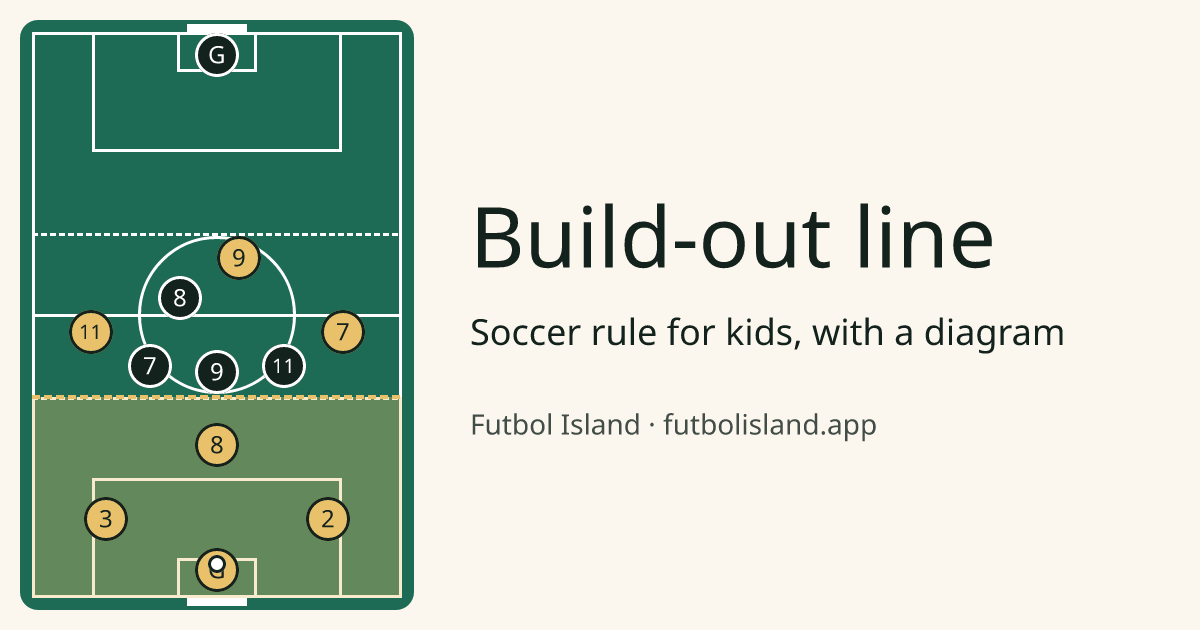
The build-out line is a line across a 7v7 soccer field, halfway between the penalty area and the halfway line, used for under-9 and under-10 games in the United States. When the goalkeeper has the ball in the hands or the team has a goal kick, the other team waits behind it until the ball is put into play.
Soccer is called football in most of the world. This guide is part of Futbol Island’s free football lessons for kids aged 7 to 12.
Build-out line: diagram
What the referee looks for
- Every opponent is behind the build-out line before the goal kick is taken or the goalkeeper lets go of the ball.
- The goalkeeper passes, throws or rolls the ball. Punts and drop kicks are not allowed in 7v7.
- Once the ball is put into play, the other team may cross the line and play goes on as normal.
- Offside: a player cannot be offside between the halfway line and the build-out line.
- A goalkeeper who punts gives the other team an indirect free kick.
Rule: U.S. Soccer 7v7 standards. Read it in the Laws of the Game (The IFAB).
Common mix-ups
“The other team has to wait until a defender touches the ball.”
No. They may cross when the ball is in play: on a goal kick, when it is kicked and clearly moves; from the hands, when the keeper releases it.
“The goalkeeper has to wait for everyone to drop back.”
The keeper may play quickly if they want to. Then the other team may challenge straight away.
“It is used in every youth game.”
It belongs to 7v7 for U9 and U10 in the U.S. Soccer standards. 9v9 and 11v11 do not use it, and other countries have their own rules.
“The line is always in the same place.”
U.S. Soccer puts it halfway between the penalty area and the halfway line. Fields differ in size, so the distance from the goal differs too.
In 7v7, 9v9, 11v11 and futsal
| Game | How the rule works |
|---|---|
| 7v7 | Used in the U.S. Soccer standards for U9 and U10, and by AYSO. Our lessons use AYSO’s build-out rules as the example. |
| 9v9 and 11v11 | No build-out line. Opponents only have to leave the penalty area on a goal kick. |
| Futsal | No build-out line. Opponents leave the penalty area for a goal clearance. |
| England | The FA’s youth formats are different and do not use this U.S. Soccer line. Check The FA’s rules for your age group. |
These are the Laws of the Game and typical US youth standards. Your league may differ, so check its rules. Sources: IFAB Laws of the Game (current edition), U.S. Soccer small-sided standards, US Youth Soccer playing rules (December 2025) and the FIFA Futsal Laws of the Game 2025-26. Checked on November 10, 2026.
Questions about build-out line
What is the build-out line in soccer?
A line across each half of a 7v7 field, between the penalty area and the halfway line. It gives the team with the ball room to pass out from its goal.
When can the other team cross the build-out line?
As soon as the ball is put into play. On a goal kick that is when the ball is kicked and clearly moves.
Can you be offside behind the build-out line?
A player cannot be penalized for offside between the halfway line and the build-out line. Between the build-out line and the goal line, offside counts.
Why can’t the goalkeeper punt in 7v7?
The U.S. Soccer standards want young teams to learn to pass out from the back, so punts and drop kicks are not allowed at U9 and U10.
What age uses the build-out line?
Under-9 and under-10 teams playing 7v7 in the United States. From under-11, in 9v9, it is gone.
Lessons that go with this rule
- Goal Kick & Build-Out Line (7v7 lesson)On our goal kick, the other team waits behind the build-out line. Once the ball is kicked and moves, they can come and press.
- Which Line Matters? (7v7 lesson)In many 7v7 leagues (like AYSO), you can't be called offside until you pass the far build-out line. Past it, offside counts, so time your run.
- Your Keeper Can Help (7v7 lesson)Pass back to your keeper when the way is clear. The keeper must play it with their feet, not hands. If it's covered, pick another teammate.
- Meet Your Team (7v7 lesson)Recognize the goalkeeper and three lines of teammates, then adjust your midfield role as the ball changes sides.
Keep reading
- 7v7 soccer formationsThe shapes for U9 and U10 teams
- 2-3-1 formation (7v7)How a 7v7 team sets up on a goal kick
- Goalkeeper in soccerThe one player who may use their hands
- Soccer field size by ageField, goal and penalty area sizes for each age group
- Soccer kick-off rules for kidsLaw 8, with a diagram
- The drop ball in soccer, explained for kidsLaw 8, with a diagram
- All soccer rules for kids16 rules explained for kids, each with a diagram: offside, handball, throw-ins and more
- Soccer terms for kids: an A-Z glossary92 soccer words in plain English, from advantage to yellow card, 18 with a diagram
Futbol Island is a free football (soccer) learning game for kids aged 7 to 12. Every idea on this page is taught on a pitch with moving players, then checked with a quick quiz.