The drop ball in soccer, explained for kids
In soccer, a drop ball restarts the game when the referee has stopped play for something that is not a foul, such as an injury or the ball hitting the referee. The referee drops the ball for one player of the team that had it, and everyone else stands at least 4.5 yards away.
Soccer is called football in most of the world. This guide is part of Futbol Island’s free football lessons for kids aged 7 to 12.
Drop ball: diagram
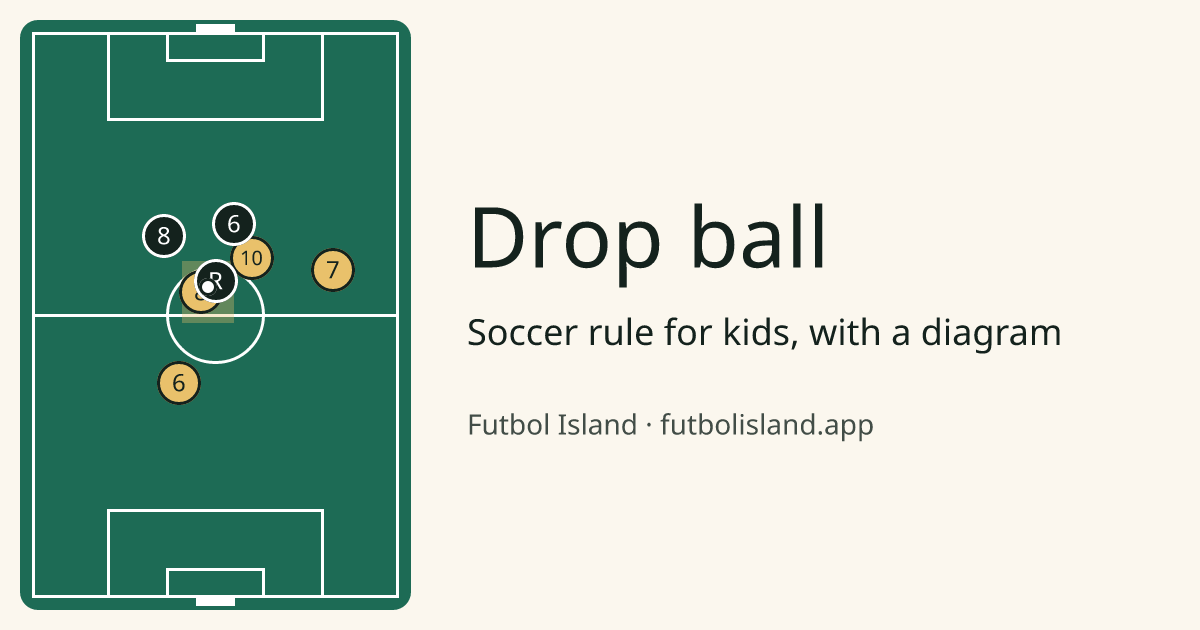
What the referee looks for
- Which team had the ball, or would have had it, when play stopped. That team gets the drop.
- Where the ball was. Inside a penalty area it is always dropped for that team’s goalkeeper.
- Everyone else, teammates too, is at least 4 m (4.5 yards) away.
- The ball touches the ground before anyone plays it.
- A goal only counts after the ball has touched at least two players.
Rule: Law 8. Read it in the Laws of the Game (The IFAB).
Common mix-ups
“Two players fight for a drop ball.”
Not any more. The ball is dropped for one player, and nobody may challenge until it hits the ground.
“You have to give the ball back.”
Giving the ball back was a kind habit under the old rule. Now the team that had the ball simply keeps it.
“The ball hit the referee, so play on.”
Not always. If the ball touches the referee, stays on the field and then goes into the goal, changes which team has it or starts a promising attack, play restarts with a drop ball.
In 7v7, 9v9, 11v11 and futsal
| Game | How the rule works |
|---|---|
| 7v7, 9v9 and 11v11 | The same rule in every size of game. On a small field the 4.5 yards is a big part of the field, so players need to back away quickly. |
These are the Laws of the Game and typical US youth standards. Your league may differ, so check its rules. Sources: IFAB Laws of the Game (current edition), U.S. Soccer small-sided standards, US Youth Soccer playing rules (December 2025) and the FIFA Futsal Laws of the Game 2025-26. Checked on November 10, 2026.
Questions about drop ball
When is there a drop ball in soccer?
When the referee stops play and the Laws give no other restart: for example a serious injury, a burst ball, or the ball hitting the referee in a way that changes the game.
Who gets the drop ball?
One player of the team that had the ball or would have had it. If nobody can tell, it goes to the team that touched it last. In a penalty area it goes to the defending goalkeeper.
Can you score from a drop ball?
Only after the ball has touched at least two players. If it goes straight into the other team’s goal, it is a goal kick.
How far away do you stand at a drop ball?
At least 4 metres, which is about 4.5 yards, until the ball touches the ground.
Lessons that go with this rule
- A Goal Kick Needs Two Options (11v11 lesson)Give your goalkeeper choices. Read the opponent before deciding where the pass should go.
- Kick-In: Have a Backup (Futsal lesson)Prepare two options before the restart, then use the one the defender leaves.
- Win It: Look, Then Choose (9v9 lesson)After gaining possession, use a clear forward advantage or secure the ball.
Keep reading
- Museum: The first LawsThe history, in the History Museum (1863)
- Goalkeeper in soccerThe one player who may use their hands
- Central midfielder in soccerThe link player in the middle of the field
- Football rules lessons for kidsThe lessons that teach the rules on a moving pitch
- The advantage rule in soccer, explained for kidsLaw 5, with a diagram
- Soccer substitutions and game length by ageLaws 3 and 7, with a diagram
- All soccer rules for kids16 rules explained for kids, each with a diagram: offside, handball, throw-ins and more
- Soccer terms for kids: an A-Z glossary92 soccer words in plain English, from advantage to yellow card, 18 with a diagram
Futbol Island is a free football (soccer) learning game for kids aged 7 to 12. Every idea on this page is taught on a pitch with moving players, then checked with a quick quiz.