The advantage rule in soccer, explained for kids
In soccer, the referee plays advantage when a team is fouled but would be better off if the game kept going, for example because it still has the ball and a clear attack. If that benefit does not come within a few seconds, the referee stops play and gives the free kick after all.
Soccer is called football in most of the world. This guide is part of Futbol Island’s free football lessons for kids aged 7 to 12.
Advantage: diagram
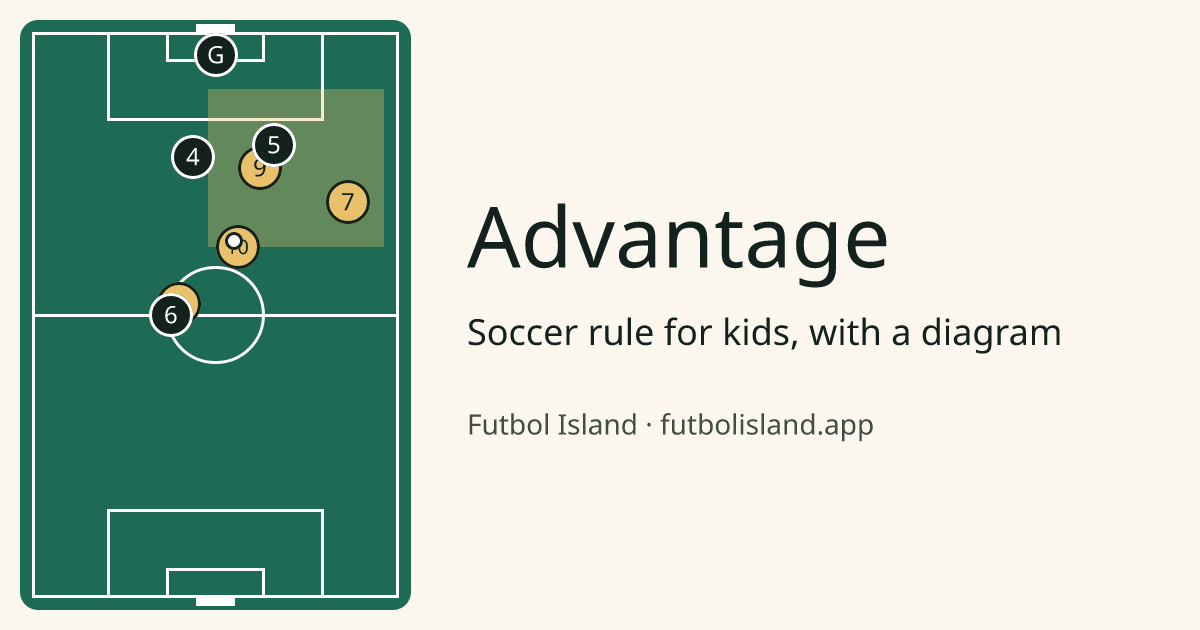
What the referee looks for
- Does the fouled team still have the ball, or get it straight away?
- Is the chance better than a free kick would be? Close to the other goal the answer is often yes.
- How bad the foul was. For serious foul play the referee normally stops the game unless there is a clear chance to score.
- The next few seconds: if the advantage disappears, the referee goes back to the free kick.
- A card that is still owed. It is shown the next time play stops.
Rule: Law 5. Read it in the Laws of the Game (The IFAB).
Common mix-ups
“The referee missed that foul.”
Often the referee saw it and chose to let play go on, because stopping would have helped the team that fouled.
“If you play advantage, the foul is forgotten.”
A yellow or red card can still be shown at the next stop in play.
“You get the advantage and then the free kick too.”
The referee only goes back if the advantage does not happen within a few seconds. A bad pass later on does not bring the free kick back.
In 7v7, 9v9, 11v11 and futsal
| Game | How the rule works |
|---|---|
| All formats | The same idea in 7v7, 9v9 and 11v11. With the youngest players, referees stop more often to explain and to keep everyone safe. |
| Futsal | Advantage is played in futsal too. A direct free kick foul still counts toward the team’s fouls for that period when the referee lets play go on. |
These are the Laws of the Game and typical US youth standards. Your league may differ, so check its rules. Sources: IFAB Laws of the Game (current edition), U.S. Soccer small-sided standards, US Youth Soccer playing rules (December 2025) and the FIFA Futsal Laws of the Game 2025-26. Checked on November 10, 2026.
Questions about advantage
What does “play on” mean in soccer?
It means the referee saw a foul and is letting the game continue, because stopping would hurt the team that was fouled.
How long does advantage last?
The Laws say the referee can go back to the foul if the benefit does not come “at that time or within a few seconds”.
Can you get a card after advantage?
Yes. If the foul deserved a yellow or red card, the referee shows it when the ball next goes out of play.
Should young players stop when they are fouled?
No. Keep playing until you hear the whistle. Our lessons teach the same habit after winning the ball: look forward first.
Lessons that go with this rule
- Win It: Look, Then Choose (9v9 lesson)After gaining possession, use a clear forward advantage or secure the ball.
- Win It: Attack or Keep It (Futsal lesson)After gaining possession, use an advantage when it is available.
- Can We Win It Back? (11v11 lesson)Challenge when the ball is there to win. If the chance has gone, get back and protect your goal.
Keep reading
- Museum: The first LawsThe history, in the History Museum (1863)
- Striker in soccerThe player who times runs behind the defense
- Central midfielder in soccerThe link player in the middle of the field
- Football rules lessons for kidsThe lessons that teach the rules on a moving pitch
- Soccer substitutions and game length by ageLaws 3 and 7, with a diagram
- Soccer heading rules for kids in the USU.S. Soccer and US Youth Soccer rules, with a diagram
- All soccer rules for kids16 rules explained for kids, each with a diagram: offside, handball, throw-ins and more
- Soccer terms for kids: an A-Z glossary92 soccer words in plain English, from advantage to yellow card, 18 with a diagram
Futbol Island is a free football (soccer) learning game for kids aged 7 to 12. Every idea on this page is taught on a pitch with moving players, then checked with a quick quiz.