Busy square: heads-up soccer dribbling drill
Busy square is a drill in which every player dribbles a ball inside a crowded square, avoiding the others, and reacts to signals from the coach. It trains dribbling with the head up, because a player who only looks at the ball will bump into someone.
Soccer is called football in most of the world. This guide is part of Futbol Island’s free football lessons for kids aged 7 to 12.
Busy square dribbling: setup diagram
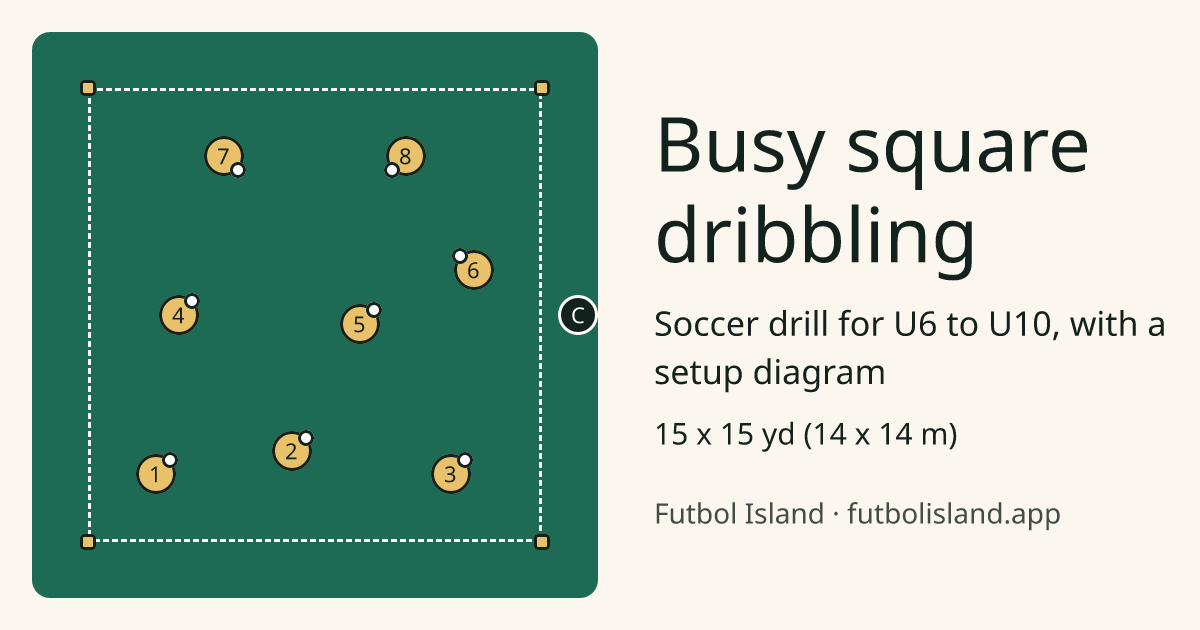
At a glance
| Detail | For this drill |
|---|---|
| Ages | U6 to U10 (ages 5 to 10) |
| Players | 6 to 16, one ball each |
| Space | 15 x 15 yd (14 x 14 m) |
| Equipment | One ball per player; cones in two colors |
| Time | 6 to 8 minutes |
| Skill | Scanning and awareness |
Change the size of the area to fit your group: bigger makes it easier for the player with the ball, smaller makes it harder. Everyone who goes out comes straight back in, and nobody runs laps.
How to run it
- Everyone dribbles inside the square, in any direction, without touching another player or ball.
- The coach holds up a cone without speaking. One color means stop with the sole, the other means turn and go the other way.
- Add voice signals: “swap” means leave your ball and take someone else’s, and “out” means dribble around any corner cone and back in.
- Make the square smaller every minute.
- Finish with a count: the coach holds up fingers for one second, and players shout the number while they dribble.
Coaching points to say out loud
- “Eyes up.”
- “Find the space.”
- “Small touches in a crowd.”
- “See it, then go.”
Make it easier or harder
Easier
A bigger square and only one signal.
Harder
Two players without a ball try to steal one, and whoever loses a ball steals another. Nobody is ever out.
Common mistakes
- A square so big that nobody needs to look up.
- Too many signals at once. Add one at a time.
- Praising speed. Here the best player is the one who never bumps.
Why it matters in a game
A midfield is a busy square. A player who can dribble while seeing other players can find the gap, and our lesson on spreading out shows where teammates should be so the gap is there to find.
The lesson that teaches it: Look, Then Turn or Return.
Questions about Busy square dribbling
How do I teach kids to dribble with their head up?
Give them a reason to look: other players to avoid and silent signals to spot. Telling them “head up” works far less well than a game that needs it.
How big should the square be?
Start with about 15 by 15 yards for ten players, then shrink it. It should feel crowded but not impossible.
Is this a warm-up or a drill?
Both. It makes a good first activity because every player has a ball and it needs no explanation.
Lessons that teach this idea
Related drills and guides
- Gates dribbling (drill)It trains dribbling with the head up, because players must look for a gate that is open.
- Dribble tag (drill)It warms players up while training dribbling with the head up and quick changes of direction.
- Shoulder check colors (drill)It trains scanning: taking a look away from the ball so the player knows what is around them before they receive it.
- Knockout (drill)It trains shielding, dribbling with the head up and winning the ball.
- Central midfielder in soccerThe link player who receives on the turn
- Soccer age groups explainedWhat U6, U8, U10 and U12 mean
- U6 soccer drills: fun games for 5 and 6 year oldsNine games for 5 and 6 year olds, a ball each, with what to avoid
- U8 soccer drills for 7 and 8 year oldsTen drills for 7 and 8 year olds: dribbling, 1v1, first passing and 3v3
- U10 soccer drills for 9 and 10 year oldsTen drills for 9 and 10 year olds: rondos, first touch, 2v1 and first goalkeeping
- Soccer dribbling drills for kidsBall mastery, ball-each games, turns and 1v1 for every age
- U8 soccer practice plan: first practice of the seasonA 60-minute plan that uses this drill
- All scanning and awareness drillsLooking around before the ball arrives.
Futbol Island is a free football (soccer) learning game for kids aged 7 to 12. Every idea on this page is taught on a pitch with moving players, then checked with a quick quiz.