Cone weave dribbling soccer drill
The cone weave is a dribbling drill in which a player zigzags through a row of cones, touching the ball with the inside and outside of the foot. It trains close control and changing direction, the skill a player needs to carry the ball past a defender.
Soccer is called football in most of the world. This guide is part of Futbol Island’s free football lessons for kids aged 7 to 12.
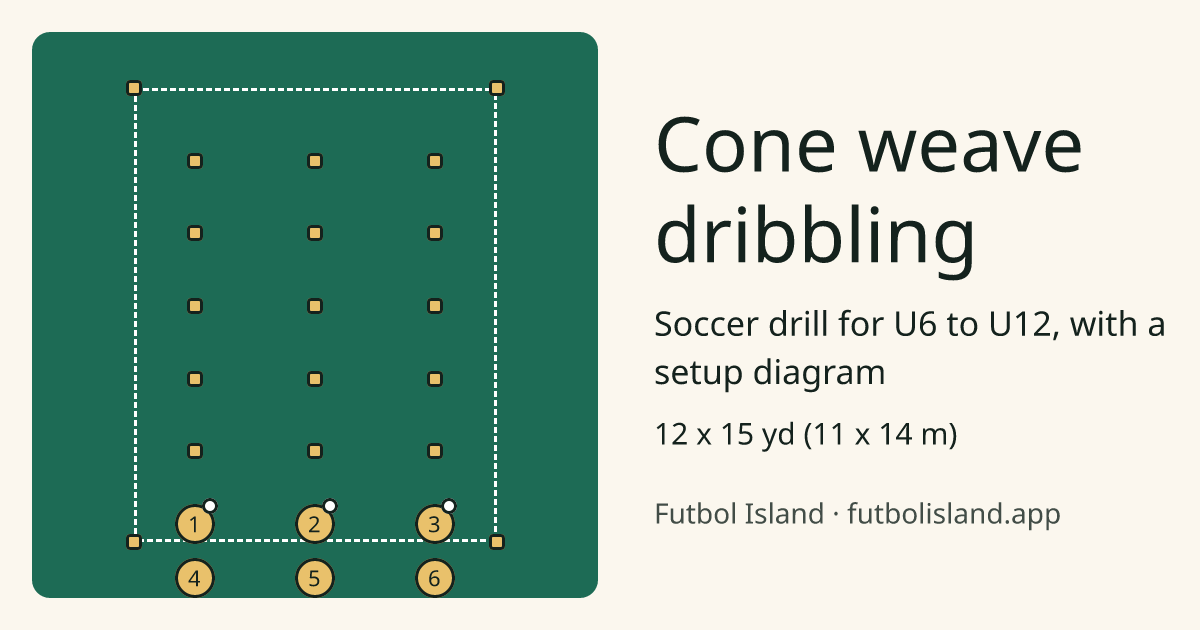
Cone weave dribbling: setup diagram
At a glance
| Detail | For this drill |
|---|---|
| Ages | U6 to U12 (ages 5 to 12) |
| Players | 2 or 3 per lane; make as many lanes as you need |
| Space | 12 x 15 yd (11 x 14 m). Each lane is about 3 yards wide, with cones 2 yards apart |
| Equipment | 5 or 6 cones per lane; one ball per player |
| Time | 8 to 10 minutes |
| Skill | Dribbling and ball mastery |
Change the size of the area to fit your group: bigger makes it easier for the player with the ball, smaller makes it harder. Everyone who goes out comes straight back in, and nobody runs laps.
How to run it
- Set out several short lanes of cones, 2 yards apart, so no more than three players share a lane.
- The first player weaves through the cones, then dribbles back down the outside of the lane.
- The next player starts as soon as the first one reaches the third cone. Nobody waits long.
- Round one: any foot. Round two: right foot only. Round three: left foot only. Round four: inside of one foot, then outside of the same foot.
- Finish with a relay: each lane counts how many full trips it makes in two minutes.
Coaching points to say out loud
- “Small touches.”
- “Ball close, like it is on a string.”
- “Use the outside of your foot too.”
- “Look up between cones.”
Make it easier or harder
Easier
Spread the cones to 3 yards apart, or let players dribble around only two cones in a figure of eight.
Harder
Close the cones to 1 yard, or put the cones in a zigzag instead of a line. Ask for a burst of speed after the last cone, because beating a defender is not finished until you run away from them.
Common mistakes
- One long lane with ten children waiting. Short lanes with two or three players keep everyone working.
- Big touches that send the ball wide of the cones. Take one touch per step near the cones.
- Always using the strong foot. Count a round only if the weak foot touched the ball.
Why it matters in a game
A cone does not move, so this drill only builds the tool. In a game the “cone” is a defender who steps one way, and the player with the ball goes the other way. Follow the weave with a 1v1 game the same day, and use our lesson on carrying the ball to show players how to read which side is open.
The lesson that teaches it: Carry or Pass?.
Do it at home
Works in a yard, a driveway or a hallway with a soft ball. Use shoes or water bottles as cones. Time ten trips, rest, and try to beat the time.
Questions about Cone weave dribbling
How far apart should cones be for dribbling?
About 2 yards (two big steps) for most players aged 7 to 12. Use 3 yards for beginners and 1 yard for a hard challenge.
How do I stop kids waiting in line?
Build more lanes. Three players per lane is the most you want, and the next player starts when the one in front is halfway.
Is the cone weave good for under-6 players?
In small doses. Five- and six-year-olds learn more from games with a story, such as Sharks and Minnows, so keep the weave short and turn it into a race.
Lessons that teach this idea
- Carry or Pass? (7v7 lesson)Watch which route the defender leaves open.
- Give Your Teammate Room to Dribble (7v7 lesson)The sole middle midfielder leaves room for a wide teammate to try a one-against-one, then reconnects after the dribble.
- Two Attackers: Commit the Defender (Futsal lesson)Carry at the lone defender, then choose the route their movement leaves.
Related drills and guides
- Gates dribbling (drill)It trains dribbling with the head up, because players must look for a gate that is open.
- Toe taps and foundations (drill)They train balance, quick feet and a soft touch, so the ball stays close when a player dribbles.
- Turn and go (drill)It trains the three basic turns, the drag-back, the inside hook and the outside hook, and the burst of speed that makes a turn work.
- 1v1 to end zones (drill)It trains taking a player on with a change of speed or direction, and for the defender, staying between the attacker and the line.
- Winger in soccerThe wide attacker who takes players on
- Nutmeg (soccer term)The ball played through a defender’s legs
- U6 soccer drills: fun games for 5 and 6 year oldsNine games for 5 and 6 year olds, a ball each, with what to avoid
- U8 soccer drills for 7 and 8 year oldsTen drills for 7 and 8 year olds: dribbling, 1v1, first passing and 3v3
- U10 soccer drills for 9 and 10 year oldsTen drills for 9 and 10 year olds: rondos, first touch, 2v1 and first goalkeeping
- U12 soccer drills for 11 and 12 year oldsTen drills for 11 and 12 year olds: 4v2 rondos, possession, defending in pairs and finishing
- Soccer drills to do at homeSolo and parent-and-child drills for a yard, a driveway or a wall
- All dribbling and ball mastery drillsOne ball each: lots of touches, turns and changes of speed.
Futbol Island is a free football (soccer) learning game for kids aged 7 to 12. Every idea on this page is taught on a pitch with moving players, then checked with a quick quiz.