Wall passing soccer drill
Wall passing is a solo drill in which a player passes the ball against a wall and controls the rebound, again and again. It trains a firm, accurate pass and a clean first touch with both feet, because the wall always gives the ball back.
Soccer is called football in most of the world. This guide is part of Futbol Island’s free football lessons for kids aged 7 to 12.
Wall passing: setup diagram
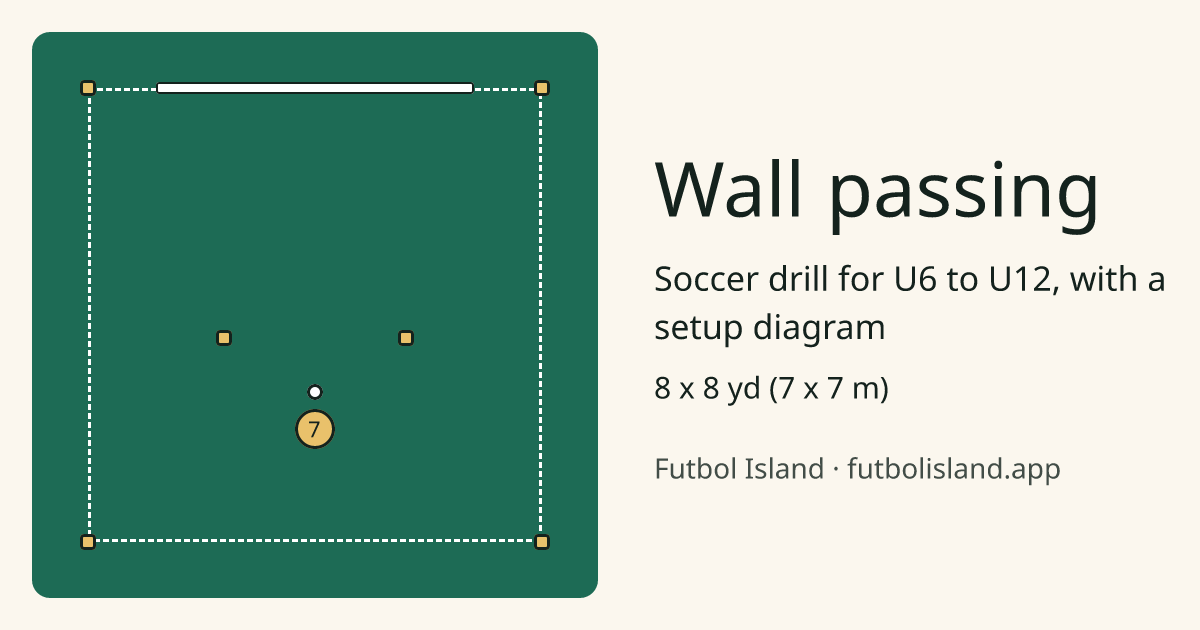
At a glance
| Detail | For this drill |
|---|---|
| Ages | U6 to U12 (ages 5 to 12) |
| Players | 1, or 2 taking turns |
| Space | 8 x 8 yd (7 x 7 m). Stand 3 to 6 yards from the wall |
| Equipment | One ball; a solid wall with no windows; chalk or tape for a target |
| Time | 10 minutes |
| Skill | Passing and receiving |
Change the size of the area to fit your group: bigger makes it easier for the player with the ball, smaller makes it harder. Everyone who goes out comes straight back in, and nobody runs laps.
How to run it
- Stand 3 yards from the wall. Pass with the inside of the foot and stop the rebound with the inside of the other foot. Twenty passes.
- Two touches: control with one foot, pass with the other. Then swap which foot does which job.
- One touch: pass the rebound straight back. Count the longest run without a mistake.
- Step back to 5 or 6 yards and hit a chalk target the size of a ball.
- First touch to the side: let the rebound come across your body, take it sideways past a cone with your first touch, and pass with the second.
Coaching points to say out loud
- “Standing foot points at the target.”
- “Lock your ankle.”
- “On your toes before it comes back.”
- “Both feet.”
Make it easier or harder
Easier
Stand closer, pass softer and stop the ball completely before the next pass.
Harder
One touch only, alternate feet, or pass from the side at an angle so the rebound makes you move.
Common mistakes
- Leaning back, which lifts the ball. Stay over the ball and strike through its middle.
- Flat feet while waiting. Bounce on your toes so you can adjust to the rebound.
- Only using the strong foot. Count the weak foot’s passes separately and try to match them.
Why it matters in a game
Every pass in a game is one of these: a firm ball to a target, and a first touch that sets up the next action. The wall is also the “wall” of a wall pass, or give-and-go, which our one-two lesson teaches with a moving teammate.
The lesson that teaches it: Look, Then Turn or Return.
Do it at home
This drill is made for home. Use a garage wall, a school wall or a rebound net, and a softer ball if neighbors are near. Ten minutes a day is enough to see a change in a few weeks.
Questions about Wall passing
How far from the wall should I stand?
Three yards to begin, so the rebound is gentle. Move back to five or six yards as your pass gets firmer.
How long should a child do wall passing?
About ten minutes. Short, regular sessions beat one long one, and the drill only works while the player is concentrating.
What if we have no wall?
A parent can be the wall: pass the ball back first time to the child’s feet. A bench turned on its side or a rebound net also works.
Lessons that teach this idea
- Look, Then Turn or Return (7v7 lesson)Look for pressure before receiving. Turn into room or give the ball back.
- A Wall Pass, or Keep It (7v7 lesson)Use a teammate to go around pressure, but check whether the return is still open.
- A Return Pass Is a Choice (9v9 lesson)Time a support run and use the return only when the defender leaves its lane open.
Related drills and guides
- Receive across the body (drill)It trains an open body shape, so the player can see the whole field and play forward with the second touch.
- Give-and-go (drill)It trains the wall pass, also called the one-two: the timing of the first pass, the sprint and the one-touch return.
- Toe taps and foundations (drill)They train balance, quick feet and a soft touch, so the ball stays close when a player dribbles.
- First touch gates (drill)It trains a first touch that moves the ball away from pressure into space, not one that stops it dead.
- First touch (soccer term)The touch you take as the ball arrives
- Give-and-go (soccer term)Pass, run past the defender, get it back
- Soccer ball size by ageSize 3, 4 or 5 for each age group
- U6 soccer drills: fun games for 5 and 6 year oldsNine games for 5 and 6 year olds, a ball each, with what to avoid
- U8 soccer drills for 7 and 8 year oldsTen drills for 7 and 8 year olds: dribbling, 1v1, first passing and 3v3
- U10 soccer drills for 9 and 10 year oldsTen drills for 9 and 10 year olds: rondos, first touch, 2v1 and first goalkeeping
- U12 soccer drills for 11 and 12 year oldsTen drills for 11 and 12 year olds: 4v2 rondos, possession, defending in pairs and finishing
- Soccer drills to do at homeSolo and parent-and-child drills for a yard, a driveway or a wall
- All passing and receiving drillsPassing to a teammate, then moving to help again.
Futbol Island is a free football (soccer) learning game for kids aged 7 to 12. Every idea on this page is taught on a pitch with moving players, then checked with a quick quiz.