Triangle passing soccer drill
Triangle passing is a drill in which four players pass a ball around three cones set in a triangle, and each player follows their pass to the next cone. It trains passing to the correct foot, an open body shape and moving right after the pass.
Soccer is called football in most of the world. This guide is part of Futbol Island’s free football lessons for kids aged 7 to 12.
Triangle passing: setup diagram
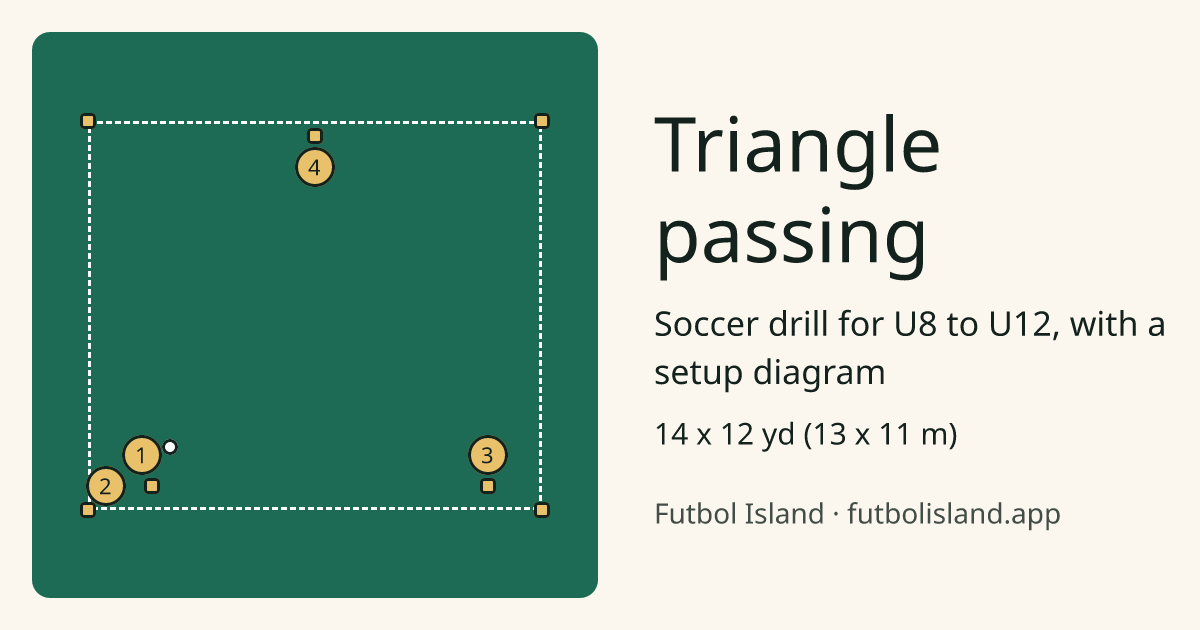
At a glance
| Detail | For this drill |
|---|---|
| Ages | U8 to U12 (ages 7 to 12) |
| Players | Groups of 4 |
| Space | 14 x 12 yd (13 x 11 m) |
| Equipment | One ball and 3 cones per group |
| Time | 8 to 10 minutes |
| Skill | Passing and receiving |
Change the size of the area to fit your group: bigger makes it easier for the player with the ball, smaller makes it harder. Everyone who goes out comes straight back in, and nobody runs laps.
How to run it
- Set three cones in a triangle with sides of 10 yards. Two players start at the first cone, one at each of the others.
- The first player passes to the second cone and runs after the pass to that cone.
- The receiver opens up, takes a first touch around the cone with the back foot, and passes to the third cone, then follows.
- Keep the ball moving for one minute, then change direction so the other foot does the work.
- Progress to one touch where possible, then to a one-two with the player at the next cone before passing on.
Coaching points to say out loud
- “Pass to the back foot.”
- “Open your body.”
- “Follow your pass at speed.”
- “Firm passes on the ground.”
Make it easier or harder
Easier
Shorten the sides to 6 yards and allow as many touches as needed.
Harder
Add a second ball for a group of five, or put a passive defender on one cone so the receiver must check away and come back to get free.
Common mistakes
- Groups of eight on one triangle. Four players means everybody touches the ball every few seconds.
- Receiving with the back to the next cone, so every pass needs an extra touch.
- Walking after the pass. The run is half the drill.
Why it matters in a game
Triangles are the shape of support: the player on the ball with one teammate to each side. Our lessons on support and spreading out teach how to make those angles in a game, when the cones are gone and defenders stand in the way.
The lesson that teaches it: Step Out of the Blocked Lane.
Questions about Triangle passing
Why do coaches talk about triangles?
Because a player with a teammate on each side always has two passes. Three players in a triangle are hard to defend with one or two defenders.
How big should the triangle be?
About 10 yards a side for U10 and U12, and 6 to 8 yards for U8. The pass should arrive firmly without being hard to control.
Is this better than a rondo?
It is a step before it. The triangle has no defender, so use it briefly to set habits, then move to a 3v1 rondo where the same passes are made under pressure.
Lessons that teach this idea
- Step Out of the Blocked Lane (7v7 lesson)Move so the defender is no longer between you and the ball.
- Move Out of the Passing Shadow (9v9 lesson)Move to change the passing lane, then read the defender again.
- Look, Then Turn or Return (7v7 lesson)Look for pressure before receiving. Turn into room or give the ball back.
- Use the Next Teammate (11v11 lesson)A third player helps when the direct pass is covered. You don’t need an extra pass when it’s already open.
Related drills and guides
- Rondo 3v1 (drill)It trains quick passing, support on both sides of the ball and a first touch away from pressure.
- Receive across the body (drill)It trains an open body shape, so the player can see the whole field and play forward with the second touch.
- Give-and-go (drill)It trains the wall pass, also called the one-two: the timing of the first pass, the sprint and the one-touch return.
- Partner passing through gates (drill)It trains accurate passing with the inside of the foot and moving to a new place after every pass.
- Central midfielder in soccerThe link player who receives on the turn
- 7v7 soccer formationsShapes for U9 and U10 teams
- Switching play (soccer term)Moving the ball to the empty side
- U8 soccer drills for 7 and 8 year oldsTen drills for 7 and 8 year olds: dribbling, 1v1, first passing and 3v3
- U10 soccer drills for 9 and 10 year oldsTen drills for 9 and 10 year olds: rondos, first touch, 2v1 and first goalkeeping
- U12 soccer drills for 11 and 12 year oldsTen drills for 11 and 12 year olds: 4v2 rondos, possession, defending in pairs and finishing
- Soccer passing drills for kidsPassing drills in teaching order: pairs, triangles, give-and-go and rondos
- All passing and receiving drillsPassing to a teammate, then moving to help again.
Futbol Island is a free football (soccer) learning game for kids aged 7 to 12. Every idea on this page is taught on a pitch with moving players, then checked with a quick quiz.