Partner passing through gates: soccer passing drill
Partner passing through gates is a game in which pairs share one ball and score a point each time they pass it through a gate of two cones to each other. It trains accurate passing with the inside of the foot and moving to a new place after every pass.
Soccer is called football in most of the world. This guide is part of Futbol Island’s free football lessons for kids aged 7 to 12.
Partner passing through gates: setup diagram
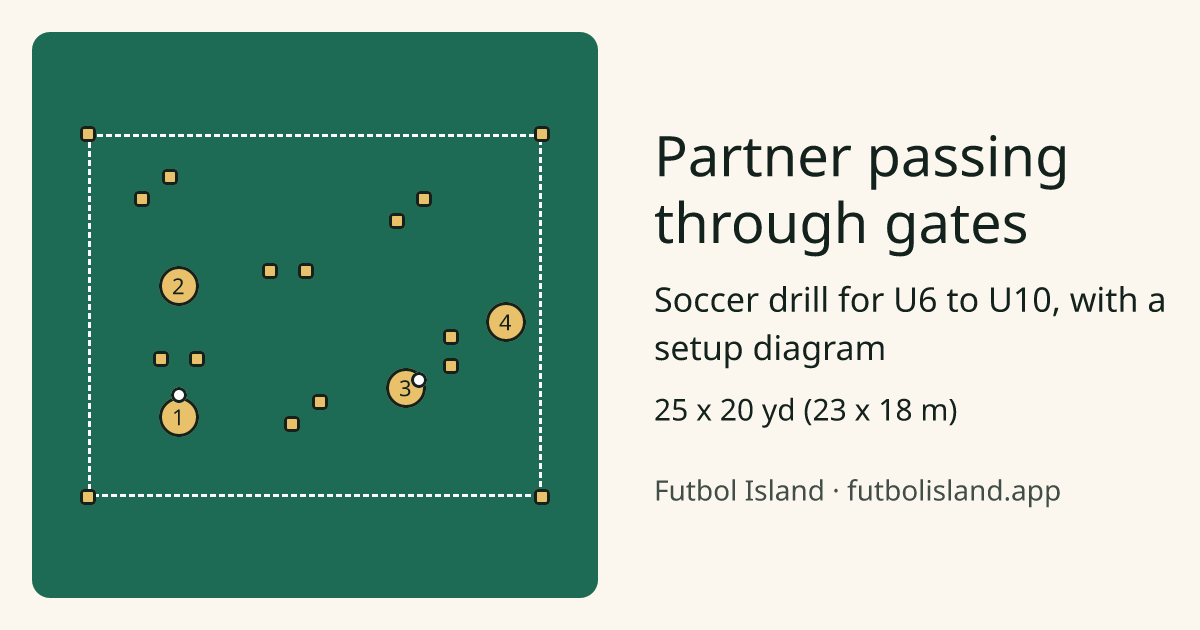
At a glance
| Detail | For this drill |
|---|---|
| Ages | U6 to U10 (ages 5 to 10) |
| Players | Pairs, 3 to 8 pairs |
| Space | 25 x 20 yd (23 x 18 m) |
| Equipment | One ball per pair; 12 to 16 cones for gates |
| Time | 8 to 10 minutes, in one-minute rounds |
| Skill | Passing and receiving |
Change the size of the area to fit your group: bigger makes it easier for the player with the ball, smaller makes it harder. Everyone who goes out comes straight back in, and nobody runs laps.
How to run it
- Scatter gates of two cones, 2 yards wide, around the area.
- Each pair has one ball. A point is a pass through a gate that the partner controls on the other side.
- A pair may not use the same gate twice in a row, so after every pass both players move.
- Play for one minute, rest and compare scores. Each pair tries to beat its own score.
- Later rounds: weaker foot only, or two touches at most.
Coaching points to say out loud
- “Inside of the foot.”
- “Pass, then move.”
- “Show your partner where you want it.”
- “Find an empty gate.”
Make it easier or harder
Easier
Wider gates and a shorter distance between partners. For U6, let each child stop the ball with the sole before passing.
Harder
Narrow the gates to one yard, or add two defenders who can block a gate by standing in it.
Common mistakes
- Toe-poke passes. Turn the foot out and use the inside, like a hockey stick.
- Standing still after the pass and waiting for the ball to come back.
- Partners too far apart, so every pass misses. Five yards is plenty for young players.
Why it matters in a game
A gate is the space between two defenders, and the partner on the far side is a teammate who moved into view. Our support lesson says it this way: move so the defender is no longer between you and the ball.
The lesson that teaches it: Step Out of the Blocked Lane.
Do it at home
A parent and a child, one gate made of two shoes. Count ten passes through it without a miss, then take a step back each.
Questions about Partner passing through gates
What is the best passing drill for beginners?
This one. It is a game with a score, every pair is busy the whole time, and it rewards the two habits that matter: an accurate pass and moving afterward.
How do I teach the inside-of-the-foot pass?
Standing foot beside the ball and pointing at the target, kicking foot turned out with the ankle locked, and strike through the middle of the ball.
Can U6 players do passing drills?
In short spells. Five-year-olds mostly want their own ball, which is normal for the age, so keep this to a few minutes and return to dribbling games.
Lessons that teach this idea
- Step Out of the Blocked Lane (7v7 lesson)Move so the defender is no longer between you and the ball.
- Make Room for Your Team (7v7 lesson)Spread into useful space so the player on the ball has another route.
- Look, Then Turn or Return (7v7 lesson)Look for pressure before receiving. Turn into room or give the ball back.
Related drills and guides
- Gates dribbling (drill)It trains dribbling with the head up, because players must look for a gate that is open.
- Triangle passing (drill)It trains passing to the correct foot, an open body shape and moving right after the pass.
- Give-and-go (drill)It trains the wall pass, also called the one-two: the timing of the first pass, the sprint and the one-touch return.
- Wall passing (drill)It trains a firm, accurate pass and a clean first touch with both feet, because the wall always gives the ball back.
- Central midfielder in soccerThe link player who receives on the turn
- First touch (soccer term)The touch you take as the ball arrives
- U6 soccer drills: fun games for 5 and 6 year oldsNine games for 5 and 6 year olds, a ball each, with what to avoid
- U8 soccer drills for 7 and 8 year oldsTen drills for 7 and 8 year olds: dribbling, 1v1, first passing and 3v3
- U10 soccer drills for 9 and 10 year oldsTen drills for 9 and 10 year olds: rondos, first touch, 2v1 and first goalkeeping
- Soccer passing drills for kidsPassing drills in teaching order: pairs, triangles, give-and-go and rondos
- U8 soccer practice plan: passingA 60-minute plan that uses this drill
- All passing and receiving drillsPassing to a teammate, then moving to help again.
Futbol Island is a free football (soccer) learning game for kids aged 7 to 12. Every idea on this page is taught on a pitch with moving players, then checked with a quick quiz.