Build-out game: playing out from the goalkeeper in soccer
The build-out game is a small-sided game that starts every time with the goalkeeper passing the ball out to a defender, while the other team waits behind a line until the pass is played. It trains playing out from the back: defenders getting wide, a midfielder showing for the ball, and the goalkeeper joining in with their feet.
Soccer is called football in most of the world. This guide is part of Futbol Island’s free football lessons for kids aged 7 to 12.
Build-out game: setup diagram
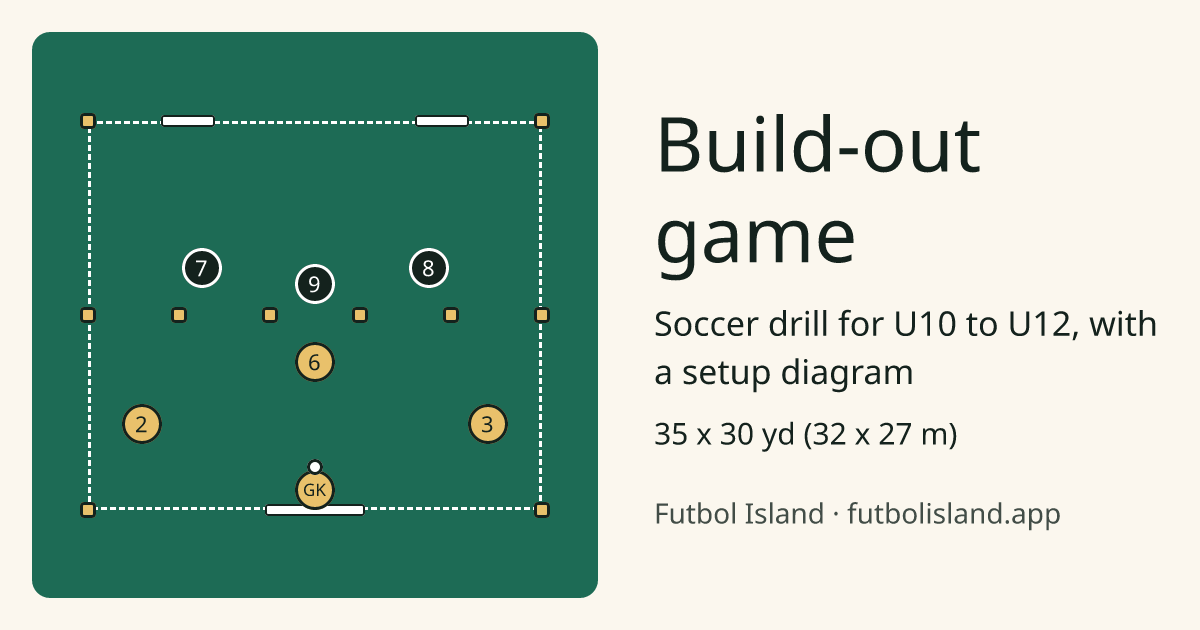
At a glance
| Detail | For this drill |
|---|---|
| Ages | U10 to U12 (ages 9 to 12) |
| Players | 8 to 12, in two teams, with one goalkeeper |
| Space | 35 x 30 yd (32 x 27 m) |
| Equipment | One goal; two small goals or cone gates; balls; cones for the line; bibs |
| Time | 15 minutes |
| Skill | Small-sided games |
Change the size of the area to fit your group: bigger makes it easier for the player with the ball, smaller makes it harder. Everyone who goes out comes straight back in, and nobody runs laps.
How to run it
- Mark a field 35 yards wide and 30 long, with a goal and goalkeeper at one end and two small goals at the other. Put a line of cones across the middle: the build-out line.
- The building team has a goalkeeper, two defenders and a midfielder. The pressing team has three players who start behind the line.
- The goalkeeper starts with the ball at their feet or in their hands and passes to a defender. Once the ball is played, the pressing team may cross the line.
- The building team scores by passing or dribbling into either small goal. The pressing team scores in the big goal if it wins the ball.
- Change roles after five starts. Every outfield player takes a turn as a defender.
Coaching points to say out loud
- “Defenders: wide and open.”
- “Keeper: pick the free side.”
- “Midfielder: show in the gap.”
- “The keeper is always there to pass back to.”
Make it easier or harder
Easier
The pressing team has only two players, or must wait three seconds after the first pass.
Harder
Remove the waiting line so the press is live from the start, as in 9v9. Add a fourth presser.
Common mistakes
- Defenders standing close to the goalkeeper in the middle, which brings the pressers close to goal.
- Kicking long every time. In 7v7 the goalkeeper may not punt, and the build-out line exists to make the short pass possible.
- Forgetting the pass back. A defender under pressure can use the goalkeeper, who must then play it with the feet.
Why it matters in a game
This is a goal kick or a goalkeeper’s save in 7v7, exactly as in our build-out lesson: the other team waits behind the build-out line, and once the ball is kicked and moves, they can press.
The lesson that teaches it: Goal Kick & Build-Out Line.
Questions about Build-out game
What is the build-out line?
A line across each half of a 7v7 field in US youth soccer. When the goalkeeper has the ball or there is a goal kick, the other team must drop behind it until the ball is in play.
Why teach kids to play out from the back?
Because it gives every player, defenders and the goalkeeper included, practice at receiving and passing under pressure, and it is how 7v7 restarts are designed to work.
Can the goalkeeper pick up a pass back?
Not a deliberate kick from a teammate. The goalkeeper must play it with their feet, which our back-pass rule page explains.
Lessons that teach this idea
- Goal Kick & Build-Out Line (7v7 lesson)On our goal kick, the other team waits behind the build-out line. Once the ball is kicked and moves, they can come and press.
- Your Keeper Can Help (7v7 lesson)Pass back to your keeper when the way is clear. The keeper must play it with their feet, not hands. If it's covered, pick another teammate.
- Two Options for a Restart (9v9 lesson)On our goal kick, two defenders split wide so the keeper always has an open short pass.
- 2-3-3: Keep the Midfield Three Ahead (9v9 lesson)After a short goal kick, the keeper supports two backs without sacrificing the central link in a midfield three.
Related drills and guides
- Goalkeeper distribution (drill)It trains accurate distribution, and choosing the teammate who is free.
- Rondo 4v2 (drill)It trains the attackers to find the pass between the two defenders, and the defenders to press and cover as a pair.
- 3v3 small-sided game (drill)It trains everything at once, dribbling, passing, shooting and defending, and gives each child far more time on the ball than a big game.
- Four-goal game (drill)It trains switching play: when one goal is crowded, the team moves the ball to the open one.
- The build-out line in 7v7Why the other team backs off on a goal kick
- The goal kick ruleHow play restarts from the goal area
- The back-pass ruleWhen the goalkeeper must use their feet
- Goalkeeper in soccerThe job, the skills and where to stand
- Center back in soccerThe defender who protects the middle
- U10 soccer drills for 9 and 10 year oldsTen drills for 9 and 10 year olds: rondos, first touch, 2v1 and first goalkeeping
- U12 soccer drills for 11 and 12 year oldsTen drills for 11 and 12 year olds: 4v2 rondos, possession, defending in pairs and finishing
- Soccer goalkeeper drills for kidsSet position, catching, angles and distribution for U10 and U12, with soft service
- U10 soccer practice plan: first practice of the seasonA 60-minute plan that uses this drill
- U12 soccer practice plan: passing and possessionA 75-minute plan that uses this drill
- All small-sided games drillsReal games with few players, so everyone is on the ball.
Futbol Island is a free football (soccer) learning game for kids aged 7 to 12. Every idea on this page is taught on a pitch with moving players, then checked with a quick quiz.