Soccer throw-in rules for kids
In soccer, a throw-in restarts the game when the whole ball crosses the touchline, and it goes to the team that did not touch the ball last. The thrower faces the field, keeps part of each foot on or behind the line, and throws with both hands from behind and over the head.
Soccer is called football in most of the world. This guide is part of Futbol Island’s free football lessons for kids aged 7 to 12.
Throw-in: diagram
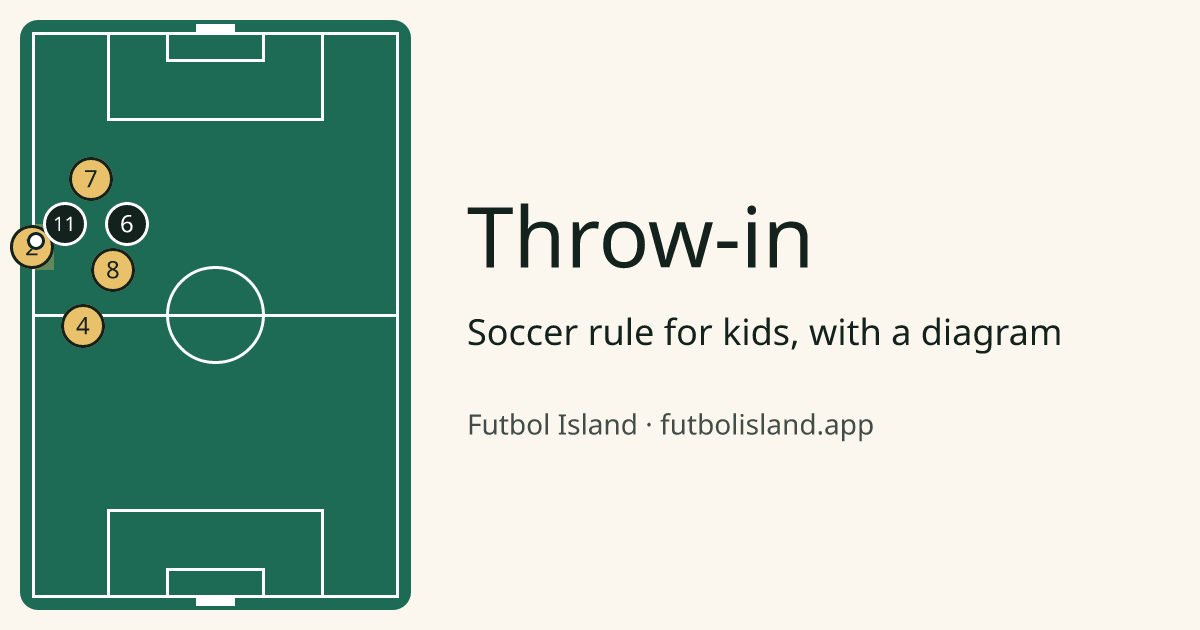
What the referee looks for
- The place: the throw is taken where the ball left the field.
- Feet: part of each foot is on the touchline or on the ground outside it when the ball is released.
- Hands: both hands, and the ball comes from behind and over the head.
- Opponents: at least 2 m (2 yards) from the place of the throw.
- A second touch: the thrower may not touch the ball again until another player has touched it.
Rule: Law 15. Read it in the Laws of the Game (The IFAB).
Common mix-ups
“Both feet must stay flat on the ground.”
The Law asks for part of each foot on the touchline or on the ground outside it at the moment of the throw. It does not say the feet must be flat.
“You can score straight from a throw-in.”
You cannot. If the ball goes straight into the other team’s goal, it is a goal kick.
“A bad throw is taken again.”
If the ball came on to the field, a wrongly taken throw-in goes to the other team. Your league may let the youngest players try again.
“The ball has to spin the right way.”
Spin is not in the Law. The referee looks at the feet, the hands and the path of the ball over the head.
In 7v7, 9v9, 11v11 and futsal
| Game | How the rule works |
|---|---|
| 7v7 and 9v9 | Throw-ins as in the full game in the U.S. Soccer standards. Your league may add its own rule for the youngest players. |
| 11v11 | Law 15 in full. |
| Futsal | No throw-ins. The ball is kicked in from the touchline within four seconds, with opponents 5 m away. |
| England | The FA lets under-10s and under-11s pass the ball in or dribble it in, as our lesson Start with Your Feet shows. |
These are the Laws of the Game and typical US youth standards. Your league may differ, so check its rules. Sources: IFAB Laws of the Game (current edition), U.S. Soccer small-sided standards, US Youth Soccer playing rules (December 2025) and the FIFA Futsal Laws of the Game 2025-26. Checked on November 10, 2026.
Questions about throw-in
Can you be offside from a throw-in?
No. A player who receives the ball directly from a throw-in cannot be offside.
Can the goalkeeper pick up a throw-in?
Not from a teammate. If a teammate throws the ball straight to their own goalkeeper, the keeper must play it with the feet. Picking it up gives the other team an indirect free kick.
Can you jump or do a flip throw?
Yes, if part of each foot is on or behind the line when the ball leaves the hands, and the ball is thrown with both hands from behind and over the head.
How far away must defenders stand at a throw-in?
At least 2 metres, which is about 2 yards, from the place where the throw is taken.
Lessons that go with this rule
- After the Restart: Rebuild the Back Three (9v9 lesson)After our right back takes a throw-in, they hurry back so we have three defenders again before joining the attack.
- Start with Your Feet (7v7 lesson)Some leagues (like England's FA for younger players) restart from the sideline with your feet. Dribble it in or pass it in: pick the open route.
- Kick-In: Have a Backup (Futsal lesson)Prepare two options before the restart, then use the one the defender leaves.
- Kick-In: The Third Player Runs (Futsal lesson)Use the first receiver to release a different runner instead of repeating the same touchline pass.
Keep reading
- Museum: The throw-inThe history, in the History Museum (1863)
- Fullback in soccerThe defender on the side, who often takes throw-ins
- Winger in soccerThe wide attacker who wins and takes many corners
- 9v9 soccer formationsThe shapes for U11 and U12 teams
- Soccer goal kick rules for kidsLaw 16, with a diagram
- Soccer corner kick rules for kidsLaw 17, with a diagram
- All soccer rules for kids16 rules explained for kids, each with a diagram: offside, handball, throw-ins and more
- Soccer terms for kids: an A-Z glossary92 soccer words in plain English, from advantage to yellow card, 18 with a diagram
Futbol Island is a free football (soccer) learning game for kids aged 7 to 12. Every idea on this page is taught on a pitch with moving players, then checked with a quick quiz.